
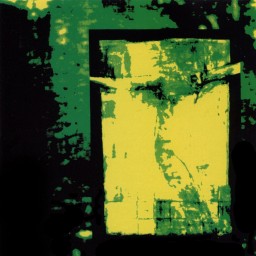
 Review by Miles Long for Pan.Thy.Monium - Khaooohs & Kon-Fus-Ion (1996)

Pan.Thy.Monium is a pretty batshit band, right?
I think I judge all these batshit experimental albums by how justified the batshitness is to the music itself, and especially in the context of the whole record. What kind of statement is made here?
For the most part, Pan.Thy.Monium, on the third album, seems to be content with structuring the record with one weird moment after another. There's a moment where it abruptly transitions to honking sound effects for like two seconds, which is pretty novel, but that's just it: it's novel. Consider how many times you're going to relisten to this record, and how many times that specific moment will move you. My point is that when the album begins, there doesn't seem to be a unifying theme to the weirdness, and it sits firmly in the realm of novelty. Or does it? More on that later...
Another layer is the general musicality of it. Sure, the weirdness may just be done for the sake of it, but can you bop your head to it? Sure, you can. It's a perfectly competent album in composition, with catchy and effective parts. If anything, the weirdness makes those parts memorable so, at the end of the day, it is still more than a listenable album. You can enjoy it every time, but, of course, you're looking for something far deeper than just that when it comes to anything labelled "avant-garde", right?
The thing about this album is that while the weirdness is generally just done for the sake of it, as I said, there is division between tracks. Why not just have one long track? Instead, we have four songs, which have atypical lengths. This points to the fact that they're more akin to movements and, consequently, have distinct purposes from one another, which justifies the splitting of length. Because of that, we can deduce that there really is a unifying theme to this album, which is composed of those presumably different parts.
In order to figure that out, though, we must first identify how these tracks are different from one another. Before that, it helps to consider the actual theme we may see before we even listen to the album. According to metal archives, the music of this band in general is centered around a chaos god known as Raagoonshinnaah. A little bird once told me that this album in particular is about that same god in a power struggle against a god of light known as Amaraah. From here, we can attempt to analyze if the music itself correlates to that information.
So, the first track is called "The Battle of Geeheeb" and, already, we see confirmation of the power struggle theme. Now, the track itself is random in experimentation, although that description probably does it injustice. It's more like an explosion of creativity, where the intention is to produce some absurdism to throw the listener off balance. That seems obvious, doesn't it? Consider, however, that the music itself isn't played cheaply at all. If I was a band whose goal is to just shock the listener with weirdness, I wouldn't care about the structure of the music at all and just focus on the novelty. That tells us that there's something deeper about this than we may first assume. One different sound leads to another. An exchange of blows between the two entities, perhaps?
Do you remember "The Devil Went Down to Georgia"? You know where the Devil's piece begins, and you know where Johnny's piece begins as well. That's where i'm getting at with this. What if... the parts of this whole album is a sequence of responses between the two opposing forces? The weirdness, then, isn't just random. Well, not really. I mean, it's not JUST random. It's random, yet, but random with a purpose. It represents an altercation between two transcendent beings. In that sense, the music begins to take a form akin to abstract art. You may suppose that the more sinister-sounding parts are from Raagoonshinnaah, whereas the sick blues-y and prog-like guitar solos are Amaraah pushing back.
"Thee-Pherenth" begins with a continuation of this battle. The near beginning of this track is actually where the part I criticized earlier comes from, where it abruptly cuts to brief honking sounds. Ironically, though, I would say that the subsequent parts of this track are a bit more structured in terms of narrative. Immediately after is a death metal part, a suffocating darkness that can be interpreted as a retaliation from Raagoonshinnaah. It leads to a tense, ascending synth section, building up more and more until it climaxes into an ambient-like section. This is Raagoonshinnaah's track, alright, as the consecutive parts contain some darkness to them. Compared to the previous track, this one uses more atmospheric sections, with ambient and doom as well. Around 19 minutes into the album, though, another solo plays in the midst of one of those ambient sections, culminating in a jingling synth sound. I interpret that as Amaraah persevering even as Raagoonshinnaah constricts him with the latter's previous successful advances. In general, though, it seems that the latter has the upper hand so far, as I feel more oppression in this part rather than light, even with the occasional moments of Amaraah probably pushing back.
That's the thing with abstract art in general. We must accept a certain amount of open-endedness inherent to the piece. However, that also means that my interpretation could be way off to yours. I suppose I hardly need to say that, so let's continue, yeah?
You'll notice also that both of these tracks end in some kind of non-musical soundscape. In "The Battle of Geeheeb", it ends in a slightly optimistic synth ambient with a loud, creaking noise, which I have always attributed to a crying baby. Maybe it symbolizes Amaraah winning temporarily in that moment. It fills me with a nostalgic feeling, one that almost seems hopeful. It's the noise of life and all its potential. "Thee-Pherenth", meanwhile, ends in a more distressing sound, and you hear the creaking once more. This time, however, it's recontextualized by the new background. Now it sounds painful. It's the same motiff, but now different, as it's clear that Raagoonshinnaah is the one that's won here, which is consistent with my theory that "Thee-Pherenth" is about him gaining the upper hand in this struggle.
Interestingly, "Behrial" is entirely a synth section. It's hopeful, and definitely sounds like light. You may even call it breathtaking, after all that has transpired in the narrative. I'd like to point out that Pan.Thy.Monium also has a motiff of dreams and, sure enough, there is the sound of a ticking clock in this section in particular. But I don't see this as dreaming but, rather, waking up. To a new beginning, perhaps? A burial marks the end of one's life, yet maybe an ending is just another form of beginning.
"In Remembrance' is a minute-long silence.
...
So who won in the end, Raagoonshinnaah or Amaraah? Well, usually, I like to leave it up to interpretation. However, here's my theory... I think it's Raagoonshinnaah who won. I think an honorific remembrance leans more towards the death of light and order, as opposed to chaos. Sure, chaos and order aren't really opposed, but we usually grieve the loss of stability way more than the loss of danger and uncertainty, even when change is found in the latter. Now, the reason why there is "Behrial" in the end is because this isn't a straightforward struggle of a good guy against a bad guy. The ending suggests that while order isn't a constant in life, light persists anyways. So maybe the struggle didn't end at all. Maybe it happens in every day of existence and, even after all that, there is always light in darkness, or chaos in order, what you will... all the things that make life. That sure is something, isn't it?