
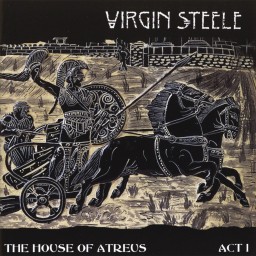
 Review by Shadowdoom9 (Andi) for Virgin Steele - The House of Atreus: Act I (1999)
Throughout the 90s, metal was declared a somewhat "dead" genre when it's plagued with what elitists consider talentless and lame. However, the genre never died. It's far from dead. There are many bands who have reached their breakthrough in the 90s yet don't get a lot of credit. Virgin Steele is one of those bands, with their late 90s material having picked up where the glory of classic metal died off when the 80s ended. The irony is how their 80s albums turned out somewhat shabby with not much commercial success, but if your favorite album of theirs is Age of Consent, you do you. I'll just have fun with their 3rd grand masterpiece in a row, The House of Atreus Act I!
The first act of a two-part saga, it consists of 22 tracks that are either interludes or moderate-length songs, with a couple 7-minute epics. Basically a similar format to Blind Guardian's Nightfall in Middle-Earth from the previous year. The sound is kinda like a blend of Blind Guardian and Manowar, though that song-interlude ratio may be hard for some people to sit through. The entire offering is like the soundtrack to a musical play/film, based on the trilogy of Greek tragedies, the Oresteia.
The prologue of the saga is the War of Troy, told entirely in the opening track "Kingdom of the Fearless (The Destruction of Troy)". Fast intensity and lyrics of war make this your friendly neighborhood power metal anthem. The 7 and a half minute length fits well with the long convoluted war. Fantastic start! The next track "Blaze of Victory (The Watchman's Song)" is a dark ballad that starts where the story really carries on, after the war. Agamemnon comes back home to his wife, and a watcher was hired to look out for Agamemnon's blaze of victory. Next up, "Through the Ring of Fire" is a more upbeat track in which Agamemnon is glad to be back home. It is followed by not one, not two, but 3 interludes; "Prelude in A Minor (The Voyage Home)", "Death Darkly Closed Their Eyes (The Messenger's Song)", and "In Triumph or Tragedy", all telling different moods surrounding Agamemnon's return. They all probably would've worked better as one track, but the album is too perfect for me to change anything. The following track "Return of the King" refers to, of course, Agamemnon. However, we get a glimpse of the sideplot where the queen is planning her revenge, and the elders, who have overheard her, warn the king. In the 6 and a half minute "Flames of the Black Star (The Arrows of Herakles)", Agamemnon reclaims his throne but is cursed by Klytemnestra.
Again we end up with 3 more interludes that could've been indexed as one track but weren't and that's still OK; "Narcissus", "And Hecate Smiled", and "A Song of Prophecy". The first and last of the interludes add to the dark mystery, although the second one is a short metal track that's more dependent on the story. Cassandra's prophecies are dismissed by Agamemnon who doesn't know his actual fate. In "Child of Desolation", Cassandra dies an innocent death, lamented in the form of a power ballad that this beautiful song is. The interlude "G Minor Invention (Descent into Death's Twilight Kingdom)" seals Cassandra's fate. Another interlude, "Day of Wrath" begins the planned assassination of Agamemnon. And so it commences in "Great Sword of Flame". The heavy speed of the song suits Agamemnon's final fight that he would ultimately lose.
"The Gift of Tantalos" and "Iphigenia in Hades" are two more interludes, telling the emotions of two different characters. The former is in the perspective of Agisthos with his happiness and rage, and the second is in the perspective of Agamemnon's wife Klytemnestra with her happiness and sadness. Very well described! "The Fire God" introduces another character, Agamemnon's daughter Electra, enraged with Agisthos and Klytemnestra. The vocals are some of the angriest David DeFeis sounds here. Anyway, Electra asks the Fire God to strike vengance against the two, which he suggests her young brother Orestes to do years after he is taken to Phocis for safety. "Garden of Lamentation" is a short ballad-like interlude with Electra's farewell to Orestes after taking him away from the kingdom, with help from the Elders who challenge Agisthos who is the new ruler. More of that part of the story is told in "Agony and Shame", a more complex progressive song. All that belonged to Agamemnon now belonged to Agisthos. "Gate of Kings" is the final full song here. Electra and Orestes have one final motivational conversation with one another. The task at hand that each person has will someday be completed, and there's still hope even with each other's distance. Such a hopeful power ballad! With that, they each part ways to fulfill their role in the quest to restore order to the kingdom, and the outro "Via Sacra" is the end credits theme, and an effective way of saying "To be continued..."
Whether or not you want to understand the story more while listening to this album, you can't deny the absolute high-quality music it contains. The music and lyrics tell the story really nail it. Any listener of any kind of music should check this masterpiece out along with their previous two albums. One of the greatest stories ever told in metal!
Favorites: "Kingdom of the Fearless (The Destruction of Troy)", "Through the Ring of Fire", "Flames of the Black Star (The Arrows of Herakles)", "Child of Desolation", "Great Sword of Flame", "The Fire God", "Agony and Shame", "Gate of Kings"