Daniel's Reviews

By 1987, the German metal scene had already built itself a very strong reputation for raw & exciting thrash that favoured aggression & violence over technique & musical theory. Many fans would have you believe that the Americans had single-handedly created the genre through hard-hitting trailblazers like Metallica & Slayer but if you do your research you’ll find that the Germans were right there alongside them. In fact, the earliest Teutonic demos from the likes of Sodom & Holy Moses were already aligning themselves with our mighty Lord Satan as far back as 1982 which puts them in direct competition with Metallica’s “No Life ‘til Leather” demo as far as historical timelines go. But unlike the Americans who would seize the opportunity with both hands, the Germans would have to wait a couple more years to see their first commercially released thrash records starting to hit the shelves. It would initially be the Big Three of Teutonic Thrash that would take up the charge with Destruction, Sodom & Kreator all making significant claims to the German thrash throne during the 1984/85 period. The next couple of years would see Kreator & Sodom edging ahead with the first legitimately classic German thrash releases & this would prove to be somewhat of a global announcement to the world with a flood of new players like Exumer, Angel Dust, Assassin, Deathrow, Tankard, Necronomicon, Violent Force, Accuser, Paradox, Holy Moses, Living Death, Mekong Delta & Vendetta all exploding onto the market at around the same time to create a healthy, thriving & self-perpetuating scene. It was amongst this hive of creative activity that Essen five-piece Darkness were learning the ropes & firming up their plans for world domination.
Darkness were actually one of the earlier German thrash bands having formed back in 1985 while the Teutonic scene was still relatively young. They’d go through various incarnations during their early years with their lineup being an ever-changing beast that morphed between three, four & five piece arrangements on a number of occasions. The young band would record five demo tapes in total over the first two years of their existence before finally seeing their lineup solidifying & gaining the interest of Peter Garattoni & Gunter Marek who decided that the product Darkness were pushing was worthy of investment. Peter & Gunter would form a label known as Tales Of Thrash Records which would provide the band with an avenue for releasing their debut album “Death Squad” in 1987.
I haven’t been able to find any information on who may have produced the “Death Squad” album so it was presumably a self-produced effort which would make sense given the low budget that was afforded to most young thrash bands of the time. But if that’s the case then the band have done a stellar job because “Death Squad” offers exactly what you’d want from a mid-80’s Teutonic thrash release. It’s raw, dirty & metal as fuck but also possesses an uncommon clarity that allows all of the individual instruments to be clearly identified & enjoyed in their own right. The rhythm guitar sound is dripping with molten metal & is a clear selling point for the album. It reminds me very much of the searing tone that Kreator would achieve on their early classics only it’s a touch dirtier & the guitar solos are just as blazing which is a major plus in my book. The unfortunately named Raper receives a bouncy, clean & powerful bass tone which accentuates the driving energy in Darkness’ music while long-time drummer Lacky is afforded lots of bass & depth in his kick drum & toms along with that signature German snare drum sound that cuts through the mix in a constant & merciless attack on your cranium. The band must have been very happy with the result because it represents Darkness’ sound in a very positive light by highlighting their obvious strengths.
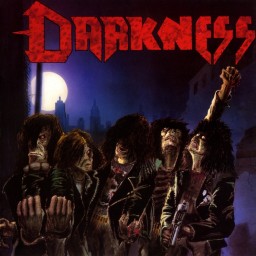
“Death Squad” would come with some reasonably attractive artwork all thing considered. It was based around a very simple concept with five long-haired & leather-clad members of the undead (the five band members presumably) preparing themselves to take on the town under a full moon. One of the crew is carrying what looks to be a machine gun &, given the title of the album, I’d hazard to guess that Essen might be in for an eventful evening. It’s interesting to note that the album title isn’t displayed on the front cover so for all intents & purposes it looks like a self-titled release. Also, when you examine the band’s logo closely you can see clear elements that have been borrowed from Kreator, particularly in the shaping of the letters. I’ll give you the tip though, this won’t be the only time we’ll be referencing Kreator in the next few minutes either. Overall though, I think this is a pretty good album cover for a young thrash band. It’s easy on the eye, suits the band’s image & is a reasonable representation of what you can expect to hear inside.
Upon dropping the needle onto the platter for the first time, the listener will find themselves confronted with quite a pretty two-minute acoustic guitar introduction piece known as “Invasion Sector 12”. I’d actually go so far as to say that it’s TOO pretty to introduce a violent thrash record like this one but that wasn’t all that uncommon for the time (see Kreator’s “Choir Of The Damned” or Metallica’s “Fight Fire With Fire” for example) & I nonetheless find it to be a reasonably enjoyable experience. But the action doesn’t really start until the first proper song kicks in with the face-melting thrash-fest known as “Critical Threshold” laying all of Darkness’ cards on the table immediately & ensuring that an appropriate level of uncontrolled chaos ensues. This is a Teutonic thrash record in the purest sense of the term & there has been absolutely no attempt to hide the band’s influences or renovate the house that has been built by the three heavy-weights of German thrash. In fact, on first impression I found it hard to think of “Death Squad” as anything other than a Kreator clone given just how familiar it sounds. Most of Darkness’ most ripping riffs are variations on Kreator’s 1985-87 material & the guitar solos could almost have been lifted straight off those records too. Not to mention the raspy Germanic-accented vocals of front man Olli which sound EXACTLY like Mille Petrozza with the occasional moment also recalling the efforts of Kreator drummer Ventor to top things off. Don’t get me wrong though. I’m a fucking Kreator tragic from way back so I don’t say any of that in a derogatory way. A band that sounds exactly like classic Kreator is a very attractive prospect for me personally.
Subsequent listens would show that there are actually a few additional elements at play on top of the obvious Kreator worship but none that are terribly surprising. The most pronounced one is the influence of Destruction in the use of lead runs to add complexity to some of the riffs but you can also hear a bit of early Sodom in some of the more basic melodic runs. Plus, some of the slower tracks include lead guitar melodies that remind me a lot of your classic NWOBHM brand of traditional heavy metal (Iron Maiden in particular) & I have to say that I could definitely do without those. The beginning of the instrumental track “Tarsman Of Ghor” (named after John Norman’s “Tarnsman Of Gor” fantasy novel) is a prime example with the use of neoclassical melodies sounding both distracting & out of place. I honestly think that Darkness would have been better served by giving them a miss altogether as they dilute the nasty atmosphere significantly.
Despite being a little raw, the performances are all very good for a Teutonic debut & you can tell that the band already had a little bit of recording experience under their belts by this stage. You won’t find any of the obvious timing issues you’d generally expect from the earlier German thrash releases other than the odd moment when the kick drum drifts a bit but in fairness Lacky’s skill sets were already superior to many of his peers. I particularly enjoy the off-the-hook approach to the solos which sees the twin guitar attack of Arnd & Pierre going absolutely mental with little concern afforded to irrelevant topics like key or theory & I find this component to represent the highlight of the album. There’s a lot of passion in the DIY feel of the faster material & many of the riff structures indicate that German speed metal may have played a fairly significant role in the band’s musical development.
There are a couple of slower tracks included however I don’t think they’re as effective as the more flat-out material like “Critical Threshold”, “Death Squad”, “Iron Force” & “Phantasmagoria”. The more restrained tempos tend to highlight the band’s limitations more obviously as the lack of creativity becomes more evident & there’s simply more room for error. Unfortunately, the album also suffers from a significant quality hole in the middle of the tracklisting with “Staatsfeind”, “Tarsman Of Ghor” & “Faded Pictures” all failing to build on a very promising start. Thankfully Darkness manage to recover things quite well during the back end but the most critical element that’s missing here, & the one that’s likely prevented “Death Squad” from competing with the big boys of Teutonic thrash, is the lack of decent choruses. Despite the energy & enthusiasm of this music, Darkness never quite manage to put together those couple of obvious anthems that are required to take a solid record to the next level & this is possibly even more important when you’ve completely sacrificed on any sort of originality because it’s just so easy to make unfavourable comparisons. All things considered though, “Death Squad” is still an enjoyable record for an old school thrasher like myself who is always on the hunt for records to fill the void that was left by the demise of the raw electricity & naivety that was so prevalent in the 1980’s. But I can’t help but think that Darkness could have amounted to more than this given what they’ve been able to achieve by simply borrowing the tools of their more highly regarded countrymen. Oh well… Did I really need another German thrash heavy-weight in my life anyway? Possibly not but “Death Squad” does a pretty good job of reminding me of why I fell in love with Teutonic thrash in the first place.
For fans of: Kreator, Destruction & Necronomicon.
Poland boasts a very strong pedigree in black metal which dates back to the height of the second wave explosion in the mid-1990’s with the likes of Christ Agony, Graveland, Behemoth, Arkona, Sacrilegium & Lux Occulta all ensuring that Polish metalheads would have a local hero to support while they worshipped at the altar of the Norwegians. However, I think it’s fair to say though that the Poles would not manage to elevate themselves to anything greater than a support act during that period & would have to wait until the mid-2000’s to compete at the elite level of extreme metal’s darkest subgenre. That gap would eventually be filled by the earliest works of a mysterious duo from Krakow known as Mgła & they would provide Poland’s extreme metal fanbase with its first black metal superstar; a title they’ve retained relatively comfortably ever since.
The Mgła story (pronounced “m-gwa” which is Polish for “fog”) would begin in 2000 when 19 year-old multi-instrumentalist Mikołaj “M” Żentara (the son of a well-known Polish actor) & drummer Dariusz "Daren" Piper decided to collaborate on a purely studio-oriented black metal project. Mikołaj’s previous experience amounted to just a couple of minor solo projects under the Arca Funebris & Leichenhalle monikers; efforts that only resulted in crude demo recordings with both following more of an industrial-tinged ambient direction than a metal one. Daren, on the other hand, had a fair bit more experience under his belt following stints with unheralded underground black metal acts like Blade Of The Sword, Holy Death & Aragon throughout the 1990’s. The pair would record two crude demo tapes during the 2000/01 period (both of which remain unreleased to this day) before deciding to collaborate with Daren’s Holy Death band mate Necronosferatus on a new black metal project going by the name of Kriegsmaschine which would see Mgła’s productivity stifled for the next couple of years. M would continue to juggle Mgła & Kriegsmachine right up to the current day but Mgła’s first noteworthy achievement would come through their involvement in Finnish black metal label Northern Heritage Records’ 2005 “Crushing The Holy Trinity” split album (which also included France’s Deathspell Omega & Finland’s Stabat Mater, Musta Surma, Clandestine Blaze & Exordium) with Mgła’s involvement with the label having been consistent ever since.
2006 would be another major year for Mgła as it would see the release of two well received EPs, the second one “Mdłości” becoming Poland’s first genuinely classic black metal record. Mgła’s music careers were now well & truly on the up & up but a change was afoot with Daren opting to leave both Mgła & Kriegmaschine in quick succession. It’s unclear as to what the reason for his departure was but one would assume that he & M must have had a major falling out for him to take such a drastic action. Regardless though, it would not see Mgła’s newly found bubble bursting with talented skinsman Maciej Kowalski (also known as “Darkside”) being quickly drafted into both bands & the rest is history really. M & Darkside would proceed to put out high quality black metal under both monikers at sporadic intervals ever since but it would be Mgła’s celebrated 2012 album “With Hearts Towards None” that would take the band to the international stage & would signal the arrival of Mgła as a live performer. It would also be my initiation to the band & to be completely honest, I have to admit that I found it a little underwhelming at the time. It was certainly an enjoyable listen but it didn’t seem to offer much that the great second wave releases of the 1990’s hadn’t already mastered & it hasn’t been a release that I’ve returned to often over the eight years since.
But this brings us to 2015’s “Exercises In Futility” record which would see Mgła reaching even greater commercial heights & would overtake “With Hearts Towards None” as the elite example of Polish black metal. As with Mgła’s first two full-lengths, it would again be released through Northern Heritage Records; the label having now built a very solid reputation through 16 years of high quality black metal releases from the likes of Clandestine Blaze, Deathspell Omega, Satanic Warmaster, Ildjarn-Nidhogg, Baptism, Inferi, Ride For Revenge, Peste Noire & Stabat Mater. M’s growing experience behind the mixing desk saw him handling the mixing & production duties once again & the result would be a fully developed, stunningly professional & crystal clear realization of his art that may be at least partially responsible for the significant backlash that Mgła have experienced from certain parts of the black metal audience who are still craving ever more lo-fi production qualities. These parties have very little basis for their qualms in my opinion as the quality of sound we receive with “Exercises In Futility” is beyond criticism in my opinion. No, it’s not in any way lo-fi but that hasn’t seen any trade-offs being made in regard to atmosphere. It’s quite simply the perfect platform for Mgła’s sweeping & melodic brand of black metal as it highlights the real strengths in the band’s sound. M’s gorgeous riffs sound thick, pure & precise which helps them to gain maximum value from the often repetitive & trance-like arrangements. It’s interesting that the bass lines are not all that easy to pick out which isn’t terribly important when your rhythm guitar tone has enough natural bass to give the music its imposing menace. Darkside’s cymbals have been afforded an uncommon brightness & vibrancy in order to showcase his impressive skill sets with the rest of his kit having been mixed a little lower in classic black metal fashion. This was presumably intentional & makes a lot of sense in the grand scheme of things. There is no reliance on artificial bells & whistles to maintain engagement here with the occasional use of keyboards being employed very subtly & with impeccable timing to enhance the atmospheric peaks. This is definitely not your most abrasive & inaccessible black metal release & it unashamedly thumbs its nose at its competition in that it achieves oodles of atmosphere without ever resorting to gimmicks or self-sabotage as a tool.
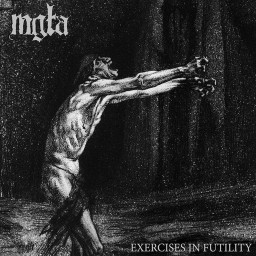
The cover artwork for “Exercises In Futility” has been borrowed from deceased French engraver Marcel Roux with this particular piece from 1908 being known as “L'aveugle” (translation: “The Blind”). It’s a disturbing image & is a fine accompaniment for the overarching lyrical concept which is completely focused on the pointlessness of life, the realization that it doesn’t really matter what you do, think or feel, the ultimate futility of our existence on this earth. It’s an incredibly depressing ideology but not one that’s terribly uncommon for black metal. It’s just that Mgła’s lyrical & musical artistry is so beautifully developed & executed that its themes become a more major part of the experience & by the end of your second listen you’ll likely find yourself genuinely questioning whether things really ARE as futile as they’re suggested to be.
Similarly, the music Mgła are pushing here is nothing new for the genre. This is an unashamedly black metal release with the band seemingly celebrating the genre’s second wave glory days with a confidence & maturity that’s rarely seen in this game. Mgła really REALLY know their sound & fans of the band’s previous material will not see any major surprising surfacing here although almost every element has been more finely honed & refined with every nuance having a defined purpose. There’s not a lot of variation across the tracklisting but there doesn’t need to be when your execution is this precise & you keep your run time to such a palatable duration. The basis for Mgła’s sound sits predominantly with classic raw Scandinavian black metal however you never lose the feeling that they should be in some way associated with the more melodic approach of Dissection because their reliance on melody is such an important component of their sound. But in saying that, Mgła never take things too far in that regard by losing the overarching menace of the rawer style of black metal so I’d never actually label them as a melodic black metal band despite the shared tools. Perhaps the clean production is responsible for further pushing the claims of that more melodic subgenre? Quite possibly & the lack of reliance on blast beats is probably another factor given the endless fascination that most modern black metal bands seem to have with them. Darkside’s semi-regular use of more open, restrained & rocky beats is certainly something you’d usually associate more with your meloblack crowd too & it’s the obvious weak point of the album for me personally.
Being the huge old-school Burzum fan that I am, I was very pleased to hear the regular influence of Varg’s more atmospheric brand of black metal on Mgła’s music here too. There are plenty of moments where I can clearly identify particular Burzum tracks as the source of inspiration however I wouldn’t say that Mgła ever really flirt with the atmospheric black metal subgenre for too long. It’s just that the riffs often have a similarly trance-inducing quality to them. “Exercises in Futility V” is probably the best example of this with its opening section owing much to the opening track “Dunkelheit” from Burzum's classic 1996 album “Filosofem”. Most tracks also contain sweeping melodic riffs that often remind me a fair bit of English black metallers Winterfylleth. There’s a majestic beauty to their construction & execution that defies the negative connotations of the lyrical themes & enhances the timelessness of the music which is a strong indicator of the significance of the release. I’d almost go so far as to use the word soothing for some of the more blasting riffs which just goes to show how Mgła manage to maintain the listeners interest through the use of subtle changes in atmosphere regardless of the fact that they generally stick to their musical guns throughout.
The musicianship on display from the two contributors is nothing short of astounding for a black metal act. The duo very clearly click as musicians with the clinical nature of the performances making it all sound so easy. I don’t think there’s any doubt that they stay well within themselves most of the time though. You get the very distinct feeling that they both have at least another couple of gears up their sleeve & leave a fair bit in the tank by the end of the album. Perhaps this is one of the things that makes “Exercises In Futility” so damn appealing to such a wide audience. They don’t over-complicate things & Darkside knows when to leave space which accentuates the transitions back into the more intense & blasting sections really well. You can easily see how Mgła would offer a greater appeal to the female audience than other black metal artists might & that’s not in any way a criticism. They’ve somehow managed to achieve a suitable level of intimidation without ever completely sacrificing on accessibility.
M’s execution of the riffs is so tight that he almost sounds mechanical at times but this is an indication of just how on top of his sound he is. You get the feeling that he has complete creative control over Mgła’s sound & deservedly so too. I’m a big fan of everything he does here. He’s clearly well versed in all of the greats of the various black metal subgenres & has only borrowed from the absolute elite which makes “Exercises In Futility” somewhat of a celebration of the genre. There’s really only the one flirtation with a clean guitar sound included with the intro to “Exercises in Futility VI” sounding very much like Anathema. M’s gravel-throated vocals remind me quite a bit of Satyr from Satyricon & are extremely effective. The fact that you can easily make out the depressive poetry of his lyrics provides further enhancement for the thematic content & gives the album’s artistic claims a further boost while his tone is evil enough to spread fear & dread throughout many a kindgom. Darkside’s drumming is even more impressive though. Especially his cymbal work which showcases both his incredible skill & a ridiculous level of attention to detail. His continued use of cymbal rolls is very unusual & I find it to be a real joy to listen to. At times it almost sounds too pretty & intricate for this style of black metal but there’s little doubt that he’s amongst the best drummers in the genre. I genuinely feel that the album wouldn’t have offered the same sort of appeal with another drummer as the simplicity of the riff structures may not have been as well received if not for the ambition & extravagance that Darkside offers us here.
It’s really pretty hard to understand the backlash that Mgła have experienced over the years. It seems very much like tall poppy syndrome to me as this is a classy flexing of the creative muscles of a band that was clearly at the peak of their powers. Sure it’s a little more melodic than I’m usually able to cope with at times, there are a few rocky beats that I’m at odds with & it essentially takes a similar direction to hundreds of black metal releases you’ve likely heard before but few artists have been as successful in their execution or offered as balanced a result. “Exercises In Futility” is a celebration of black metal as an art form & a bold statement of intent &, as such, it represents not only the pinnacle of Mgła’s career but also of Polish black metal as a whole.
For fans of: Uada, Kriegsmaschine & Plaga
The English thrash scene of the 1980’s was always a bit different to that of the more celebrated Americans & Germans. It was more about quality over quantity with far less options for consumers to choose from & perhaps this contributed to the comparative lack of fanfare that the Brits received. It’s hard to say but one thing’s for sure & that’s that Birmingham thrashers Sacrilege played a very important role in the development & subsequent growth of English thrash metal in the mid-to-late 80’s. They may not have been the very first UK thrash band. That honour would likely sit with Bristol’s Onslaught whose initial demo tapes saw the light of day way back in 1983 when Metallica & Slayer were only just beginning to make waves off the back of their classic debut albums. But 1984 would see Sacrilege taking their own tentative first steps out into the thrash wilderness & by the time 1985 rolled around we’d see a small English scene being formed with several debut albums being released in quick succession.
When you examine the early English forays into thrash-oriented realms, it’s hard to miss the important role that hardcore & crust punk played in the development of the local scene. Unlike the majority of their American counterparts, the early British thrash releases universally included a strong punk component, at times even being significant enough to compete on an equal footing with the metal one. Perhaps the strength of the local NWOBHM scene of the early-to-mid 80’s was responsible for keeping metalheads from jumping ship & heading over to thrashier waters but the punks seemed to be genuinely excited by the more aggressive & extreme sounds coming out of the early thrash scene. The 1985 debut albums from Onslaught, Sacrilege, Concrete Sox & English Dogs all show the outcome of punks exploring their newly found interest in metal.
Sacrilege began life as a crust punk band in Birmingham, England in 1984. Guitarist Damian Thompson & drummer Andrew Baker had played in d-beat bands Warwound & The Varukers together before Thompson had left to start Sacrilege with vocalist Lynda “Tam” Simpson, a move which saw his former band mate following shortly afterwards. The influence of the early US thrash scene would soon have a major impact on the band’s sound which saw even their earliest demo recordings catering to both audiences. By the time Sacrilege entered Rich Bitch studios in Birmingham to record their debut album “Behind The Realms Of Madness” in July 1985 they were very much a hybrid act. The album would be released through small independent Bristol label Children Of The Revolution Records & not only would it be the release that best signaled the coming of the English thrash metal assault but it also become a major historical landmark as one of the first releases to incorporate a combined crust punk & thrash metal sound. Sacrilege’s lyrical content showed clear signs of the band’s origins too as they took a much more politically charged approach than any thrash metal band had attempted previously which would be a major influence on the early UK grindcore scene. “Behind The Realms Of Madness” would be my first experience with Sacrilege back in the early 1990’s & I have to say that I found it to be more interesting than anything else. I found it very hard to categorize with the unusual production & regular stylistic jumps being initially a little off-putting with subsequent revisits seeing the album gaining more & more traction as I became accustomed to its unique quirks. These days, I perhaps don’t rate it quite as highly as many other thrash fans seem to but I certainly find it to be an enjoyable listen.
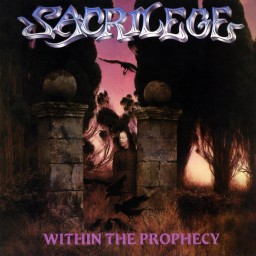
So this brings us to the topic of discussion in Sacrilege’s sophomore album “Within The Prophecy” which would be released through London-based label Under One Flag Records in 1987. Under One Flag were a subsidiary label of Music for Nations who had a very strong pedigree in quality metal stretching back to 1983 & by the time “Within The Prophecy” was released Under One Flag had already been responsible for releasing several noteworthy metal albums such as English Dogs “Where Legend Began”, Onslaught’s “The Force” & Possessed’s “Beyond The Gates”. Despite it’s unusual sound, Sacrilege’s new label must have been fairly happy with the result of the “Behind The Realms Of Madness” recording sessions because “Within The Prophecy” would once again be recorded at Rich Bitch Studios with Mike Ivory returning to share the production duties with the band. Bass player Tony May would not participate in the recording with guitarist Thompson handling the bass duties in his absence. Tony had always struggled with the pressures of the recording process & by that stage it had all simply gotten too much for him & he’d leave the band shortly afterwards.
As with the debut, the production job that resulted from the “Within The Prophecy” sessions would be a major talking point & would prove to be somewhat of a love-it-or-hate-it prospect for many fans. “Behind The Realms Of Madness” had commanded a similar response with it’s thick but somewhat muffled guitar tone gaining a cult following amongst underground metal & punk fans alike. It seems like the band had wanted to maintain that sound moving forwards as there are no signs of additional clarity being sought for the follow-up. On the contrary, “Within The Prophecy” offers an even more overwhelmingly filthy guitar tone that is thrust out to the front of the mix & reminds me very much of the early grindcore scene that was just around the corner. The distorted bass tone blends in with the wall of guitars while drummer Andy Baker struggles to compete on a sonic level with a booming snare drum sound being his main defensive weapon. It’s a very noisy sound to be honest, however it has a lot more life to it than the debut with the additional brightness contributing to the overall energy levels & the pure distortion only adding to Sacrilege’s metal credentials despite the lack of definition. In its defense, I don’t think the lack of clarity ever diminishes my ability to make out the riffs & it seems to have been a conscious decision to take more of a mid-tempo approach with this album in order to ensure that the band gained maximum impact from this guitar tone as faster material may have resulted in a messier outcome. The positive of this approach is that “Within The Prophecy” sounds much more extreme than it actually is. The guitar tone masks the simplicity of some of the riffs & it’s doubtful that they would have been as effective with a cleaner production. On the other side of the coin, this style of over-the-top production job does make the album sound a bit samey which can’t be said of its predecessor which included noticeably more stylistic variation. Underneath the noise is a band that clearly isn’t pushing the top tier bands but knows their sound & niche quite well & doesn’t stray outside of their creative comfort zone too much.
“Within The Prophecy” came with some very different cover art to the debut which sported the suitably dark & nasty image of a grim reaper type character stalking a graveyard. This time they went for a photograph of a woman standing by a couple of stone pillars which seem to mark an entrance of some sort & she is being greeted by a murder of crows. It’s a fairly drastic stylistic departure from the debut it has to be said & is nowhere near as effective in my opinion. The image seems far more appropriate for a gothic rock or darkwave release than a thrash metal one & is not done any favours by the colour scheme that’s been employed for both the band’s logo & the album title. The bubbly Sacrilege logo offers very little menace when presented in glistening pale blue & white while whoever opted to go with a purpley pink for the album title should surely have been sacked immediately.
After the initial shock of the production settled, the first thing that most fans noticed about “Within The Prophecy” was the reduction in the crust punk component of Sacrilege’s sound & this was the cause for some concern amongst the band’s more punk oriented fans. It’s a much more metal focused release than “Behind The Realms Of Madness” was although it tends to stick mainly with mid-paced tempos which isn’t something you’d usually associate with a thrash metal release. The record also offers hints at the doom metal sound the band would employ for 1989’s “Turn Back Trilobite” record & as such it marks somewhat of a transitional release for Sacrilege. In saying that though, I feel that the doom metal component of “Within The Prophecy” is generally overstated. Sure, Sacrilege is from Birmingham. But do we really hear all that much Black Sabbath in their sound? I don’t think Sabbath’s influence is as obvious as some reviewers seem to think. It’s more in the structure of some of the groovier down-tempo riffs which often provide a sneaky little hint at the groove metal sound that would be developed in the USA in the coming years.
I have to admit that I’ve always struggled with the idea of Sacrilege as a genuine thrash metal band &, even though “Within The Prophecy” was arguably their thrashiest release, it’s also a very good example of why. Sacrilege’s riffs are rarely something you’d immediately associate with thrash. They’re not often all that fast & rarely employ tremolo picking. In fact, if you really examine them you’ll often find that they’re closer to traditional heavy metal in structure however it’s the guitar tone that makes it almost impossible to make that association as the resulting rawness & atmosphere has a lot more in common with thrash & (in much the same way as the debut) represents the deciding vote in the genrificiation debate with thrash being the victor simply because it’s closer to the truth than the alternatives. I actually read someone referring to the sound of “Within The Prophecy” as “sludge-thrash” the other day & that’s not all that bad a description really. Although the crust punk component has been reduced, extreme metal fans will very easily be able to identify links to grindcore in the groovier mid-paced riffs, particularly during the B-side. It’s really very clear that Sacrilege was a major influence on the early grindcore movement which shouldn’t be all that surprising when you consider the links to early grindcore exponents Unseen Terror through former Sacrilege guitarist Mitch Dickinson (Unseen Terror also including future Napalm Death member Shane Embury). Upon revisiting the album for the first time in years this week, I was actually surprised at just how many riffs reminded me of Terrorizer & Napalm Death.
There are a couple of really cool little keyboard intros & interludes included which definitely add to the atmosphere & the track durations are quite lengthy for a thrash release with just the seven tracks including the epic eleven minute closer “Search Eternal” which beautifully sums up the various elements at play across the previous six songs. It’s interesting that the band have opted not to go with traditional song structures with very few (if any) of these tracks utilizing choruses & I feel that this has contributed to the saminess I mentioned earlier. The faster material at the start of the A-side has a noticeable Dark Angel vibe to it with the lengthy introduction to the opening track “Sight Of The Wise” positively reeking of Slayer’s “Hell Awaits”. In fact, that song is a total trash-fest which probably goes a long way to firming up the album’s thrash credentials. There’s not a trace of punk or doom about the early stages of the record in all honesty. Those elements become far more prevalent as the record progresses.
The musicianship on display is generally pretty basic but is clearly not intended to be a focal point. The use of guitar harmonies is a real strength as they provide a pleasant contrast to the over-the-top rhythm guitar tone & add to the overall atmosphere. I wouldn’t say that Thompson is a particularly talented lead guitarist as his solos are fairly generic but he certainly has a knack for melody when he puts his mind to it. His rhythm playing is pretty sloppy for the most part but this is not really a significant hinderance due to it being partially disguised by the noisy production & also the inherent crust punk street cred that is attached to the band. The drumming of Andy Baker is the clear weakness of the album in my opinion though. A lot of his beats incorporate a swing that may owe a lot to Black Sabbath’s Bill Ward but are often quite bouncy at the same time. Although that may sound good on paper & is certainly a differentiator of sorts, in reality it takes away from the intensity of the music at times & limits the album’s potential to an extent.
As with any female-fronted metal band, Tam’s vocal performance tends to receive a lot more attention than it might otherwise have drawn. In actual fact, her vocal contributions are kept a little bit more minimal than you’ll generally be accustomed to with thrash bands & (perhaps surprisingly) I don’t tend to think of her as one of the more important elements of the album, at least not from a purely sonic point of view. The debut saw her going with an aggressive & punky delivery that offered a little more extremity than we get here where she’s presented in a cleaner fashion. There’s more femininity about her performance here & I wouldn’t say that it’s overly aggressive. She doesn’t exactly “sing” & her limitations are more obvious than they were on the debut as she’s definitely a little more exposed but she does a reasonable job without ever taking the reins as the focal point of the band. She’s definitely a point of difference but Sacrilege tends to rely on the production to give them their x-factor rather than the riffs which aren’t exactly a drawcard when viewed in isolation.
When you take a look at “Within The Prophecy” holistically, my last statement sums up the record pretty well actually. None of the elements of Sacrilege’s sound are taken from the top tier of the thrash metal spectrum however the sum of their parts amounts to significantly more than the individual elements might suggest. One of Sacrilege’s most important attributes is that they know what they do well & make every effort to gain maximum value out of those key components so it’s very hard to be critical. On the contrary, I actually find myself feeling an attraction to “Within The Prophecy” that defies much of the content of my review thus far. There’s a quality to the song-writing that seems to thumb its nose at the lack of vocal hooks & general variation & I never find myself losing engagement. Despite what some critics may think, I find that there’s something to be said for bands that have their own sound & focus purely on what they do well without ever stepping too far outside their comfort zones & the overall consistency of the tracklisting here is testament that this approach works. So much so that I can’t help but rate “Within The Prophecy” ahead of its more highly regarded older sibling. It’s definitely more in line with my personal taste given the reduced punk component which was always going to be an advantage but I think that its more focused approach has had a positive impact on the appeal it offers me too. Overall, it’s a very strong release that’s often overlooked in favour of “Behind The Realms Of Madness” however I think that most thrash fans will enjoy it, regardless of which side of the genre tag debate you might fall on. In fact, I’d go so far as to say that “Within The Prophecy” is my favourite English thrash release to the time.
For fans of: Détente, Onslaught & English Dogs
Sometimes in metal you can uncover an artist that possessed enormous talent & vision but somehow managed to slip through the cracks & miss the boat completely. An artist that was perhaps so far ahead of their time that they simply drifted under the radar without ever drawing the level of attention that they so rightfully deserved. These occurrences seem to be a lot more common these days in an online market that’s completely flooded with bedroom wannabes but it’s much rarer for your more experienced old-school metal fanatic to identify a band from the first couple of decades of metal that is not only regarded as a tier one player in their field but who have also never crossed their radar in any capacity. But that was the scenario I was presented with when I returned to metal following a decade in the musical wilderness in 2009. It seemed quite strange to see an unfamiliar name that was apparently involved in the NWOBHM movement sitting right up near the top of the doom metal charts on several recognized (but inferior) online metal resources as I thought I knew everything there was to know about pre-1998 metal. I'd soon discover that the reason for my ignorance was largely because mysterious London doom metallers Pagan Altar’s legendary self-titled release was in fact recorded as a demo & only saw a proper release in 1998 i.e. the very year my interest in metal had begun to wane. Once I gave the self-titled Pagan Altar release a few listens, I came to the realization that whilst I found it to be a generally enjoyable listen, there were a few elements to it that saw me unable to rate it as highly as most doom fans seem to want to do. The vocals tended to grate on me over time with Terry Jones repeating the same phrasing over & over again. I also found it frustrating that there were portions of very high quality doom metal on display right across the tracklisting but there wasn’t really a song that didn’t see the band diluting it with more upbeat & less effective material at some point. And lastly, the DIY production was always going to be a limiting factor when rating a supposedly classic doom release.
So this brings me to “The Time Lord” EP; an archival release that covers Pagan Altar’s earliest previously unreleased recordings. The band were first formed in 1978 by father & son team Terry & Alan Jones which impressively makes them one of the earliest players in the NWOBHM story; a fact made even more impressive by the clear metal credentials of most of this material. Pagan Altar clearly didn’t waste any time & weren’t short of inspiration as all of the material included on “The Time Lord” comes from the 1978/79 period which pushes Pagan Altar into uncharted territory for the traditional doom metal subgenre which is generally regarded as having kicked off around 1982 through bands like Witchfinder General. I don’t think this can be understated because what we have here is five tracks that are already fully formed & developed rather than yet another 70’s proto-doom exponent whose doom credentials were tenuous at best. In historical context, this could indeed have made “The Time Lord” the first true doom metal record if a) it had seen an actual release & b) you discount Black Sabbath & Pentagram’s 70’s works (which I do). That’s really pretty surprising given that I’d never even heard of Pagan Altar up until 2009.
“The Time Lord” would eventually see the light of day through Swedish label I Hate Records in 2004. It was clearly a good move for I Hate as they hadn’t really released anything of significance up until that point & it would enable them to cash in on the underground buzz that had been steadily building around the reissues of Pagan Altar’s self-titled demo during the mid-to-late 1990’s. I have no idea how the label came across these recordings. Presumably through the band themselves you would think as they reformed the same year as this record came out after discovering that their self-titled release was selling for insane prices online. Nonetheless, the purpose of the original demos is unclear. Given their quality, I would have to guess that they weren’t given an appropriate level of marketing as I can’t understand how a legitimate record deal wouldn’t have eventuated from them to be honest. It’s one of metal’s greatest shames really as there was so much promise in this band right from the very beginning so it would have been interesting to have seen what they could have become had they managed to get their debut album onto the shelves during the height of the NWOBHM in 1980. Unfortunately, it was not to be & we’d be destined to ponder over what might have been for decades to come.
“The Time Lord” E.P. includes just five tracks but spans a full half hour in duration due to the lengthy run times of most of the songs. The first couple of tracks were recorded at a studio in New Cross, London while the other three were laid down at Pagan Altar’s own studio with the band presumably handling production themselves. Despite having been remastered in recent times, the sound quality is of demo tape quality & also gives the impression of having been recorded pretty much live. The self-titled release may well have been a demo recording too but it certainly had a heavier overall sound than what we get here. I would think that some of that can be put down to the time it was produced though as there were very different expectations when it came to recording heavy music in the 70’s with things changing pretty quickly during the early 80’s. Being a doom metal release, the rhythm guitar sound can definitely do with more weight as it comes across as pretty thin, even though it does possess a distinctively 70’s quality that adds to the mystique to a degree. That’s a characteristic that’s shared by the entire release really. There’s an authenticity to "The Time Lord"s sound that makes it a little more endearing than it might otherwise have been. It has depth, substance & meaning. You can really get involved with it on an emotional level. It’s not a quick fix & is not as obvious as what the majority of early 80’s metal would become & that’s an attractive prospect for me personally.
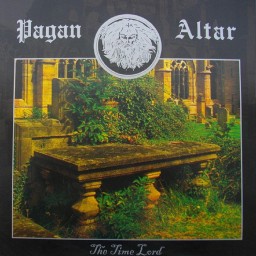
The original I Hate Records pressing of the E.P. came armed with a cover that showed a photograph of a stone bench that was draped in long grass, shrubbery & sunlight. To me this image doesn’t do the doomier side of Pagan Altar's sound justice as it doesn’t accurately reflect the darkness of some of the material, even though it does have an organic 70’s hippy vibe to it that isn’t necessarily without context within the band's noticeably psychedelic sound. The subsequent reissues however, come with the noticeably darker & more mysterious image of a foggy cemetery in front of a spooky stone building with the face of a bearded man (presumably the Time Lord himself) looking down on the scene. It’s a much more suitable accompaniment for the music contained within in my opinion so I’m glad to see that all re-releases have continued with it.
The early music of Pagan Altar isn’t really all that different to that of the infamous self-titled 1982 release in all honesty. In fact, three of the five tracks were re-recorded for that release & in much the same format too. There’s a fair bit of variation in style evident across the tracklisting which keeps you on your toes without ever sounding jarring. Of the five tracks on offer here, I’d suggest that four of them fall very obviously into the traditional doom metal category with Black Sabbath’s 1970’s material being the obvious inspiration. But there’s a much stronger psychedelic influence to this material than Sabbath ever incorporated with the expansive lead guitar work being very much the result of having crossed Tony Iommi with Hawkwind. I’d suggest that Pentagram’s more psychedelic 70’s material is not a bad point of reference with the lengthy title track following more of a psychedelic rock route than a metal one. In fact, it kinda sounds like a more psychedelic version of the rockier material that Black Sabbath were producing at the time (see 1978’s “Never Say Die!” album) which probably shouldn’t be a surprise given Pagan Altar’s obvious affiliation with their idols. It’s interesting that the atmosphere of almost all of this material seems to keep at least a few toes planted firmly on the rock side of the fence even during the most metal moments which has a fair bit to do with the production &, surprisingly, I find this to provide an extra layer of appeal. I honestly wouldn’t have guessed I’d view it as a positive if you had of suggested it to me beforehand but it’s hard to deny the attraction of an authentic 70’s rock sound for a music tragic like myself.
The musicianship on display is excellent throughout. Particularly from lead guitarist Alan Jones & bassist Glenn Robinson. As highlighted on the self-titled release, Jones is the best thing about “The Time Lord” & it’s his generous contribution that gives Pagan Altar their psychedelic edge. Alan was already a very skilled campaigner with his long melodic solos always being well constructed & full of meaning & intent. Glenn Robinson has quite clearly spent a great deal of time studying at the Geezer Butler School Of Heavy Metal Bass Guitar as he seems to possess a similar understanding of how to run his own race whilst never losing sight of his overall role in the band. His performance here is really interesting & I enjoy it for much the same reasons as I’ve always loved Butler’s contributions to Sabbath. A couple of different drummers have contributed to the different sessions but there’s not a noticeable difference between the two & both have formed a more than reasonable combination with Robinson, with the interaction between the instrumentalists being one of the real strengths of the EP. Interestingly, none of the three contributors to the rhythm section would be around for the recording of the self-titled release in 1982 & neither would rhythm guitarist Les Moody who features on the first couple of tracks which is a very strong indication of the level of ownership the Jones brothers had over Pagan Altar.
As I mentioned earlier, one of my major gripes with the self-titled release was the repetitive nature of Terry Jones’ vocal phrasing but thankfully that doesn’t seem to be an issue with “The Time Lord”. I was actually looking out for it given the shared tracklisting but I couldn’t identify any real problems to speak of. Terry’s delivery is very distinctive but changes a little bit between the tracks with a opener “Highway Cavalier” seeing him employing a gnarlier & significantly gruffer style for example. I didn’t notice it as much on later releases but Terry sounds very much like Manilla Road front man Mark Shelton most of the time & when you take into account the significant psychedelic elements in both band’s early works it creates strong parallels between the two. I think Terry’s voice is well suited to the 70’s psychedelic rock feel of “The Time Lord” & he brings the doomier material a similar haunting quality to Black Sabbath’s Ozzy Osbourne. “The Black Mass” is a fine example of this as it’s pure Sabbath worship for the most part while the outstanding vocal hooks in “Judgement Of The Dead” represent the high point of the EP. It’s interesting that I struggled a bit with lengthy closer “Reincarnation” on the self-titled release but here I find it to be a more enjoyable experience. Perhaps the repetition in the vocal phrasing had eventually caught up with me by the time that song graced my ears & the song structure admittedly still lacks direction here but for some reason it seems more attractive despite not being all that different. It could be that the 70’s vibe is more becoming for that particular track with its hippy-ish feel.
Overall, “The Time Lord” is a very consistent release with no weak material included. Occasionally the band will throw in a simpler riff that sounds a touch more basic than I'd like however the vocals & song-writing are generally strong which helps to overcome this issue. The lack of sonic weight in the primitive production job is certainly an inhibitor & there’s no doubt that it prevents me from reaching for the higher scores but I enjoy the classic 70’s hard rock feel of the instrumentation & arrangements which has a timeless quality to it & the fact that the traditional doom metal atmosphere is already in full effect is impressive for such early recordings. I don’t think too many doom fans will be disappointed with “The Time Lord” but the limitations of its format & tracklisting probably make it a little less essential than it might otherwise have been. Still... I have to admit that I slightly favour it over its more celebrated 80's counterpart so there's no denying that it's a pretty decent listen all round.
For fans of: Ozzy-period Black Sabbath, 70’s Pentagram, Manilla Road
I can still vividly remember my first Cryptic Slaughter experience. I was 13 years old & had just jumped onboard the exciting late 80’s thrash metal juggernaut. I’d developed a strong friendship with another boy in my class & we hung out after school most days. He was a very talented guitarist for his age & he began to teach me how to play. In fact, he even loaned me one of his electric guitars so that I could practice at home & we’d often jam around with his older cousin who was an Alex Van Halen & Charlie Benante obsessed drummer with his own place. One day we were listening to Anthrax’s back catalogue in his disgustingly filthy lounge room when I made a comment about how fast a certain passage was & this seemed to trigger a healthy dosage of scoffing from the two cousins. When I asked what they were laughing about they simply told me to strap myself in before placing a copy of Cryptic Slaughter’s 1986 debut album “Convicted” onto the platter. Needless to say that my mind was well & truly blown by the sheer velocity that was emitted from the cheap ghetto blaster speakers & I quickly realized that I had a lot to learn about metal. I’d end up quite liking the “Convicted” album & those feelings have been maintained over the years which has seen me awarding it a positive rating upon revisiting it earlier this year. It was arguably the fastest thing that had ever been released to the time & is worth exploring for that reason alone but there’s always been somewhat of a running debate in crossover thrash circles over which of the first two Cryptic Slaughter albums is actually the best. I always favoured the debut but it’s been decades since I last gave their sophomore album “Money Talks” a few spins so I thought it might be time to re-evalute that position.
Cryptic Slaughter first formed in 1984 when they were still in their mid-teens. They all attended the same Santa Monica high school & their mutual passions for Slayer, Venom, Motorhead & GBH would provide the catalyst for the recording of a demo tape entitled “Life In Grave” the following year. This would see them attracting the interest of Metal Blade Records head Brian Slagel who would include the track “Reich Of Torture” on his “Metal Massacre VII” compilation in 1986. It was at this time that the Californian crossover thrash scene was starting to take shape following the release of DRI’s seminal 1985 album “Dealing With It”. DRI had relocated from Houston to San Francisco in 1983 & are generally regarded as the first band to successfully combine thrash metal with hardcore punk. Their fresh new sound would have a major impact on the thriving San Francisco thrash scene & would influence bands like Attitude Adjustment to follow their lead with their own debut album “American Paranoia” hitting the shelves in 1986. The other Californian crossover hot spot could be found in Venice with Suicidal Tendencies front man Mike Muir being the central figure in an exciting new scene that would spawn albums from not only his main band but also his Suicidal Records label signings Excel & No Mercy (Muir’s other band) in 1987. It was amongst this exciting new Californian music landscape that Cryptic Slaughter’s debut album “Convicted” would be created with Metal Blade house engineer Bill Metoyer in 1986 & it would prove to be arguably the fastest & most savage of the early crossover thrash records released globally. The band members may only have been very young but they made up for their lack of technical skills & experience with a raw energy & enthusiasm which would give “Convicted” an appeal that would draw in fans from both metal & hardcore punk audiences. In fact, it would also prove to be a major influence on the early UK grindcore scene with Cryptic Slaughter’s use of blast beats in particular being a major influence on grind acts like Unseen Terror & Napalm Death. The band would subsequently become known as one of the originators of that technique along with artists like S.O.D. & Repulsion.
I wasn’t much of a hardcore fan at the time but the violence & electricity in Cryptic Slaughter’s music was able to draw me in & I'd find a fair bit of enjoyment in “Convicted”, despite it never threatening to usurp the Slayer’s & Kreator’s at the very heart of my thrash-obsessed teenage esteem. For this reason, I would chase down the band’s second album “Money Talks” through my high school’s black market tape trading network with the older skaters in the year above me generally being my source for securing quality crossover thrash releases. “Money Talks” would once again be released through Metal Blade who were nothing short of a US metal institution by this stage, having been responsible for releasing a whole slew of classic albums since their inception in 1982; Warlord’s “Deliver Us” & “And The Cannons Of Destruction Have Begun…”, Slayer’s “Show No Mercy”, “Haunting The Chapel” & “Hell Awaits”, Trouble’s “Psalm 9”, Omen’s “Battle Cry” & Fates Warning’s “Awaken The Guardian” being just some of the high quality output Metal Blade had been responsible for in the mid 1980’s. As was generally the case, Bill Metoyer would once again be responsible for taking the reins & he would be credited as co-producing the album with the band members themselves. Unfortunately the results would prove to be a little inconsistent in my opinion. “Money Talks” may possess more clarity than “Convicted” but it lacks the energy of the debut. It simply sounds less unified & focused & comes across as a little messy. Scott Peterson’s drum kit certainly sounds bigger & there’s good separation between the instruments with Rob Nicholson’s bass lines being easily discernable throughout however the main problem is with the guitars as they sound weak & thin & have much more of a sloppy punk feel to them than they did on the debut. This is one of the major weaknesses of “Money Talks” in my opinion & I find it strange that many people don’t seem to see it as an obstacle.
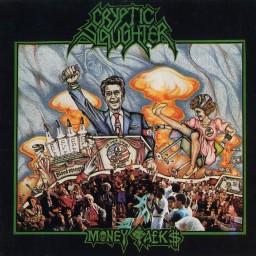
The cover art for “Money Talks” was a definite improvement over the cheap school boy drawing we got with “Convicted” though with Jeff Harp from Long Beach hardcore punk outfit Final Conflict being responsible for the politically-charged image that shows Ronald & Nancy Reagan leading a money-driven campaign of lies & deceit over the American people. This DIY style of image would again provide the influence for a whole slew of similar record covers from UK grindcore bands over the coming years & it’s very much in line with Cryptic Slaughter’s lyrical approach which would touch on some very serious subject matter for a group of teenage boys. The huge influence that the local punk scene had played on this approach is very obvious.
Where “Convicted” saw Cryptic Slaughter seemingly stamping their feet on the accelerator without ever even considering the option of easing it up, “Money Talks” sees the band adding a little more variety to their approach instead of trying to blast the listeners into submission from start to finish. There’s a stronger use of melody in this material which is highlighted by the employment of slower & noticeably groovy breakdowns within most tracks. Despite the fact that this sounds good on paper, the result isn’t quite as positive because when Cryptic Slaughter aren’t brutalizing their audience into submission they tend to leave their technical failings more exposed to criticism. Personally, I find the breakdowns to be very generic & I don’t think they add much value. I’d much rather see the band sticking to the higher velocity delivery of the debut to be honest & when we do see them dropping their shackles & going for broke they possess the same impressive levels of intensity. There’s a noticeable post punk influence to some of the more laidback bass lines which is interesting though & I find this to be a welcome inclusion.
The performances of the various band members are very hit & miss & it seems to me that the blasting material tends to hide a lot of the deficiencies in the techniques of the young band members. There are regular timing issues here with drummer Scott Peterson seeming to struggle with the more mid-paced material. In fact, the band sounds like a runaway train a lot of the time with guitarist les Evans also contributing a very sloppy performance. It’s only the raw aggression of front man Bill Crooks that manages to pull the band out of the fire a lot of the time & he represents the clear highlight of the album for mine. He sounds nothing short of psychotic at times with his take-no-prisoners approach being just what the doctor ordered for a metal & punk audience that was now craving ever more extreme feats of human exertion.
Despite the fact that “Money Talks” is generally regarded as a crossover thrash release, I have to admit that there’s really very little thrash metal included here (or metal for that matter). To my ears, it’s much more focused on a straight-edged hardcore punk sound in combination with the regular use of blast beats so I think the thrashcore tag is a more accurate description of the sound you can expect the hear. There’s no doubt that this contributes to me not rating the album as highly as the debut but the top heavy tracklisting has also played a part. All of the best material is laid on the table within the first four tracks & I find my interest tends to wander through the back end with the last few tracks seeming to peter out significantly. There are no real shockers included but I find it very difficult not to let the production & performance issues taint my listening experience &, for that reason, “Money Talks” has never offered me much appeal.
For fans of: DRI, Attitude Adjustment & Wehrmacht
Different bands have very different stories. Some will seemingly go from zero to hero in a matter of a year by getting signed almost immediately & laying down their debut album before they’ve even had time to fully develop while others are much more of a slow burn with a number of false starts along the way. New Jersey thrash metallers Hades fall firmly into the latter category with the band’s story having already spanned a full decade by the time their debut full-length hit the shelves in 1987. In fact, the very first incarnation of Hades was formed way back in January 1978 which would have made them arguably the earliest thrash band in existence if they had in fact been a thrash band at the time. This wasn’t the case however. They were still playing radio-friendly hard rock covers & learning to play their instruments but their dynasty had already begun with guitarist Dan Lorenzo having already selected the band’s moniker in a ninth grade mythology class.
As with so many high school bands, not a lot would happen for a full four years until Hades would find themselves opening for the raw & exciting Twisted Sister who were showcasing their debut “Ruff Cutts” E.P. at the time. This show would prove to be the catalyst for Hades to get more serious with their debut single “Deliver Us From Evil” seeing the light of day shortly afterwards. It was a pretty lackluster affair in my opinion which saw the band pushing more of a traditional heavy metal sound. Live shows would start to flow more regularly at this point however & a couple of cheap demo tapes would soon lead to appearances on the “Metal Massacre VI” & “Born To Metalize” compilations. Vocalist Alan Tecchio, second guitarist Scott LePage & bassist Jimmy Schulman would join the fold in 1985 & another single entitled “The Cross” would follow shortly afterwards in 1986.
It was around this mid-80’s period that Hades would become more interested in the burgeoning thrash metal movement that was taking the world by storm than your reliable old Maiden’s & Priest’s. Main song-writer Dan Lorenzo would become infatuated with Slayer & Exodus’ debut album “Bonded By Blood” & it would see Hades making a significant change in musical direction. The New Jersey thrash scene had a reasonably strong pedigree in the early years of the subgenre with Overkill & Whiplash being amongst the earliest exponents of the sound but Hades would become a part of a second wave of New Jersey thrash bands that included the more extreme Blood Feast & Blessed Death who had recently abandoned their speed metal roots.
Things were heating up for Hades with 1987 proving to be the most important year in the band's story thus far. The interest in their second single had led to them signing a recording contract with US label Torrid Records who had made a name for themselves through Exodus’ legendary 1985 debut album “Bonded By Blood”. Torrid co-founders Ken Adams & Todd Gordon would bring in producer David Blake who had previously worked with Hades on “The Cross” single & the three of them would produce the “Resisting Success” album in collaboration with the band themselves. Adams & Gordon had been enormously successful with their involvement in the production of “Bonded By Blood” so this arrangement boded very well for Hades but I have to admit that the result was a little bit of an anticlimax given just how strong, influential & enduring the production job on Exodus’ debut was, particularly that iconic rhythm guitar tone. “Resisting Success” sounds very much like the third tier underground thrash release that it is & that’s mostly due to a tinny guitar tone that doesn’t manage to fully highlight the strength & energy in the riffs & melodies. The rhythm section sound much better however. Particularly the bass guitar which has received a lot of emphasis in the mix & for good reason. I recently read that Jimmy Schulman asked the engineer to give him a similar sound to Chris Squire from legendary London progressive rockers Yes which makes a lot of sense when you hear the result. Drummer Tom “Agh” Coombs’ kick drum has been allocated a fair amount of high end which gives it a noticeable click but it’s nothing too extreme & the drums are generally well presented. This sort of raw but reasonably adequate production job was par for the course for mid-80’s thrash debuts so I don’t want to be too harsh but I just get the feeling that Hades had a little bit more to offer than is shown to us here.
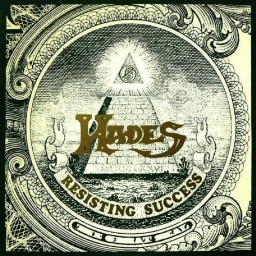
The cover art for “Resisting Success” is fairly interesting although it’s not exactly in a style the screams of thrash. The medieval looking logo & borders, the Illuminati-style pyramid with the levitating peak, the more subtle album title…. it all seems a little bit more progressive to me & I wouldn’t have been surprised if the music it contained sounded kinda like 70’s prog rock. In fact, there are strong stylistic similarities to the cover art used for the 1979 self-titled debut album from US progressive metal outfit Legend to tell you the truth. Hades music does have a fair bit of sophistication about it at times though & the last couple of tracks offer more than a hint at a progressive influence. Particularly the 9+ minute closer “Masque Of The Red Death” which is a fully fledged progressive metal affair. There’s actually a fair bit of ambition shown for a thrash debut with good complexity throughout the entire tracklisting so I literally felt a penny drop inside my brain when I discovered that Hades had already been around for a decade by this stage. You very rarely see a band having to wait that long to hit the shelves but (in much the same way as the before-mentioned Twisted Sister who formed in 1972) the added experience they’d gained along the way shows pretty obviously here.
Musically, this is definitely a thrash metal album. Sure, Hades may flirt with other subgenres on occasion but their overall sound sees those moments always sounding like a thrash band that’s trying something different. A lot of that has to do with the crunchy guitar tone & chuggy mid-paced riffs which are distinctively thrash oriented but there are a few old demo & single tracks included that give you a very graphic view of the transition that Hades had taken over time. The more emotionally-charged acoustic-led “The Cross” is probably the most obvious example & it’s the only track that I’d describe as fitting better under the classic heavy metal banner than a thrash one although “Sweet Revenge” (another old single track) is somewhat of a hybrid. That’s not to say that the rest of the material is always flat-out however as Hades aren’t afraid to slow things down for the occasional Sabbath-inspired groove riff. In fact, when they’re at their slowest I can hear distinct similarities to Swedish doom masters Candlemass which is probably emphasized by the operatic vocal delivery. I’ve often seen “Resisting Success” linked with speed metal too but apart from the odd riff in opening track “The Leaders?” I don’t really see it. There's certainly fast stuff included here but Hades tend to traverse a wide array of tempos.
The quality of the musicianship is outstanding for a debut album & this is a real strength for the band. Hades make great use of the twin guitar attack with the lead work all proving to be more than capable. I really dig a band that can use guitar harmonies without ever approaching the cheese line but it’s the rhythm section that impresses me most. Tom Coombs’ drumming is always interesting with his array of fills & cymbal work giving Hades’ sound additional freshness. Bassist Jimmy Schulman is the best thing about “Resisting Success” though as he approaches metal bass playing from a far more progressive direction, regularly employing bass chords as well some quite complex licks & solos. He’s a really talented musician in his own right so I’m not overly surprised that the producers have opted to highlight that in the mix.
The other major talking point is the contribution of front man Alan Tecchio whose higher register delivery may not be all that common in thrash circles but proves that this approach can be more than effective when it’s done right. His voice occupies a similar space to Agent Steel’s John Cyriis & Anthrax’s Joey Belladonna a lot of the time &, although he’s not always on the money, he usually manages to get by on charisma alone. Alan is definitely at his best when he gets right up there though & I find those sections to be the most satisfying on the record. See album highlight “Legal Tender” for a great example of that as his soaring screams beautifully compliment some exhilarating riff work that reminds me very much of Megadeth’s “Loved To Death”. My only complaint with Alan is that he does occasionally try to force too many words into his phrasing & it ends up sounding a little bit clunky.
Overall, “Resisting Success” is a pretty good way to kick off a recording career. There are no weak tracks included & there’s an air of professionalism about everything even if the production perhaps doesn’t reflect that as well as it might have. The one negative is that there probably aren’t quite enough highlights to warrant the higher scores. All of this material is of a good quality but it’s rarely great. In saying that though, I;m gonna throw out a big call by saying that I think it was the best thrash debut to come out of New Jersey to the time & that includes Overkill’s “Feel The Fire”. If ythe idea of a sophisticated mid-80's thrash record with higher register clean vocals sounds interesting to you then you could do a lot worse than this.
For fans of Lååz Rockit, "Spreading The Disease"-era Anthrax & mid-80's Overkill.
The US power metal scene was kind of America’s response to the NWOBHM movement. In much the same way as the British term was employed, the label isn't overly specific. It’s used more as a catch-all for American bands that played a style of heavy metal that was structured in much the same way as the NWOBHM elite but had shunned its hard rock influence in favour of a renewed level of aggression derived from the early US thrash metal movement. Amongst its most celebrated exponents was a Florida outfit known as Savatage who were built around the skill sets of two brothers in Jon & Criss Oliva; Jon the enigmatic front man with the powerful voice & Criss the enormously talented guitar slinger with the gift from God. For just over a decade, Savatage would play a major role in the growth of the still relatively new US heavy metal scene, most notably through a string of four successive classic albums that stretched from 1987 to 1993. However, tragedy would strike in October 1993 when the vehicle Criss & his wife were travelling in was struck by an out of control drunk driver. Criss was killed instantly. Jon Oliva would continue to push forwards with Savatage as a tribute to his brother on & off for many years however the project now seems to have reached its final resting place with no activity since 2015.
In 1995, German label SPV would announce the release of a tribute album to honour the career of Criss Oliva. SPV had been around for more than a decade by that stage but wasn’t exactly a haven for quality metal with German thrashers Holy Moses’ 1990 album “World Chaos” being their only noteworthy metal record to the time. The release would take the form of a live album that collected recordings from a number of shows spanning the course of a four year period from 1987 through to 1990. Long-time Savatage producer Paul O’Neill would oversee the project, his metal credentials having been predominantly built around his production work on all of the band’s albums since 1987’s “Hall Of The Mountain King” as well as Omen’s “Escape To Nowhere” & Metal Church’s “Hanging In The Balance” records. But it’s very safe to say that Paul knew how to get the best out of Savatage & he was just the man to handle this particular project.
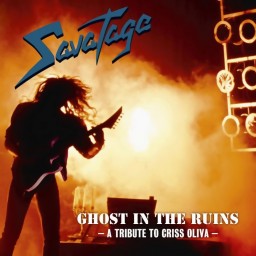
The release would be known as “Ghost In The Ruins” (a title that Savatage had been considering for their classic 1991 record “Streets: A Rock Opera”) with the sub-text “A Tribute To Criss Oliva”. The album cover would show a simple photograph of Criss playing live on stage with a bright orange light beaming down from behind which left him shrouded in shadow, so the project was very clearly centered around honouring Savatage’s lost hero. It was also very clear that the concept had been borrowed from Ozzy Osbourne’s 1987 live album “Tribute” which was created to honour legendary guitar hero Randy Rhoads who had died in a light airplane crash. The structure of the album is very similar with the inclusion of several short shred sections, one track being an unaccompanied guitar solo & an acoustic rehearsal recording closing out proceedings. I’m honestly not too sure that Criss would have been happy with closer “Post Script”. Sure it’s a beautiful piece but Criss’ performance on that track isn’t exactly clinical as he duffs more than a few notes. I’m certain that he would have liked another crack at it.
I’m not sure how he’s managed it but Paul O’Neill has done a stellar job at producing “Ghost In The Ruins”. The task of pulling together material recorded at various different venues across a three year period & making it all sound like a single show with a consistent sound production must have been enormous but he’s achieved it amazingly well here. All of the instruments sound great with Jon’s voice being presented with both power & clarity. This is the very epitome of a well-balanced live recording with the guitars being presented at the front of the mix but never overpowering the other elements. In truth, I wasn’t the biggest fan of the rhythm guitar tone on a couple of Savatage’s early releases but songs like “Sirens”, “City Beneath The Surface” & “The Dungeons Are Calling” have never sounded better now that they no longer have to contend with the overly-dry sound their studio versions suffered from. So essentially everything is in place for another undisputed heavy metal classic, right?
But here’s the thing…. I’ve just never been able to understand the appeal of Savatage. Whilst I’m seriously enamored with Criss’ lead work & find him to be one of the most underrated shredders in metal history, I just can’t get into the albums as a whole. Fans seem to place Jon Oliva up on a pedestal alongside many of the great heavy metal front men of all time but I simply don’t see it. His voice sounds a lot like Udo Dirkschneider trying to do a Rob Halford impression & failing dismally a lot of the time here & it seems to me that he’s been massively overrated over the years. Plus, the song-writing has never presented me with strong enough hooks to lure me back again & again. The only reason I DO find myself returning for semi-regular revisits is to see if I’ve finally reached a stage in life where I can appreciate the quality that everyone else in the metal scene seems to find in Savatage’s music.
Stylistically, Savatage are often associated with the power metal or progressive metal camps but in truth they’re just a straight down the line heavy metal band who doesn’t mind a bit of theatricality. I guess I’m not exactly the target audience for those sort of theatricalities to be honest as they come across as pretty cheesy most of the time. A song like the lengthy long power ballad “When The Crowds Are Gone” is a fine example of this as it sees me being reminded of KISS’ ultra-cheesy “God Gave Rock & Roll To You” from the “Bill & Ted’s Bogus Journey” soundtrack more often than is healthy for a metal band. In saying that though, it also shows that the more expansive material from an album like “Gutter Ballet” can be translated to the live environment better than I would have thought it might have however there’s not a lot that I would say is genuinely progressive here. Sure, there are some tracks that were built as part of an over-arching album concept & additional instrumentation has been included to add weight & interest but the orchestration & song structures aren’t consistently expansive or experimental enough to warrant being tagged as progressive.
With the exception of the previously mentioned acoustic number, Criss’ performance is nothing short of mind-blowing. He utilizes an exceptional technique to pull off light-speed runs with an ease that leaves old shredders like myself wanting to dump our guitars in a ditch by the side of the road. He really was an enormous talent & his lead work is both majestic & exhilarating here. Whilst many shredders were simply regurgitating the work of their idols, Criss would take the influence of guitar gods like Eddie Van Halen & Randy Rhoads & create something all of his own that was undoubtedly very technical yet never lost sight of the fact that a classic solo also needs to offer memorability to be most effective. It really is a shame that I can’t consistently enjoy the rest of Savatage’s sound because it seems like Criss’ talent is completely wasted on me. The half time arena-style ride bell use that drummer Steve Wacholz seems to favour so much does a great job at nullifying any interest that might have been building for me. I’ve always wanted more metal drumming from Savatage but it seems that they’ve never quite been able to let go of their commercial aspirations so are more comfortable for the engine room to simply play a supporting role.
So why am I even reviewing “Ghost In the Ruins” when I know full well that I haven’t liked any of the Savatage records I’ve reviewed previously? Well, there have always been one-off songs that I’ve quite liked & the idea of a live best-of left me hopeful that once all of the filler was removed it would leave me with an album that offered me a more consistent level of appeal. And to be honest, I was actually feeling pretty positive about the chances of that happening after the first three tracks too as they’re all very enjoyable (particularly “24 Hours Ago” which is the best of the proper songs included in my opinion). But things take a sharp downward curve towards the middle of the record with four of the next five songs leaving me frustrated & bored. They pick things up again in the back end with a solid procession of enjoyable tracks & Criss’ brilliant unaccompanied guitar solo closing out the album well but the damage had already been done during that mid-section I’m afraid. Songs like “Strange Wings”, “Gutter Ballet” & “When The Crowds Are Gone” simply have too much of a hard rock radio flavour for my liking & would sound much more appropriate in a huge arena than a down & dirty metal venue. That’s really the element that I struggle with the most here & the fact that Jon’s voice doesn’t connect with me like it seems to with Savatage’s rabid fanbase sees me destined to never quite understand their immense popularity in heavy metal circles. “Ghost In the Ruins” may be the best Savatage release I’ve heard to date & long-time fans will unquestionably find themselves in raptures of enthusiasm over it but this band simply isn’t for me.
For fans of: Metal Church, Virgin Steele, Queensryche
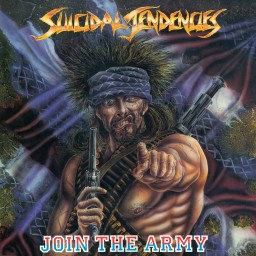
Crossover thrash… it’s always been more of a niche subgenre really. In fact, when most metalheads hear that term mentioned there’s usually only a short list of bands that pop into their minds & almost all of them are American with California being one of the more notorious breeding grounds for these hybrid groups (along with New York of course). Historians investigating the roots of the Californian scene will almost certainly begin by looking at two key occurrences. One would be the relocation of D.R.I. from Houston to San Francisco in 1983 with D.R.I. going on to become a huge influence on the early crossover scene. Their 1985 debut album “Dealing With It” represents arguably the first genuine crossover record to be released globally & it would provide the basic building blocks for other East Coast bands like fellow San Franciscans Attitude Adjustment & Santa Monica’s Cryptic Slaughter to launch their careers off with 1986 seeing full-length releases from both acts.
Now, you may be waiting for me to announce the second key moment as Suicidal Tendencies’ self-titled debut album from 1983 but that’s not exactly where I’m going with this. Suicidal’s debut was indeed a very important & influential record for the local scene but it wasn’t technically a crossover thrash release in my opinion. The band were still closer to a standard hardcore outfit at that point. Sure, they may have incorporated some flashy, chorus-effected guitar solos into their repertoire which was generally discouraged in the punk scene but there wasn’t a major metal influence on the riffs & song structures just yet. That element of the band’s sound wouldn’t be fully developed until talented guitarist Rocky George replaced Jon Nelson in their lineup the following year; a lineup change that would prove to be more significant than any of the band members probably realized at the time as it would subsequently alter the course of Californian crossover history.
Suicidal Tendencies’ sophomore album wouldn’t be released until 1987 which was a full four years after their debut had taken the underground by storm. By that stage the crossover thrash sound had been fully formed & defined by bands like D.R.I., S.O.D. & Corrosion Of Conformity, so why are Suicidal so often referenced as being one of the innovators? Well for starters, the band was first formed in the Venice beach area way back in 1980 which predates almost all of the other key players & secondly, they always had small elements of metal in their sound & had been an influence on the early thrash metal bands like Anthrax, Megadeth, Metallica & Slayer with their 1983 hit single “Institutionalized” building a sizable cult following after introducing the MTV audience to hardcore. But it was arguably the involvement of Suicidal front man Mike Muir in building the Venice crossover scene that was the most important factor. A year after Rocky had joined the band, Muir would put together his own label known as Suicidal Records, intended primarily to give local hardcore & crossover bands an avenue for releasing their music. The label’s first release would be a compilation record entitled “Welcome To Venice” which included the Suicidal track “Look Up… (The Boys Are Back)”; a song that would see Suicidal pushing further out into more metal-infused waters than ever before. Interestingly, the record would also include material from Muir’s other two bands, Los Cycos (also featuring Suicidal bassist Louiche Mayorga & former guitarist Grant Estes) & No Mercy (with guitarist Mike Clark who would join Suicidal in 1987), along with fellow Venice locals Beowulf & Excel. All of these acts would become the basis for the Venice crossover scene in the years to follow with Beowulf, No Mercy & Excel all releasing their debut albums in 1986/87 which made “Welcome To Venice” quite significant in the grand scheme of things.
The success of the debut would see Suicidal signing with Caroline Records (i.e. the New York sub-label of Richard Branson’s London-based Virgin Records) for the follow-up “Join The Army”. Caroline hadn’t made all that big an impact with their previous undertakings but “Join The Army” would prove to be their first release to gain any genuine success with Suicidal reaching number 100 on the Billboard charts, most likely off the back of the popularity of “Institutionalized” as well as their strong following in the skateboarding scene. The cover artwork would be quite distinctive & I feel that this has played a part in the success of the album. The picture of a muscular solider making an obvious call to arms seems to be quite an ingenious play really. It’s not the most professional of images however it’s done well enough to satisfy the DIY punk rock & skateboarding philosophies but also draw in a new audience of fans who were looking to be a part of something fresh & underground. For this reason, the album cover has gone on to gain somewhat of a cult status in metal circles & is still instantly recognizable to this day.
The band would co-produce the album with Primus bassist Lester Claypool whose only previous production experience with a metal-related release came through the 1984 live album “Live Sentence – No Parole From Rock ‘n’ Roll” from Graham Bonnet-fronted LA hard rockers Alcatrazz which would be followed up by engineering credits on the first two solo albums from super-talented young Alcatrazz guitarist Yngwie Malmsteen. The result was probably not quite what the band would have hoped for as “Join The Army” certainly doesn’t sound as punchy & energetic as it’s more highly regarded older sibling. This is mainly due to a very tinny rhythm guitar tone that had much stronger ties to the hardcore scene than it did with metal. The guitars were also left too far back in the mix & there are some noticeable variations in both volume & balance across the tracklisting. The rhythm section sound much better & are able to overpower the guitars fairly comfortably with Louiche Mayorga’s bass guitar tone being the driving force behind the album.
Despite being touted as the most important release in the growth of the crossover thrash subgenre by many, I have to say that “Join The Army” isn’t the most thrashy or metal sounding record. In fact, I’d suggest that the “crossover thrash” tag isn’t entirely accurate because this is definitely more of a transitional release that sees Suicidal still in the process of diluting their early hardcore sound. There’s really only a couple of genuine crossover thrash tracks included to be honest (see opener “Suicidal Maniac” & album highlight “I Feel Your Pain… & I Survive”) although there are further hints across some of the other tracks as well. The major component of the band’s sound was still hardcore punk in my opinion with more than half of the tracklisting sitting fairly comfortably under that banner. Perhaps this is contributed to by the guitar sound I mentioned earlier because it’s not particularly conducive to metal. There’s a reasonably strong influence from traditional heavy bands like Black Sabbath & Motorhead here too though with songs like the title track & “A Little Each Day” seeing Suicidal incorporating chuggy, mid-paced metal riffs just as often as they do your fast-paced & thrashy tremolo-picked ones. The skate punk links tend to be more of an aesthetic thing rather than anything attached to the band’s sound & I’d hazard to suggest that it’s really just the video clip for skater anthem “Possessed To Skate” that’s mainly responsible for that.
One of the big differentiators from most of Suicidal’s peers in the 80’s hardcore & crossover scenes was the technical skill of the band as Suicidal show off a lot more talent than most of their competition were capable of at the time. They really were a very tight unit with each of the musicians sounding like they're in total control of their instruments. The performance of bassist Louiche Mayorga is of particular note as I’m really impressed with his contribution. There’s a lot of energy about his playing & he & drummer R.J. Herrera clearly have a very strong background in the punk scene. It’s interesting that Rocky George played in a hardcore punk side project band called Pap Smear from 1984-86 alongside Slayer guitarist Jeff Hanneman & drummer Dave Lombardo & I have to wonder whether that was where he picked up his interest in thrash. Rocky George is clearly a very talented shredder in his own right & is one of the real drawcards of Suicidal’s classic period releases for me personally. By his own admission, Rocky had an obsession with the elite musicians from all genres & you can hear that in just how confident & capable both his rhythm & lead work are. Suicidal always incorporated guitar solos (much the chagrin of punk purists) however Rocky was able to take things to another level &, in doing so, played the major role in gaining the attention & approval of a metal audience.
One of the other major talking points of the “Join The Army” album is the change in direction from band leader & front man Mike Muir. The debut had seen him taking a more traditional hardcore approach to delivering his lyrics but here were see him moving in a couple of different directions. At times we find him toning back his aggression for a cleaner & more melodic delivery which often highlights his technical deficiencies. In fact, he can be quite pitchy during these moments & I find them to be pretty tough going for the most part. Then at other times he seems to be attempting to hit on a more gruff & muscular metal-oriented tone that’s equally ineffective. He really does annoy me here & I don’t think he was quite up to the task at this point in his career which actually results in him being the major contributor to me not really getting a lot of enjoyment out of the album overall. I honestly don’t think there are too many problems with the music from an instrumental point of view. It’s really just the Mike’s dodgy performance & the weaker production that put me off a bit along with the continual use of hardcore style gang vocals.
Ultimately, “Join The Army” is a representation of a band that was still in transition from a very successful & confident hardcore punk band into a metal/punk hybrid. As I suggested earlier, I think it will still appeal more to the open-minded hardcore fan than the Big Four obsessed thrasher but almost every song incorporates some sort of reference to metal. I guess the crossover thrash tag is probably used as more of a catch-all given that there wasn’t really any other genre tag that fit at the time but I have to seriously doubt the credibility of statements that link “Join The Army” with the birth of the crossover thrash subgenre. I mean there were literally dozens of other crossover releases around between 1985-87 & many were of a much higher standard & sported a much more defined hybrid sound than what we get here. Perhaps it’s just a matter of taste though as the most iconic songs here seem to be some of the ones that appeal to me the least (particularly the God-awful title track which sounds more like Kid Rock than it does S.O.D.). “Join The Army” is a fairly inessential release in the Suicidal Tendencies discography &, although it could be regarded as a necessary evil for the role that it played in the development of their sound, I’d suggest skipping it & moving on to their next few releases.
For fans of: DRI, Cro-Mags & “Animosity”-period Corrosion Of Conformity
Nashville, Tennessee…. it’s not exactly a location that immediately brings to mind vicious mosh pits or light-speed tremolo riff sessions now, is it? And for good reason too. But by the mid-to-late 1980’s, metal had made such a mark on popular culture that it wasn’t uncommon to read of bands like Intruder who were fighting against local stereotypes & producing their own brand of high intensity music, all in the name of replicating their metal idols. Intruder are generally regarded as a thrash metal act but the truth is that they’d yet to discover Slayer by the time they recorded their debut album “Live To Die” in 1987 & their sound was still more in line with speed metal; a subgenre that had thrived in the United States in the preceding few years with several of the major cities becoming hot beds for the sound. New York’s Anthrax & Original Sin, Chicago’s ZnöWhite & Damien Thorne, Los Angeles’ Savage Grace, Agent Steel & Abattoir, Atlanta’s Hallows Eve & New Jersey’s Blessed Death had all had a crack at appeasing the speed gods by this stage so these were exciting times for American speed metal fans.
Intruder first formed as a four-piece way back in 1984 but were still known as Transgresser in those days. They were pretty much a Black Sabbath covers band to begin with but gradually integrated some original material into their repertoire over time which would result in two demos being recorded in 1984 & 1986; the second of which would lead to a single album recording deal with Iron Works Records. Iron Works was a sub-label of Californian label Azra Records & had previously enjoyed some success with Jag Panzer’s debut album “Ample Destruction” & (to a lesser extent) Liege Lord’s first up effort “Freedom Rise”. It was a deal that would see the band making the difficult decision to change their moniker to one that better suited their sound due to many fans seeming to link the word Transgresser to Satanic black metal.
Intruder’s debut album “Live To Die” would be recorded locally at Treasure Isle Studios in Nashville in 1987 with producer Tom Harding who was mainly known for his work with country artists like Lyle Lovett & Marie Osmond. It would be one of the very first US metal releases to be recorded purely digitally after Manowar had tested the waters with their “Fighting The World” album earlier that year. Interestingly though, the record would come out sounding pretty good for an underground speed metal debut, despite the guitar tone varying a little between tracks. All of the instruments can be easily identified with the rhythm guitars managing to overcome a particularly loud & boomy snare sound that really cuts through the mix. The lead guitar tone is nice & shreddy & really highlights the obvious skills of talented axe-man Arthur Vinnett.
The cover artwork for “Live To Die” is worth mentioning as it doesn’t really represent the sound that Intruder were pushing at the time all that well. It’s a pretty disconsolate looking image that would be much more appropriate for a depressive funeral doom metal release than an up-tempo speed metal affair but at least it’s attractive to a metal audience, even if it might not be the specifically desired subsection.
Despite already having stated my opinion on the most suitable genre tag for “Live To Die” earlier on in the review, it’s not actually all that clean cut as there are also tracks that move predominantly in the thrash metal & heavy metal space even though there’s often a bit of cross-pollination going on. I’m guessing that this can mainly be put down to the fact that the band were still very much in transition from a more traditional heavy metal band into one that focused entirely on the relatively new thrash metal craze that had taken over the underground. This is evident in the way that many of the songs hit kind of a middle ground between two styles. For that reason, it’s not all that easy to pick out any obvious influences. One moment you’ll be hearing a bit of Whitesnake or Van Halen, then later in the same track you’ll find the likes of Anthrax springing to mind but Intruder never really sound all that intimidating for a supposed thrash band.
A lot of that is due to the more traditional & accessible performance from front man Jimmy Hamilton whose delivery sits comfortably on the more melodic side of the thrash/speed metal equation. Jimmy can really sing when he puts his mind to it & I’d describe his tone as sitting somewhere between former Riot front man Guy Speranza & Anthrax legend Joey Belladonna. The question of whether he’s an ideal fit for a speed metal band is worth asking though. I think he does a really good job here however I have to admit that I regularly find myself thinking that he would have made a great hard rock singer. The rest of the band are all well qualified for their tasks too & always have a great energy about them. There’s some good complexity to the arrangements without ever sounding like the band were trying to be overly showy. But the star of the show is definitely lone guitarist Vinnett who slays pretty much every solo here. He’s an extremely talented shredder & I actually find a few of his solos to be powerful enough to lift some of the flatter material to another level. I have to wonder how he sounded without the additional rhythm guitar tracks in a live environment though. The few acoustic guitar sections are a lovely touch but I can do without the semi-regular use of gang vocals to be honest.
It’s hard to fault a record like “Live To Die”. The tracklisting is generally very consistent with only slower heavy metal number “Cold-Blooded Killer” falling a little flat. I can really appreciate the quality of the musicianship & composition & find myself engaged throughout most of the album but I think Intruder were just lacking a bit in the hooks department at this point in their career. They also sound a little too light-weight to really drive their point home at times & perhaps that’s got something to do with the fact that they chose to record with a country music producer. This is compounded by the fact that the less intense numbers tend to be the weaker ones & (perhaps unsurprisingly) I tend to gravitate towards the thrashier songs like album highlight “Victory In Disguise”. There’s certainly some good metal here with more than enough energy to get most thrashers jumping around a mosh pit but Intruder weren’t threatening the Big Four at this stage.
For fans of: Lååz Rockit, ZnöWhite, Anthrax
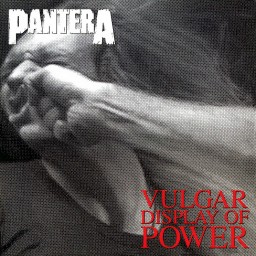
We all know the story by now & probably have for more than 25 years. Two teenage brothers with a music producer for a father start a glam metal band & record a succession of arguably substandard albums in daddy’s studio before taking a drastic stylistic u-turn in which they’d manage to single-handedly invent the groove metal subgenre & become one of the biggest metal bands in the world. 1992’s “Vulgar Display Of Power” album would not only consolidate the concepts that had been presented on Pantera’s 1990 breakthrough album “Cowboys From Hell” but it would also see their new sound receiving further refinement & definition in a clear statement of intent. In doing so, it would become the benchmark for the groove metal subgenre for decades to come & would also influence the creation of a number of additional subgenres which would focus on different elements of the Pantera sound.
Despite the subsequent tragedy that would put any chance of a Pantera revival to rest, their story was somewhat of a fairytale which made them an easy target for people that were looking for a reason to question the merit of their seemingly overnight success. Tall poppy syndrome is rife in the global metal scene & they would have to deal with the ongoing backlash from former fans who would turn on them purely because they’d gained popularity. There were also those that would abandon their idols due to their distaste for their many copy-cats & the subgenres they’d pioneer. It’s all more of an image thing in my opinion & I can still remember feeling a bit of pressure to understate my passion for Pantera’s music with my schoolmates once they hit the big time & were the talk of the schoolyard. But the truth is that I had a strong connection with the band for several years. I’d picked up on “Cowboys From Hell” very early & had given it a good old thrashing prior to the release of “Vulgar Display Of Power” which would be a regular in my home stereo & Walkman along with the follow-up “Far Beyond Driven”. But strangely, at some point I must have lost touch with Pantera because it’s been decades since I last explored their highly regarded “Vulgar Display Of Power” record & I have to admit that I’m keen to see whether it still stands up today.
The album would be the band’s second for Atco Records which was a subsidiary company of the huge major label Atlantic Corporation. There’s little doubt that this major label support was a significant factor in both the exposure that Pantera would receive & also the quality of the product they were able to produce. Having said that though, I’ve never thought that the cover artwork for those first two breakthrough records was anything to write home about. Sure, Pantera’s music left many feeling like they’d received a swift & unexpected punch to the face but the image has always seemed kinda dumb to me personally & it’s for that reason that I never thought about purchasing a “Vulgar Display Of Power” t-shirt to tell you the truth. If you wanted to pin point the major negative connotation that people had with the band during their glory years it was that they were a bit of a yobbo band for unintelligent meatheads to get violent to & I honestly think that the album cover has contributed to that concept along with Phil Anselmo’s drunken chest-beating. The band’s logo looks like it was created on a Commodore 64 with a dot matrix printer too.
The recording of “Vulgar Display Of Power” would once again see renowned metal producer Terry Date overseeing the project in conjunction with drummer Vinny Paul. The band & label were obviously very happy with the result of the “Cowboys From Hell” sessions so it would seem to have been a bit of a no-brainer. Terry had already accumulated a strong metal resume by the time he became involved with Pantera with his list of credits including artists like Metal Church, Dream Theater, Overkill & Soundgarden, although his horizons had looked even brighter since with Overkill’s “Horrorscope”, Dark Angel’s “Time Does Not Heal” & Soundgarden’s “Badmotorfinger” having further propelled his reputation & ensured that he was in high demand by metal musicians for many years to come. And you can easily see why too because “Vulgar Display Of Power” offered everything you could want from a professional 90’s metal production. Everything sounds super crisp & full of life with a very guitar-heavy mix & a lot of depth in the drums. Vinny’s kit definitely has a fair amount of click to it but the toms sound like deep tubs of infinite weight & his kick drum combines beautifully with Rex’s warm bass sound. Dimebag’s guitar tone is crushingly thick & makes full use of the mid-range scoop technique that was so popular at the time with bands like Metallica & Overkill. Overall, it’s a very 90’s sounding record & is as polished as you could want from a major label release. I don’t doubt that the quality of the production has had a noticeable impact on the album’s success.
So if “Vulgar Display Of Power” is the record that truly defined the groove metal sound, what exactly did it do differently? Did they simply take the musical style of Exhorder’s two-track demo tape & run it through a major production budget with a name producer or give the early groove metal sound that White Zombie’s sophomore effort had pushed a bit of meat on its bones? Well I have to admit that I was possibly one of the first people to raise the Exhorder comparisons & I came to that conclusion without ever having heard or read about similar theories elsewhere. I didn’t just pluck the idea out of nowhere so it must have some merit to it but there’s a lot going on here that indicates that Pantera were the sum of many long-term influences & not simply cashing in on another band’s sound. I mean there are a lot of different elements at play here & when you actually lay them all out in front of you it becomes very clear as to why Pantera would become so successful during a period when the rest of the metal scene would be forced to evolve or fade into obscurity. Pantera simply seemed to have all bases covered. To elaborate a bit, the basis of the classic Pantera sound comes from a combination of three main elements in my opinion; all of which were as close to sure-fire winners as you’re likely to find in the early 90’s market. Firstly, you’ve got a very strong Black Sabbath influence that focuses heavily on the power of the riff. I’m mainly thinking about the “Master Of Reality” & “Vol 4” era Sabbath & Pantera has picked up a lot of their heaviness & groove there. Particularly in the way that they employ some of their melodic riffs whilst never sacrificing on overall heaviness. They often remind me of some of those classic stoner metal riffs that Sabbath started to employ across those albums, especially when combined with a wah pedal. Check out the bridge riff in “Live In A Hole” as a prime example. The other classic metal influence that’s pretty easily identified is that of Ozzy Osbourne’s Randy Rhoads period solo albums & not only in the lead guitar work. Some of Dimebag’s riffs are pretty clearly inspired by Randy’s more angular & melodic riff work with the verse riff from “Live In A Hole” being a prime example.
The second major component of Pantera’s makeup is the thrash metal one which is perhaps a little less prominent than it was on “Cowboys From Hell”. The band have always stated that they were heavily influenced by the likes of Metallica & Slayer. I don’t hear much Slayer in “Vulgar Display Of Power” but the Metallica influence is very obvious in both their faster, thrashier moments as well as the mellow first half of “Hollow” which reeks of your more commercial Metallica works like “Nothing Else Matters”. “Fucking Hostile” is pretty much entirely based on Metallica’s thrash sound with even the guitar solo sounding remarkably like it could have been lifted from “…And Justice For All” while the faster parts of “Rise” instigate similar feelings. The most brutal track on the tracklisting however (& unsurprisingly my clear favourite) is “By Demons Be Driven” which seems to lead the way for Fear Factory’s precision industrial metal assault later in the year but my point was that two of the three major components Pantera had built their sound on came from the most widely celebrated names in metal music in Black Sabbath & Metallica which was always going to be a good platform to work off.
The third component is just as important though. Particularly given the time that “Vulgar Display of Power” was released. The early 90’s had seen the grunge & alternative rock movement completely wiping out a lot of metal’s commercial aspirations with many of the big names electing to dilute their sound in a bid to stay relevant. Pantera took a slightly different but much more effective approach by sneakily finding ways to incorporate the best bits from many of the biggest alternative acts & it’s surprising just how much of this can be found on the album. I actually think that the seamless implementation of this element of their game enabled them to be embraced by the alternative scene at the time while a band like Anthrax or Motley Crue might not have been, despite similar endeavours, & I have to wonder how much Terry Date had to do with it given his history with bands like Soundgarden, Mother Love Bone & Screaming Treea. Take a listen to the clean verses from “This Love” for example & tell me they don’t sound like Alice In Chains. Or perhaps investigate “No Good (Attack The Radical)” whose verse takes a stab at a funky Faith No More groove before crossing over into a sound that seems far too similar to the one we’d hear from nu metal bands like Korn in the coming years. Yep… Pantera weren’t just trying to fit in with the alternative scene. They were influencing them back too.
Probably the biggest revolution that the band was responsible for was the use of the rhythmic bottom string chug riffs that would sprout a number of off-shoot subgenres. Nu metal is the obvious one but how about djent? I have absolutely no doubt that Meshuggah built their sound from the off-beat Rush-inspired chug riffs like the verse of “A New Level” or the chorus of “Live In A Hole”. How about the rap metal subgenre then? There are certainly some riffs included that share a similar quality to those that Rage Against The Machine would take to the top of the charts later on in 1992 & check out the solo in “By Demons Be Driven”. Sound much like something Tom Morello would use? What about metalcore? There’s no denying that chunky groove-oriented breakdowns & aggressive (but still somewhat) melodic hardcore style vocals became all the rage after this record blew up. And finally, where would the wealth of US groove metal bands like Machine Head be without riffs like the chorus of “A New Level”. In fact, come to think of it, if you chucked some guttural death metal vocals over that chorus it’d basically amount to genuine death metal.
BUT! Would any of this have even been possible if this was Pantera’s debut album? I don’t think so. I actually think that a major ingredient in the band’s success was the musical maturity they’d gained after almost a decade in the scene. I mean it’s extremely unlikely that a bunch of kids could pull all of those influences together & present them in such a well-developed package without the assistance of extensive composition & recording experience. After all, the performances here are absolutely fucking phenomenal. The rhythm section are super tight with the kick drum & bass guitar sounding like a single entity. Vinny’s beats are certainly ultra-heavy but they never lose that underlying groove that gave Pantera a touch more accessibility than their competition & he & Rex really set the perfect platform for the main attraction to do his work. To be honest, I think Dimebag Darrell was the most unique lead guitarist the world had seen since Randy Rhoads as he’d developed his own style in a completely self-taught, non-theoretical fashion without the rules that are generally followed by classically trained axe-men & for that reason he was able to develop skills that no one had even dared to attempt. To top it off, he had truly mastered his craft by this stage in his career. Randy’s influence is undeniable. As was Eddie Van Halen’s for that matter & all three possessed some sort of x-factor that left me feeling that you could simply point them out the way to the stage, stand back & watch the magic. A mark of just how talented this bloke was can be seen during the solos where he’s unaccompanied by any additional guitar tracks. Not many metal guitarists could get away with that & it certainly helps that he’s got such a killer rhythm section to back him up. I don’t think you can buy the sort of synchronicity that comes with growing up together whilst learning your instruments.
Vocally, we can see Phil Anselmo continuing a transformation that began on “Cowboys From Hell”. This time he’s dropped a bit of his more melodic side & has focused much more intently on raw anger & vitriol. I actually think Phil took the art of aggressive metal vocals & made it acceptable in a commercial sense with this record. He was able to achieve this by leveraging his louder-than-life attitude & in-your-face appearance which offered huge appeal for all of the battlers out there who now wanted working day heroes who rejoiced in their imperfections in a similar way to the grunge movement. It was just what people wanted after the glitz & ponce of the glam metal dominated 1980’s & his hardcore punk look & persona certainly helped him to gain further crossover appeal.
To be honest, “Vulgar Display Of Power” doesn’t exactly sit in my comfort zone from a stylistic point of view. I don’t mind the groove metal sound but it’s never been something that I’d actively go out of my way to chase down. Pantera is a bit different because, as I’ve shown here, there’s a fair bit more on offer both musically & technically. In saying that though, I’m actually surprised that I couldn’t get my rating up higher than I have given that the album contains riffs of the standard of the main riff in "Mouth For War" (which is one of the greatest in the history of recorded music in my opinion). Almost every track is of a very high quality with the possible exception of closer “Hollow” which suffers from a horribly cheesy first three minutes before making a good recovery in the back half thanks to a superb Dimebag metal riff. But I don’t think there’s quite enough genuine highlights to give me the consistent shivers I require for my higher marks. I guess the likes of "Walk" & "Fucking Hostile" have never quite hit me as hard as they did for most fans. It’s really a taste thing more than a quality one as it’s hard to complain about a record that’s so beautifully executed. Pantera had genuinely acquired “a new level of confidence & power” & it shows very clearly with an album that’s unlikely to disappoint many metal fans regardless of your genre preference.
For fans of: Exhorder, Lamb Of God, Machine Head
The city of Belo Horizonte may not be Brazil’s most populous city. In fact, it’s only its sixth. But if you trace back the origins of extreme metal in South America, it may just be the most important for a couple of reasons. The first of which would be the birth of Brazil’s two biggest extreme metal exports in Sepultura & Sarcofago in 1984 with Sepultura destined for global domination during the 1990’s & Sarcofago becoming an important influence on the early black metal story. The second key achievement for Belo Horizonte was the formation of Cogumelo Records in 1985; a label that would play a pivotal role in the development of the Brazilian metal scene. 1985 would see Cogumelo releasing Brazil’s very first death/thrash release in Sepultura & Overdose’s split album before following it up with the highly regarded “Warfare Noise” compilation & Sepultura’s debut full-length “Morbid Visions” in 1986. These releases may have sounded primitive from an international perspective however they would open up a world of exciting possibilities for young Belo Horizonte metalheads, resulting in a handful of fresh new bands who would consistently challenge each other in terms of raw extremity & would each have an avenue for getting their music released via Cogumelo. Bands like Holocausto & Exterminator would follow the path that Sarcofago had paved by pushing out into your more evil death & black metal territory while Chakal & Mutilator would go down the thrash metal route of Sepultura who were themselves taking further strides to validate the creative importance of the region by producing South America’s first genuinely classic record in 1987’s “Schizophrenia” album.
Mutilator would begin life as a five-piece known as Desaster in 1985; presumably taking their moniker from the misspelt title of an early Destruction track called “Total Desaster” from the previous year. The decision to go move forward with an alternate name would be triggered by a lineup change that saw Sepultura roadie Silvio SDN joining the band for a short-lived stint behind the microphone which spawned two demo tapes in 1986. Following Silvio’s departure, we’d see existing guitarist Kleber picking up the vocal duties in a new four-piece arrangement which would see Mutilator through to their debut album “Immortal Force” in 1987. It’s interesting that lead guitarist Alexander Magoo would be offered the lead guitar role in Sepultura around that time but he turned them down in order to concentrate on Mutilator with Andreas Kisser scoring himself the gig for the recording of “Schizophrenia”. Oooooooooo…. that’s gotta hurt, doesn’t it?
The album cover for “Immortal Force” is somewhat of a missed opportunity as it just looks like a cheap demo where the band didn’t bother or couldn’t afford to source a decent image. The latter is actually the truth as Cogumelo weren’t exactly raking it in & the result is essentially just Mutilator’s logo with the album title printed on a black background. You’ve gotta wonder whether this has contributed to the band’s profile staying a little more underground than was perhaps warranted from a musical perspective. I’d guess so because it’s quite rare to see them mentioned anywhere these days & that’s a shame really. A nasty image like we saw on the Chakal debut or the early Sepultura records could have been just what the doctor ordered but sadly it wasn’t to be. At least they didn’t have to deal with the Nazi symbolism that marred the Exterminator & Holocausto debuts I guess.
Possibly a bigger concern is the quality of the production though as “Immortal Force” has definitely had its potential stunted in this regard. I don’t believe Cogumelo could afford a producer & it shows very obviously with a disappointing & restrictive mix that would be one of the major talking points of the album. The most serious flaw is the terribly thin rhythm guitar sound which fails to give some pretty high quality thrash riffage the foundation it deserves. Those guitars were also destined to be positioned much too far back in the mix & their tone & volume varies between tracks. The booming drums have received the opposite treatment though which seems to be a bit of a local signature. That snare drum is absolutely massive & it leaves the poor guitarists struggling for impact most of the time. These sort of sound quality issues were nothing new for the Brazilian metal scene & fans have learnt to love the primitive nature of these youthful efforts but I can’t help but feel sorry for Mutilator here as they had a lot more to offer than this mess. Thankfully, I can overlook it pretty comfortably given that my ears have been trained by years of tape trading underground demos from South America but I’d imagine that a good portion of Mutilator’s potential market wouldn’t have been so kind.
Mutilator are often referred to as a death/thrash act & I’ve regularly seen the black metal tag chucked around too. That may well have been an accurate description for the band’s early demo & compilation recordings but by the time they came to record “Immortal Force” they’d dropped any reference to black metal. There are still a few death metal references here & there but it’s predominantly a thrash metal record & a particularly violent one at that. Mutilator combine the approach of your darker & more aggressive US thrash bands like Slayer & Dark Angel with the razor-sharp incisiveness of Teutonic thrash outfits like Kreator & Sodom & the raw primitivism of local heroes Sepultura & Sarcofago. The hints at death metal mainly come about through the use of purely palm-muted tremolo riffs & the occasional beat that borders on blast territory. When Mutilator slow things down for chuggier mid-tempo bridges though there can be very little doubt about what genre you’re listening to. In fact, I have to admit that they’re a much better band when they’re going flat out. Those slower parts are easily the least impressive on the album as the riffs tend to be pretty simple & generic while the inverse is true of the faster parts which seem to draw on “Darkness Descends” era Dark Angel more often than not. This is pretty much a total riff-fest though. It really is a shame about the poor production because one gets the distinct impression that some of this quality riffage has had its blade blunted. This isn’t necessarily the case with the guitar solos however as Alexander Magoo’s lead work is one of the more appealing elements of the album. He goes completely berserk in playing as many notes as he can possibly fit into his allocated time & does some serious damage to his whammy bar in the process. There’s not a lot of precision or theory about his contribution however it’s very effective nonetheless. You can comfortably pick up the influence of Slayer’s Kerry King on his technique however I often find myself being reminded of the Hofmann brothers’ efforts on the first couple of Deicide records too so this is possibly another link to a death metal-tinged sound.
Much like some of Mutilator’s Brazilian peers, you’d be a brave man to put your money on the band staying completely in time & “Immortal Force” has its fair share of timing issues. You won’t find that it hinders your enjoyment factor as much as it might have on other Cogumelo releases like Holocausto’s “Campo de exterminio” but the two records do share similar attributes in this regard. My problems with Holocausto’s debut were centred around the fact that the drum beats that were employed weren’t suitable for the riffs that were played over them so it often sounded like the guitarists were playing a different song to the drummer & you get a little bit of that here too. It’s not that any of the musicians can’t play their instruments. It’s more that they struggle to stay in time with a beat that’s being played at a tempo that seems inappropriate for the task. In saying this though, the flaws can often be as much of an attraction as a distraction with South American extreme metal. On a more positive note, some of the transitions have been beautifully executed with the band clearly having been influenced by Sepultura who were already making this element of their game into somewhat of a signature. Sepultura would throw in an additional bar or a quickfire drumming change at a key moment to ensure that they really maximized the transition into the next verse with all band members coming together in unison & Mutilator have done a good job at emulating that technique.
Vocalist Kleber is apparently a lot less growly than his predecessor which may be why I don’t seem to associate Mutilator with death metal as much as other people that might be familiar with their early demo & compilation work. He opts for more of a bark & reminds me heavily of Sodom’s Atom Angelripper with little bits of Sepultura’s Max Calalera here & there. I quite like his delivery even if he’s prone to trying to stuff too many words into short passages at times. Perhaps this is a symptom of singing in English which is not his native language so you can expect the usual humorous South American lyrical quirks. I’ve always enjoyed the blatant grammatical errors in Brazilian thrash of the time & Mutilator seem to have been a little more successful than some it has to be said. The lyrics focus mainly on the usual topics of violence & hatred which suits the violent music down to the ground.
Despite all of its flaws, I find Mutilator’s music hard not to like. It has an authenticity & integrity about it that accentuates its metal street credibility. The production problems do limit the level that my appreciation has the potential to go however there’s more than enough quality song-writing on offer to get me banging my head & thrashing my body around. There’s an overall consistency to the tracklisting that you won’t find in many South American extreme metal releases & I don’t think there’s actually a weak track included. I do think that opener “Memorial Stone Without Name” is probably the weakest of them though & I would have liked to see the album kick off with one of the stronger tracks like “Butcher”, “Tormented Soul” or “Paranoiac Command”. This is more of an observation than a complaint though & overall I think Mutilator have produced one of the more successful Brazilian debuts of the time. In fact, I’d comfortably take it over the first up efforts from Attomica, Exterminator, Holocausto or Chakal. It’s worth exploring if you’re into the more cult/necro South American extreme metal of the period.
For fans of: Slayer, “Darkness Descends”-era Dark Angel & 80’s Sepultura
New York crossover thrash outfit S.O.D. (otherwise known as Stormtroopers Of Death) were an incredibly important band. Not only for the role they played in defining the crossover thrash sound in its very early stages but also for bringing it to the attention of a metal audience who may otherwise have let it fly under the radar as they immersed themselves in the heavy hitters of the more traditional thrash model. I can attest to this first-hand as S.O.D. were one of the only crossover bands that I actively sought out during the early years of my metal obsession & that was absolutely due to the various band members that made up the group. Particularly the link to Big Four member Anthrax. For those that aren’t already aware, S.O.D. was a genuine supergroup comprised of Scott Ian & Charlie Benante from Anthrax, Dan Lilker from Nuclear Assault & Billy Milano from The Psychos & their 1985 album “Speak English Or Die” would go on to become the most celebrated & influential release for the crossover thrash subgenre to this day. However, as is so often the case with supergroups projects, S.O.D.’s life span would only be short with the band dissolving once the popularity of Anthrax & Nuclear Assault started to grow significantly. This would of course leave front man Billy Milano without a project. Enter M.O.D. Otherwise known as Method Of Destruction (or, as Billy sometimes likes to refer to them, “Milano’s On Drugs”).
M.O.D. would first come together in New York City in 1986 when Milano recruited three relatively unknown musicians with the intention of continuing down the path that S.O.D., Anthrax & Nuclear Assault had paved. His association with Jon & Marsha Zazula’s Megaforce Records label through his days in S.O.D. would quickly lead to a recording contract which would have been a huge kick-start for any new metal band at the time. The Zazula’s had played an extremely important role in the formation of the early thrash metal scene & their involvement in unearthing Metallica cannot be understated for it would be Megaforce that would first release the monolithic “Kill ‘Em All” & “Ride The Lightning” albums. But Jon & Marsha weren’t ones to rest on the laurels & they proceeded to add a number of impressive releases to their resume over the next few years with important underground records like Manowar’s “Into Glory Ride”, Exciter’s “Violence & Force”, Blessed Death’s “Kill Or Be Killed”, Anthrax’s “Armed & Dangerous”, Overkill’s “Feel The Fire” & Testament’s “The Legacy” being amongst the highlights. S.O.D.’s “Speak English Or Die” was also on that list so it would only be logical that Jon & Marsha would get first crack at Billy’s new project.
The Zazula’s would take more than a passing interest in the recording of M.O.D.’s 1987 debut album “U.S.A. For M.O.D.” with both being credited as executive producers. They would also bring in long-time associate Alex Perialas to manage the recording process along with Billy’s former band mate Scott Ian, a team that had proven to be quite successful on the “Speak English Or Die” record. Alex had actually engineered most of Megaforce’s early releases & the S.O.D. album had been his first attempt at producing but he’d follow that up with Nuclear Assault’s Brain Death” E.P. in 1986. The result of Alex & Scott’s labour would be a decent sound that serves M.O.D. well enough without ever really hitting the listener as hard as they may have been with a brighter & more exciting production job. You can easily distinguish all of the different instruments though & the guitar tone in particular sounds very much like what you would expect from a more underground 80’s thrash release. The overall sound was certainly good enough for a first-up effort however I just think that M.O.D. were probably a little heavier than what we experience here so there was room for improvement.
M.O.D. were very tight instrumentally. They really do come together as a unit very well for a band that had been together for such a short time & a lot of this can be put down to the efforts of the drummer Keith Davis & bassist Ken Ballone who clearly possess a fine pedigree in the hardcore punk scene on the evidence here. There’s a truckload of energy in their performances with Keith even producing some excellent blast beats during the occasional DRI-style thrashcore moment. Guitarist Tim McMurtie’s axe assaults the listener with a long procession of high quality (if sometimes fairly generic) thrash & hardcore riffs that should be more than enough to keep both fanbases happy. It’s interesting that many of these riffs sound uncannily like Anthrax or S.O.D. so I have a strong suspicion that Scott was much more involved in the composition & arrangements than we know. I obviously don’t say that as a negative though as Scott was somewhat of a riff-master & he certainly knew how to maximize the impact of a riff through clever arrangements. In fact, opening track “Aren’t You Hungry?” is actually an old unrecorded S.O.D. track so it’s very clear that the whole project had Scott’s blessing. Perhaps as a parting gift to Billy who had clearly been the one left in the lurch following the disbanding of S.O.D.
Don’t expect long & shredding guitar solos here folks because that’s not M.O.D.’s bag at all. They simply don’t have time for those sort of shenanigans when they’ve got a full 23 tracks to get through in just 43 minutes. The influence of hardcore punk is obvious throughout the record with short-&-sharp track durations, NYHC-style gang vocals & those trademark stop/start arrangements all adding to the energy that makes “U.S.A. For M.O.D.” so fun to listen to. I can certainly do without some of the joke tracks though. Particularly the intentionally offensive & unpolitically correct ones that brutally attack minorities like African Americans, AIDS victims, homosexuals & the obese (see “Aren’t You Hungry?”, “A.I.D.S” or “Spandex Enormity”). This sort of thing certainly wouldn’t be acceptable in today’s society & I have to admit to finding it somewhat offensive despite having a good understanding of how much our social etiquette & tolerance has changed over the past few decades. Billy has made a habit of somehow managing to get away with this sort of thing over the years & it can’t be denied that he has a unique character to his delivery that sees him always maintaining the listener’s attention as the clear focal point of the band. His enthusiasm can’t be doubted & he often reminds me of fellow New York crossover front man Tommy Christ (of Ludichrist & Scatterbrain fame) in his hyperactive story-telling.
At the end of the day, you shouldn’t go into “U.S.A. For M.O.D.” expecting a life-changing, emotionally-charged experience. There’s absolutely nothing new on offer here but I don’t think that was ever the intent. The album is simply intended as a tool to get your heart racing & your blood pumping whilst always ensuring that your tongue stays firmly in your cheek. Unsurprisingly, it’s the more serious sounding & more substantial tracks that leave the most lasting impression on me & I do wish that there was a stronger focus on producing a consistently high-quality thrash record rather than one that mostly sounds like the band were having a bit of drunken fun. There’s no doubt that the tracklisting is little bit inconsistent but there’s more than enough meat on these bones to keep me interested &, despite sounding very much like a poor man’s S.O.D., “U.S.A. For M.O.D.” competed fairly well in a New York crossover scene that had already spawned bands like Carnivore, Agnostic Front, Crumbsuckers, Prong & Ludichrist.
For fans of: Anthrax, S.O.D. & D.R.I.
Some of you may be aware that I’ve recently been taking it upon myself to investigate some of the rarer & more niche subgenres of metal so as to both expand my metal knowledge & to help make Metal Academy the most helpful & all-encompassing metal-related website on the internet. Well, if you could look inside my mind when I read about the niche subgenre of metal known as “gorenoise” recently you would likely have seen me uttering something similar to “Gorenoise?? What the fuck is that?”. And I’d have had every right to in all honesty. The gorenoise subgenre is more of a sub-subgenre with only a handful of bands of any note moving around in this space with any regularity. For the sake of this review though, I’ve chosen one of the more highly regarded releases in gorenoise circles & it comes from an artist that has released literally hundreds of albums over the space of the last decade or so.
So, what is gorenoise exactly? Well it’s essentially a combination of two widely varying subgenres of music that are both fairly niche in their respective fields it has to be said. Most extreme metal fans worth their salt would at least have some sort of knowledge of the existence of the goregrind subgenre which was first created by Carcass back in the late 1980’s. But many probably aren’t terribly familiar with the “harsh noise” movement that sprouted out of the Japanese experimental music scene a couple of years earlier. Harsh noise (as its name suggests) is all about the creation of huge walls of abrasive noise & it’s really got very little to do with metal but it does share a common element with goregrind in that they may just be the least accessible styles of “music” on the planet (& I use the term music fairly loosely when it comes to harsh noise). So one of my missions when I decided to undertake a review of a well respected gorenoise release was to determine whether it actually had any right to being associated with metal music at all &, as you’ll soon find out, the answer was not as straight forward as I’d hoped.
Phyllomedusa is essentially the work of one man in Maryland producer Matt Mansfield who has released a huge body of work under a whole slew of different monikers over more than a decade now. He’s been releasing music under this particular guise on his own Hypyractyv Larynx Frogquencies label almost every other week since 2007 & has also been involved with a number of collaborations over that time with his sound being cross-pollinated with several different subgenres of metal on the various releases. Interestingly, Matt seems to have an unusual fascination with frogs & the word “Phyllomedusa” is actually the name given to a family of tree frogs. So, given that knowledge, you probably won’t be too surprised when I tell you that the Phyllomedusa project is entirely based around amphibian themes. In fact, in his every day life Matt is actually a frog photographer & herpetologist for National Geographic & usually goes by the name ”Big Frog” when conducting his various “musical” endeavours. Ooooookkkkaaaayyyyyy….. so we’re definitely dealing with a unique individual here & one that certainly doesn’t take himself all that seriously which I would imagine is probably a prerequisite for all fans of gorenoise to tell you the truth.
Naturally, the cover artwork for 2011’s “Desiccation in Progress (Version II)” features an image of one of our amphibian friends along with a completely illegible & fairly cheap looking logo made up of what looks like various frog-related bits & pieces so there’s been no attempt to hide the fact that Big Frog has his tongue stuck firmly in his cheek. Further reinforcement can be found by taking one look at the tracklisting which is both biologically & comically flavoured i.e. two characteristics that are very much in line with your typical goregrind model. Nineteen tracks initially seemed like a particularly arduous task to sit through however my fears were quickly alleviated when I noticed that the total duration of the “album” was a meer ten & a half minutes! Yes, you read that correctly ladies & gentlemen. This may just be the shortest album I’ve ever come across. I mean most singles & EPs are longer than that these days. But I think there’s a good reason for that so bare with me.
Upon first listen I was immediately pushed onto the back foot in no uncertain terms. I had recently been listening to a release that must have had a fairly low volume level because no sooner had I pressed play than I received an involuntary physical direction to throw my headphones off in self-defence. I actually can’t describe just how loud the wall of noise that came bursting out of those speakers was however let’s just say that I’ll be lucky if I don’t experience any long-term effects. After drastically reducing the volume I was ready to give it another shot though & on my second attempt I was presented with a slightly less voluminous but only marginally less confronting audio assault. My first impression was that the production job is actually very bright & electronic sounding which is not something I would usually relate to metal music. It’s much closer to something you’d hear in electronica. Particularly on the more industrial end of the spectrum. The high end electronic noises have an ear-catching vibrancy about them however you won’t get much time to take them in as everything flies past in a matter of seconds before moving onto something entirely similar. The artificially produced snare sounds aren’t to my taste much which is a real concern given that there’s about twenty zillion of them in the ten minutes. They just sound really cheap. Kinda like one of those wind-up monkeys banging away on their little drum. They’re very much in the style of your entry level midi-keyboard sound but in all honesty, most of the nuances are completely irrelevant because everything is dwarfed by the huge, bulbous, throbbing mass of noise that engulfs everything throughout pretty much the entire ten minutes. The levels have very clearly been thrust up to eleven to make sure that there is as much distortion as possible & that everything is as loud as humanly imaginable. I’d imagine that the wave file for each track would simply be a solid bar from top to bottom.
It’s actually really hard to look at “Desiccation in Progress (Version II)” from a musical point of view because I’m not sure it actually qualifies under that term. I can see where the grindcore association is loosely drawn from in the continual use of hyper-speed blast-beats, sudden & seriously brutal changes & ultra-deep death metal vocals however this release is much further over towards the harsh noise side of the equation than the metal one. Perhaps in a similar way to some of Darkspace’s later material being more ambient than black metal. I mean you can’t hear anything like a riff here. Is there any guitar at play here? I dunno. It’s simply not possible to identify anything from the wall of noise with even the continuous snare hits being hard to pick up on occasion. The very idea of melodic composition seems almost irrelevant with gorenoise & for that reason it’s very hard for any of these tracks to identify themselves from one another. In fact, ten minutes almost seems too long for the minimal quantity of ideas going on here. I find myself losing interest fairly quickly after the initial novelty wears off so I can’t see myself giving one of these releases multiple listens without a considerable break in between & perhaps it wouldn’t be advisable for your health anyway all things considered.
The vocals are an interesting topic because it sounds like Big Frog has gone to great effort to actually SOUND like a frog & the amphibian-related effects that are included on many of the tracks would support that theory. I have no idea as to whether there are actual lyrics for these tracks but it’s highly doubtful because it would have taken much longer to write them than to compose & record the entire album. I can’t see anyone sparing the time to read them anyway as these tracks fly past in a heartbeat. I’m not too sure if the vocal delivery employs the use of pitch-shifting technology or not because it’s fucking deep but I find it much more easily palatable than some of your more obviously artificial goregrind exponents & I actually think it’s done pretty effectively.
At the end of the day, “Desiccation in Progress (Version II)” is a novelty release. Nothing more, nothing less. So if you’re looking for substance here you’ll be seriously disappointed. The sheer abrasiveness of the wall of sound is all that matters & I’d be surprised if most fans of the gorenoise subgenre aren’t really more obsessed with shocking their friends & family than becoming emotionally engaged with the music. But in saying that, I do enjoy the sheer brutality of it all in some way. I can’t say that I’ve ever come across a more brutal style of music & that appeals to me from a purely conceptual point of view. It’s therefore possible that I’ll never be as harsh as I probably should be on an album like this & my score is based on the fact that, even though it may not be my cup of tea, I’d still much rather listen to this than Heavy Load, Helloween or Warlord.
For fans of: Vomitoma, Anal Birth, Menometrorrhagia
The Swiss thrash metal scene may not have been terribly prolific during the mid-80’s but it was certainly a case of quality over quantity. Zurich had birthed a trio of bands that could only be described as a thrash powerhouse in blackened thrash pioneers Hellhammer, their more refined & mature younger brother Celtic Frost & their prodigal (& substantially more technical) sons Coroner. Zug had also played a supporting role through aggressive thrash outfit Messiah however the city of Geneva had been relatively quiet up until 1987 with thrash fans having to wait patiently for their first homegrown heroes to produce a record of any note.
Geneva’s initial nomination for thrash metal glory would go to talented five-piece outfit Apocalypse who first formed in the mid-1980’s with an untitled demo tape being produced shortly afterwards in 1985. Following the demo, the band would spend two years honing their craft before deciding that enough was enough. Apocalypse would start their own label through which to release their music & Crash Records was born. Crash’s only release would be Apocalypse’s self-titled debut album which would finally see the light of day in 1987. It was a self-produced effort too & was recorded locally at Aquarius Studios in Geneva. Given the DIY nature of Apocalypse’s initial undertaking, one would imagine that the band must have seen very few available options for releasing recorded music through more qualified third parties however Crash Records would end up being a short-lived venture with “Apocalypse” being picked up by not only fellow Swiss label Out Of Tune Records but also Music For Nations subsidiary thrash label Under One Flag in 1988. Under One Flag had already been involved in the release of several notable underground metal releases from artists like English Dogs, Onslaught, Possessed, Holy Terror & Sacrilege so Apocalypse would likely have felt that they were in good hands.
In a time when ultra-raw production jobs were par for the course for young thrash bands, Apocalypse seem to have dodged a bullet with their debut. Or maybe that’s not giving them enough credit because for a self-produced debut record this production job has exceeded expectations by a fair margin. The rhythm guitar sound is beautifully tailored to precision thrash riffage while the drums are vibrant & in your face & the solos are shredding & exciting. If I’m being particularly picky I might suggest that the snare drum is a touch too loud & the bass could be a little more prominent in the mix but as far as self-produced debut productions go “Apocalypse” sits pretty comfortably on the top shelf.
Musically we have a fairly sophisticated brand of thrash metal on offer here with a strong progressive attitude being evident in much of the material. The basis for the Apocalypse sound clearly resides in your Metallica/Testament style of US thrash however there are also some quite technical sections included. In fact, tracks like “A Tale Of A Nightmare” & the old instrumental track “Dark Sword” (which was originally included on the 1985 demo tape) fit very comfortably alongside Coroner under the technical thrash metal tag. We even see them pushing further out into progressive metal territory on darker, mid-paced number “The Night Before & I get the feeling that Queensryche may have been a strong influence on the band here. Despite the clear musical talent on display during some of these parts of the album though, I do have to say that they’re not always presented in a particularly fluent fashion & can be a little jarring on the ears with the complexity being more disorienting than the smoother execution of the bands that inspired them. There’s also a noticeable melodic element to most of this material & the influence of speed metal & power metal is very clear. The thrashiness of the riffs is not in question however this strong focus on melody often leaves me drawing comparisons to bands like Metal Church or Savatage while the Maiden-esque guitar harmonies that are consistently employed across the album wouldn't feel out of place on a Helloween record.
It has to be said that the musicianship on display is exceptional for a European debut. Momos Domenjoz’ performance behind the drum kit is fantastic throughout with his cymbal work being particularly interesting. The twin guitar attack of Pierre-Alain Zurcher & Julien Brocher is very tight indeed with their riffage reminding me a lot of James Hetfield in its precision attack & their shredding solos being a key element in Apocalypse’s arsenal. Front man Carlos Sprenger goes for a more traditional & classic style of delivery than most of his Swiss thrash counterparts with his tone sitting somewhere between Diamond Head’s Sean Harris & Metallica’s James Hetfield. Carlos' voice resides mainly in your higher registers & seems to be very highly praised by fans but I don’t think he’s quite in the class that some people seem to claim. Perhaps a little more consistency in the song-writing is all that’s required as I do find the two speed metal tunes “Fuck Off & Die” & “Back To The Fire” to be pretty tough going along with closing track “Cemetery” which also sounds a little flat to my ears.
The inclusion of two instrumentals amongst the nine tracks is worth mentioning & despite both being very well executed (particularly “Crash” which sits amongst my album highlights), I have to wonder whether this is a sign that Apocalypse weren’t quite ready to record their debut. I mean the album jumps around a little more than I’d like stylistically after the first few tracks & this seems to me to be an indication that Apocalypse were still defining their signature sound. I could certainly have done without the drunken attempts at humour that taint the end of “Fuck Of & Die” & the otherwise particularly strong opener “Digital Life”. This sort of stuff is both unnecessary & annoying in the context of an otherwise very professionally presented thrash metal record. Thankfully its impact can be overlooked fairly comfortably.
At the end of the day, “Apocalypse” is a pretty enjoyable way for the band to kick off their recorded music career. It has its wins & losses but leaves me feeling predominantly positive despite a third of the tracklisting being a little bit subpar. The sophistication & professionalism with which Apocalypse conduct themselves is impressive for a purely self-financed debut & you can understand why Metallica would have chosen to take them out as supports for their European tour. Sadly for Apocalypse, they’d fail to capitalize on such a wonderful opportunity with their sophomore album “Faithless” not seeing the light of day until 1993, by which time the grunge movement had completely eradicated the commercial relevance of the classic 80’s thrash sound. Apocalypse’s musical careers would unfortunately peter out shortly afterwards but thankfully we have this reasonably enjoyable debut record to remember them by.
For fans of: Testament, Xentrix, “Master Of Puppets”-era Metallica
As any perennially curious metal-loving obsessive must do, I’ll occasionally come across a band that, regardless of their alignment with my particular taste or the level of enjoyment I may derive from their music, leave me utterly amazed at the scope & ambition they’ve displayed through their grandiose reenactment of their collective musical vision. Sometimes it can be due to the over-the-top complexity of an artist’s composition & arrangements. On other occasions it might have something to do with the strict adherence to arduous thematic guidelines that ultimately lead to a more complete portrayal of an artistic vision. Or it could simply be due to the sheer breadth of the musical palate that’s been drawn from or the quality of the production & musicianship required to pull everything off. But then, even more rarely, at intervals that generally span across several years, you’ll identify an artist who can achieve all of the above. An artist above artists. A creative trailblazer who has no notion of limiting their scope in the name of focus & accessibility. Boston-based avant-garde progressive metallers maudlin of the Well are one such artist.
I became aware of maudlin of the Well quite late compared to many fans. Their 1999 debut album dropped just as I was taking a well-earnt break from the metal scene & our paths wouldn’t cross until my brother Ben introduced me to them a decade later. The group were built around a core of multi-instrumentalist Toby Driver, keyboardist & percussionist Jason Byron & guitarist Greg Massi with a procession of additional musicians floating in & out at various stages. After forming in 1996, maudlin of the Well had released several demo tapes before being picked up by Dark Symphonies Records; a label run by Ted Tringo, the keyboardist from fellow Massachusetts neoclassical darkwave outfit Autumn Tears. From the look of the Dark Symphonies release list it would seem that the label was originally set up mainly so that Autumn Tears would have a place to release their own music with maudlin of the Well being the first outside project to receive a release. They’d also prove to be by far Dark Symphonies most prized signing to this day with the “My Fruit Psychobells… A Seed Combustible” album first putting the label on the map & the subsequent pair of sophomore releases becoming the label’s only genuine classics. It would be these highly revered 2001 records “Bath” & “Leaving Your Body Map” that would see me breaking my cherry with the band & it would prove to be an interesting experience to say the least.
The two records were always intended to be part of the one unified artistic vision & I’m not too sure why they weren’t initially released as a double album. All of the material is supposed to have been “written” whilst lucid dreaming & astral projecting…. well… to be fair the band have always stated that they simply accumulated pre-existing ideas from whatever alternate dimension they were astral projecting into & brought them back to reality where they expanded & elaborated on them. Sounds like complete bullshit to me. Particularly as I can easily pick up the influences for a lot of the material. I guess these theatricalities are all part of the over-arching artistic concept the band leaders had dreamt up; not only for their music but also their image & legacy. They clearly wanted to keep their audience intrigued & that can be seen very obviously in the way that the cover artwork for each album is essentially a visual representation of the other album’s title. Not to mention the self-perpetuated rumors of there being clues to a hidden secret that no one has ever been able to figure out in the liner notes. But if you ignore all the artsy bullshit, the thematic content is consistent across the two records & the material is known to be a combination of rearranged & re-orchestrated older material along with some newly-written custom-built works with all of the online evidence pointing to much of the musical inspiration coming from Tiamat’s classic 1994 album “Wildhoney”. This is interesting because there are definitely some moments that prove this to be true however these records offer so much more than that with an enormous amount of variety on display.
When preparing to review these two releases, the question of whether to do them separately or as one combined piece of work was something I pondered over for a day or so but ultimately opted to treat them as the unique releases that they are. The two albums may well be linked from a visionary & artistic sense however they each possess their own unique identity & there’s so much in each of them that I feel they deserve to be treated individually. So let’s start with “Bath”.
The cover artwork for “Bath” isn’t the most metal thing you’ll ever see & I think it’s a suitable representation of what you can expect to hear inside. It’s different, it’s interesting, it’s quirky & it doesn’t tie itself to any style of music in particular which is very true of maudlin of the Well’s music. I’m not too sure who produced these records but they’ve done a very good job it has to be said. The cleaner non-metal sounding material in particular sounds glistening & radiant while the more intense metal based tracks are possibly not quite as well represented. There’s certainly a lot of dynamic range on offer with plenty of mid-range frequencies in the mix which is a pleasant change from the overly compressed production jobs we’ve become used to in extreme metal. The depth of bass in the drums is lovely to hear & the clean guitar work & subtle use of keyboards are very professionally handled. The whole production very much in line with the expansive progressive rock & metal approach & I think this was generally suitable for a release this high on musicality & ambition.
Stylistically, “Bath” seems to be an outlet for all of Toby Driver’s wildest musical fantasies. I mean there are so many musical influences on display here that it’s a wonder that Toby was ever able to get his head around the sheer breadth of scope in this undertaking. It’s not just a case of having wildly varying content from track to track but within the tracks themselves. For example, “They Aren’t All Beautifull” kicks off sounding very much like Morbid Angel & Immolation before taking a drastic u-turn around the halfway mark & spending the remainder focusing on a quirky Mr.Bungle experimental rock style. “The Ferryman” starts off in the chunky doom death style of My Dying Bride before morphing into something akin the The 3rd & the Mortal & finally heading back to those strange Mr. Bungle vibes. “Girl With A Watering Can” continues with The 3rd & the Mortal’s female vocal led approach before hitting a Tool style alternative metal riff & culminating in a melodic metal crescendo similar to Katatonia. It’s a lot to take in but the transitions are very rarely jarring. In fact, it’s pretty amazing as to just how smoothly the arrangements change & morph when you consider how vast the musical scope is on some of these pieces. And that’s just the metal-based pieces. The cleaner material actually makes up more of the album than the heavier material does & if anything it’s more impressive. You’ll find traces of many disparate subgenres like avant-prog, art rock, psychedelic rock, jazz fusion, folk music & indie rock scattered across the tracklisting with all being beautifully composed & executed. “Birth Pains Of Astral Projection” even kicks off in the style of “Twin Peaks” while “Marid’s Gift Of Art” is quite reminiscent of Bjork’s artsy chamber pop efforts only with a slightly more neoclassical feel. If I’m honest, the pieces that have the most significant impact on me are generally some of those cleaner efforts like the gorgeously ambient Tiamat-inspired opener “The Blue Ghost/Shedding Qliphoth”, the relaxing “Interlude 1” or the pretty closer “Geography” that reminds me of Anathema & Tiamat’s gentler works.
The instrumental performances are astounding given just how broad the musical palate is. These musicians traverse such a wide variety of sonic landscapes however they very rarely seem out of their depth. For the sake of attributing a label to maudlin of the Well’s sound, I’d suggest that it sits most comfortably in the middle ground between progressive metal & avant-garde metal. A few of the more significant pieces like “They Aren’t All Beautifull”, “The Ferryman” & “Birth Pains Of Astral Projection” definitely fall into avant-garde territory with some very weird sounding moments to be enjoyed. In fact, I’d suggest that I find motW’s more psychedelic material to be the weaker parts of the album as they can be a little grating. But not all of “Bath”s tracklisting is avant-garde. Expansive & ambitious? Yes. But not necessarily avant-garde. There’s a lot of material here that falls more into the realms of progressive art rock & takes the form of either a more complex version of traditional sounds or a dramatic musical departure from the usual directions of rock & metal musicians. The album also leaves me with the impression of being quite symphonic & orchestral in its construction. It’s sometimes even chamber-ish in its instrumentation but there’s a dreamy atmosphere to most of the tracklisting that allows you to sink into the lush soundscapes in between the more aggressive death metal backbone. The guitar solos are of particular interest to me thanks to a refreshing jazz fusion approach that delivers such interesting note selection & phrasing for a metal-based release. In fact, I’d suggest that the lead guitar work may be my favourite element of the album.
But not only is “Bath” a diverse offering from an instrumental point of view. It’s also pretty diverse from a vocal one with four different vocal styles employed throughout. There’s a traditional death metal grunt, there’s a screaming metalcore style delivery, there’s a cruisy & clean indie rock vocal & there’s a beautiful higher register female voice. Personally, the vocals are probably one of the areas that limits me from your higher ratings to be honest. As much as Jason Byron’s death metal growls are pretty standard for death metal, they do seem a bit out of place over some of the music they’re layered over & subsequently seem a little bit cheap. I actually think the album would have been better off with a completely clean vocal approach to be honest. And then Toby Driver’s indie rock vocals take me a llllloooonnnnggg way out of my comfort zone. They remind me quite a lot of artists like Ben Lee or Dinosaur Jr in that they don’t place a great emphasis on staying in key. They’re also a little short on masculinity for your average red-blooded metal audience but somehow they work & I’ve found myself enjoying them more & more over time. The female vocal performance of Maria-Stella Fountoulakis is always a welcome inclusion though & I’m continually reminded of the voice of Kari Rueslatten from The 3rd & The Mortal whenever she enters the fold.
At the end of the day, “Bath” is a wonderful expression of art in general & it offers deep insights into the wide array of influences of the various artists. Could there possibly be TOO many disparate influences combined here to really maximize the impact of each individual element? Quite possibly. I mean I do often find myself wishing they’d explored a particular sound a little more than the brief dalliances we’ve been provided with so that’s a strong indicator that this may be the case. It does make every track so distinct though as they all possess their very own special characteristics & qualities. “Bath” is a wonderful album that perhaps just takes me a little too far outside of comfort zone to command classic status.
For fans of: Kayo Dot, Thy Catafalque, In The Woods…
The UK thrash metal scene has always been a little bit of an under-achiever in my opinion. When you consider that the Brits not only perfected hard rock but also invented & then reinvented heavy metal in the space of a decade, it must have been a rude shock for them when the rest of the world finally caught up, stole the reins & charged off into the distance. Locals will try to maintain that B-grade thrash band X or C-grade thrash band Y were unlucky not to have blown up to the same levels as the Big Four but those sort of claims are very ambitious in my opinion. That’s not to say that all English thrash is inherently bad or anything. You just won’t find anything as timeless or genre-defining as the Americans & Europeans would produce. Despite this fact, some people will tell you that thrash metal was first created by the English with the infamous Venom often being touted as the point of origin for that particular subgenre along with speed metal, black metal & extreme metal in general. But if you actually examine Venom’s music in detail, you’ll soon discover that there’s almost no legitimate thrash metal in their sound at all. If you really want to find out where British thrash came from, you need to start with Bristol’s Onslaught & a little known four-piece from Brighton going by the name of Deathwish, both who began life way back around the time that Metallica would change the metal world forever with their debut album “Kill ‘Em All” in 1983.
Onslaught would jump out of the blocks with a slew of demo tapes before releasing their debut album “Power From Hell” in 1985. It would be the first proper release to come out of the English thrash scene & would be promptly followed by records from bands like Sacrilege, English Dogs & Concrete Sox. Unfortunately for Deathwish, it would take them a full three years to produce the three song “Sword Of Justice” demo tape in 1986 with their first proper album release not coming until 1987 which meant that the horse had somewhat bolted by that stage. The band had been picked up by short-lived English thrash label Metalworks Records which was only in operation from 1987 through to 1990 & Deathwish’s “At The Edge Of Damnation” album would be by far the label’s most noteworthy release. The record would be produced by an experienced campaigner in fellow Englishman Pete Hinton who already had the production credits on a number of quality NWOBHM releases on his resume by that stage including Saxon’s classic “Wheels Of Steel” & “Strong Arm Of The Law” albums, Demon’s “The Unexpected Guest” & Witchfinder General’s seminal “Death Penalty” record as well as the “Diamond Dreamer” & “Eternal Dark” releases from Dutch heavy metallers Picture, so one would have thought that Deathwish were in good hands.
Unfortunately for Deathwish, the resulting recording sessions would produce mixed results. There’s good separation between the instruments & vocals which are all well balanced & easily identifiable however it would be the sound of the down-tuned rhythm guitar tracks that would prove to be the source of most conversation around the quality of the production job. Sure, it’s not the most metal of guitar tones but it does give the “At The Edge Of Damnation” album a unique character. It very much reminds me of the more underground & lower budget early 80’s NWOBHM releases which gives it an almost endearing quality not afforded to other thrash bands of the time. There is definitely a case to say that it’s not distorted enough for thrash though. It’s got more of a punky feel to it & that wouldn’t have been a surprise to anyone with a passing knowledge of Deathwish’s roots as the band first came together because of their mutual love of Black Sabbath & hardcore punk bands like Discharge & GBH rather than your Metallicas or Slayers. There’s no doubt that the guitar tone contributes to “At The Edge Of Damnation” sounding a bit too much like a C grade release but to my ears it also creates a point of difference that gives Deathwish their own unique sound.
Musically, I have to say that I find myself sitting on the fence as to whether “At The Edge Of Damnation” is a legitimate thrash metal release or not too. Sure it has its thrashy moments like the very “Kill ‘Em All” sounding opener “In The Name Of God” or the re-recorded demo track “Sword Of Justice” but I don’t think too many fans would argue that this is not the thrashiest of thrash releases. In fact, most of this material sits more comfortably under the traditional heavy metal banner than the thrash one in my opinion although if Deathwish were American I wouldn’t hesitate to label them as US power metal as they kind of have a foot in both camps. A lot of the time we find Deathwish opting for simple but effective NWOBHM style riffs that don’t necessarily utilize the obsessive palm-muting which was very much a trademark of the thrash metal sound. You can easily see the hardcore influence here. Particularly during the faster tracks like “Demonic Attack” which sport a dirtier & looser punk vibe. This is often very straight forward stuff but it’s well organized & confidently executed which was perhaps the result of having spent four years paying their dues in a market dominated by heavy riff-oriented bands like Diamond Head, Grim Reaper & Angel Witch prior to recording their first record. The guitar solos of Dave Deathwish also show off a more traditional pedigree than most thrash shredders. The vast majority of Dave's licks are based on the pentatonic scale & therefore have a bluesy feel that reminds me of Motorhead’s Fast Eddie Clarke, Black Sabbath’s Tony Iommi & Metallica-period Dave Mustaine. There’s not a lot of technical flair on display & Dave is heavily reliant on simply sounding ballsy which doesn't always work for him it has to be said.
The vocal performance of front man Jon van Doorn is a major component of the Deathwish sound & is also another contributing factor in Deathwish being associated with classic heavy metal. His voice has an epic quality to it with a lot of confidence & strength in his lower & mid-range delivery & the ability to scream like a banshee when the opportunity calls for it. In fact, I actually find myself being reminded me of a number of classic heavy metal singers at various points with Manowar’s Eric Adams, Iron Maiden’s Paul Dianno, WASP’s Blackie Lawless & Blind Guardian’s Hansi Kursch all popping into my mind at various stages. From the look of that list it’s not surprising that I mentioned the US power metal term earlier in my review & it could be argued that it’s Jon’s contribution that’s the most important element in Deathwish’s sound given that the instrumentation is often quite basic. I mean some of these songs really don't have any right to be as catchy as they are & it's largely thanks to a strong emphasis on quality hooks & confident & energetic performances.
When you take a look at the tracklisting holistically, there’s no denying that there’s a lot of consistency about "At The Edge Of Damnation”. In fact, there’s not a weak track included here as far as I'm concerned. It’s just unfortunate that, as unique & character-filled as it is, the production job does limit the appeal that the album is ever likely to offer. There are a truckload of familiar sounding but very solid & enjoyable metal riffs on offer but I can’t help but think that they would have benefited from a more thrashy guitar tone. As it is though, Deathwish have given us an interesting & enjoyable first-up effort that probably deserves a little more attention than its gained with fans of UK thrash.
For fans of: Onslaught, Exciter, Omen.
Goregrind…. it really is the very definition of a niche subgenre, isn’t it? I mean how many times have you come across a metal fan who claims it as their favourite style of metal? I don’t recall a single instance to be honest however most fans of death metal & grindcore find it to be a bit of fun. Particularly in a live environment. The subgenre was built on the sound of early Carcass in 1987/88 (through their “Flesh Ripping Sonic Torment” demo & “Reek Of Putrefaction” album in particular) but the subgenre didn’t really take off with only a handful of artists carrying the torch through the early 1990’s. Bands like Finland’s Xysma, Sweden’s General Surgery & Regurgitate, Pathologist from the Czech Republic & Impetigo from the USA would all soldier on through the early-to-mid 90’s but it would be a Polish band that would make the most substantial impact.
Dead Infection first formed in 1990 following the implosion of grindcore band Front Terror & would proceed to release a couple of album-length demos in 1991/92 before being picked up by German death metal & grindcore label Morbid Records for the recording of their debut album “Surgical Disembowelment” in 1993. It would go on to become Morbid’s most popular release to the time so one would imagine that the label’s management would’ve been very keen to see a follow-up being released as quickly as possible. It would be a full two years before “A Chapter Of Accidents” would see the light of day though, however it would prove to have been well worth the wait for goregrind fans who still regard it as being amongst the elite releases for the subgenre overall.
“A Chapter Of Accidents” was recorded & mixed at Izabelin Studio in Warsaw, Poland in February & March of 1995 with the band & label sharing the production duties. It would see Dead Infection sporting a brand new lineup with drummer Cyjan & guitarist Tocha now being joined by new guitarist Mały & a dedicated vocalist in Jaro. On “Surgical Disembowelment”, former bassist Kelner had delivered the vocals in a particularly deep but largely traditional death metal style however the introduction of Jaro would prove to be significant as his use of artificial pitch-shifting technology to manipulate the sound of his voice would give Dead Infection a noticeably different feel. The heavily down-tuned guitars that were so evident on the debut are still employed here but to much greater effect thanks to a substantially brighter & less fuzzy tone while the rhythm section have a lot more impact & power. The drums in particular sounded pretty flat & lifeless on the debut but here they have a lot more click & snap to them which emphasizes Cyjan’s violent attack. The overall improvement in sound would be a major win for Dead Infection & it makes for a generally more appealing listening experience.
You won’t discover anything dramatically fresh or new in Dead Infection’s cookie-cutter brand of grindcore. It’s about as goregrind as goregrind gets really but that shouldn't be any surprise to anyone who has been lucky enough to take in the gloriously grotesque cover artwork. Dead Infection's instrumentation relies heavily on the influence of early Carcass, Napalm Death & Terrorizer & the use of blast beats is a particularly major component in their sonic arsenal. Cyjan’s talent for decimating his kit with light-speed, machine-gun style blasting is initially a major attraction for a fan of the more extreme end of metal like myself & it’s refreshing to hear it used in a more organic & less precise manner than we’re used to in more modern times. That human element is something that’s often missing these days & I feel that these imperfections can sometimes play an endearing part in the grindcore ethos. But in saying that, it’d be remiss of me to gloss over the fact that Cyjan’s excessive blasting tends to make for a pretty samey album overall. There’s really very little to differentiate the tracks from each other. Especially as none of the riffs are anything you haven’t heard many times before from the more well-known grindcore exponents I mentioned earlier.
Th other thing that contributes to the samey-ness of “A Chapter Of Accidents” is Tocha’s approach to the “vocals”. I have to admit that the pitch-shifted pig-noise style of goregrind delivery has never been something that I’ve found particularly interesting & I think it limits the appeal of the overall release for me personally. For starters, it takes away any individual personality from the vocal delivery because it’s almost impossible to differentiate one vocalist from another when their voices are manipulated in this manner. And secondly, I don’t think the feeling of aggression & anger that death/grind artists are trying to convey comes across all that well when the vocals don’t sound human & that’s further exacerbated when there’s no attempt to deliver actual lyrics. In fact, I recently read that the lyrics for the album were actually written AFTER the recording took place so they’ve got no correlation with what you’re hearing on the record whatsoever (not that you’d be able to tell anyway). The question has to be asked why they even bothered. Am I the only one that thinks the use of actual words sounds much more aggressive than simply making sounds? It doesn't even matter if they're in a language I don't understand. I think it’s the lack of any message behind the anger that makes it less legitimate.
Anyway, I’m a fan of brutal metal music & this is a particularly brutal example so there’s a lot for me to like here. It’s just that the issues I’ve listed put a cap on how highly I'm ever going to be able to rate it. The length of the album may not seem too long at just 38 minutes but given the lack of variety & the fact that a few of the later tracks are a touch weaker, I think “A Chapter Of Accidents” would have benefited from a little culling. If you chop the four weaker tracks out of the tracklisting I think you’d be left with a more palatable package which inherently doesn’t sound as monotonous due to the shorter length. As it is though, “A Chapter Of Accidents” serves its purpose quite well without ever pushing up into “essential” territory.
For fans of: Regurgitate, Haemorrhage & “Reek Of Putrefaction”-era Carcass.
1987 was a big year for Canadian thrash. Bands like Voivod, Razor, PileDriver & Sacrifice had already done the groundwork over the previous few years but ’87 would be there year that saw the local scene taking the next step in its evolution with a new generation of bands making their initial forays into the world of recorded music. Amongst them were outfits like Slaughter, Aggression, Infernal Majesty & the subject of this review in four-piece Montreal thrashers DBC (otherwise known as Dead Brain Cells).
DBC had only formed in February of the previous year but had wasted no time in delivering their self-titled debut album in partnership with well-respected New York metal label Combat Records who had already made quite a name for themselves in the underground scene through records like Megadeth’s “Killing Is My Business… & Business Is Good!”, Possessed’s “Seven Churches”, Nuclear Assault’s “Game Over” & Dark Angel’s “Darkness Descends”. Combat brought in experienced campaigners Steve Sinclair & Randy Burns to handle the production & engineering duties; each possessing some imposing resumes that included production credits on genuinely classic metal records such as “Seven Churches”, “Darkness Descends” & Megadeth’s “Peace Sells… But Who’s Buying?”. It almost sounds too good to believe for a young Canadian band that had yet to make a name for themselves but such was the scenario DBC saw themselves in when they made their way into the studio for the first time.
As with so many 80’s metal releases, the cover artwork for “Dead Brain Cells” is a cheap & nasty affair that was drawn by bass-playing front man Phil Dakin. It really doesn’t do anything to push DBC’s chances of commercial success outside of their home country. I mean if you saw this in the shelves of your local record store you’d probably assume that it was a self-financed & recorded effort from the band down the road. Not a release from a label with as strong a reputation as Combat. I’m quite surprised that Combat allowed this to happen & it would likely be one of the main contributing factors to DBC not having made the commercial impact they deserved. The other is probably the childish moniker they opted to take up. It does nothing for DBC’s chances of presenting themselves as a sophisticated modern metal band & portrays them more as a group of immature teenagers looking to shock their parents. In fact, I’d suggest that reducing the band’s full name to DBC was likely an effort to reduce the impact of their poor initial decision but a full renaming would have been a much better option. Thankfully these aesthetic issues are not representative of the musical quality contained within.
Sinclair & Burns’ production job is actually very good & presents DBC in a very positive light. "Dead Brain Cells" certainly sounds of its time however there’s a great energy to this music that gives the band every chance of impressing the listener. The most noticeable element is a rhythm guitar sound that could probably do with a touch more distortion at times as the guitar tracks sound a little thinner than I’d like when unaccompanied but come together nicely with the other instrumentation in the grander scheme of things. It reminds me of another Combat Records release in Nuclear Assault’s “Game Over” album in that respect which just so happens to be another Sinclair produced effort. The kick drums have a snappy click to them that sees them really cutting through the mix & during the more intense hardcore-driven moments they can almost fool you into thinking that you’re listening to blast beats.
DBC’s musical direction is made up of several components. Firstly, you have a very sophisticated & mature modern thrash metal sound that’s been built on a love of aggressive American thrash like Slayer & Nuclear Assault. DBC are a fucking tight outfit & I regularly find myself being surprised at just how accomplished the composition & arrangements are considering that this was only the band’s first studio outing. I can only assume that the various band members had done a fair bit of time paying their dues in other bands before forming DBC. Otherwise the producers have done a fantastic job at pulling this off. There’s an impressive complexity to some of this material that sometimes even hints at the tech thrash direction the band would take for their second & final studio album “Universe” two years later. Album highlight “Monument” is the strongest realization of this & it leaves my mouth watering at the prospect of an entire album’s worth of that sort of material. The transitions are particularly impressive & showcase a group of musicians that understand that a good metal song is not just a series of disparate riffs thrown together in haphazard fashion but should flow naturally. The excellent performance of talented drummer Jeff St. Louis shouldn’t be overlooked in this regard. Then on the other side of the coin, there’s a clear crossover thrash influence here with several short two-minute tracks having been included & a good third of the album being comprised of high velocity bursts of hardcore punk-derived aggression in the spirit of Bad Brains & DRI. In fact, front man Phil Dakin’s delivery comes very much from the classic snot-nosed hardcore model & he suits these light-speed sections down to the ground. I really enjoy his performance actually. He presents plenty of anger but also possesses a not insubstantial amount of charisma.
There are no weak tracks included on “Dead Brain Cells”. It’s an extremely consistent album that starts with a real bang as the opening three songs represent the strongest part of the album. In fact, the B side also kicks off with four belters so I’d suggest that it was a conscious decision to ensure that they got off to a good start on each side of the album with the less impressive material filling out the remainder of each side but that’s not to say that you’ll find the quality to peter out because that’s simply not the case. I tend to enjoy the more mature & ambitious thrash metal focused numbers the most with “Monument”, “Lies” & “M.I.A.” being the pick of the bunch. The more crossover heavy tracks tend to appear on the B side. There is one instrumental track included in “Tempest” which is interesting listen but isn’t one of the stronger works. I think I would have preferred it to be vocal given my strong opinion of Dakin.
This is some top notch thrash right here which sees “Dead Brain Cells” sitting very comfortably under the undiscovered gem banner. Regardless of those aesthetic issues I mentioned earlier, it’s still very hard to explain how a band with this much talent didn’t manage to make more impact than they did. I mean there are a lot of second tier thrash bands out there that can only wish that their music had this much impact. I would highly recommend that all fans of 80’s thrash give this one a few spins because I can’t see you being disappointed.
For fans of: Slayer, Nuclear Assault, DRI
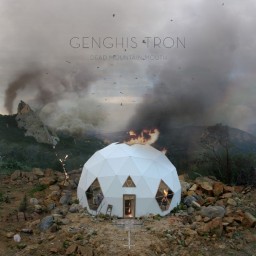
Cybergrind, eh? Yep… “What the fuck is that?” I hear you ask. Well to be honest, I couldn’t have answered that question up until the last couple of days. In fact, the only reason I can now is because I made a conscious effort to hunt down a well-regarded & pure cybergrind record for the sole purpose of finding out just what the fuck that term is referring to. I mean it sounds so absurd when you think about it. Grindcore is such a raw & organic subgenre that’s built on a complete lack of pretense & even less subtlety so mixing it with electronic music sounds on paper like it might tarnish the integrity of what the musicians are trying to achieve. But what the fuck would I know?! I’ve been proven to be wrong before so just maybe I’d be found to be wrong again. Time would tell.
The band in question are known as Genghis Tron & they’re a three-piece outfit that began life in New York in 2004. They initially put out a few EPs before releasing their debut full-length “Dead Mountain Mouth” through Crucial Blast Records in 2006. The unusual cover art doesn’t really give anything away & it’s hard not to notice how atypical it is for an album that’s loosely associated with the grindcore movement. Perhaps I should have taken that as a sign? I dunno but this record doesn’t look, feel or sound anything like any grind record I’ve heard before or since.
Genghis Tron’s musical concept is based on the cross-pollination of intense & blasting grindcore, the complexity of mathcore, abrasive & chaotic electronica & elements of a more laidback IDM sound. Kinda like Discordance Axis meets a nice cross-section of Aphex Twin’s discography. Now I know that might seem like a lot to swallow but surprisingly… it works! It certainly takes a listen or two to get used to but the production of Converge guitarist Kurt Ballou is good which perhaps helps to make it a more cohesive result than it might have otherwise been & it ends up playing like a challenging & interesting piece of art. Not everything works mind you but that’s the price you pay when taking on a hybrid of such differing extremes & the positives easily outweigh the negatives.
Will grindcore fans enjoy this record? Well…. I don’t know about that. In fact, if I’m honest, I’m not sure that the cybergrind term is entirely well suited to Genghis Tron’s music. I mean it really does go against the very basic ethos of the grindcore movement. This is clinically put together. It’s very clean. And I’m not actually sure I hear a lot of hardcore about many of the riffs either. Sure there are a lot of light-speed blast beats on offer but those are just as common in technical death metal & I hear a fair bit of that particular subgenre here with some of the more technical sections being splendidly executed & showcasing the undoubted chops that guitarist Hamilton Jordon possesses. He really does fit himself very tightly inside these programmed drum beats & it makes for a highly focused assault at times. The mathcore reference is certainly relevant though as there’s an ADD-fueled chaos about most of these tracks with sudden tempo changes & hectic arrangements being the order of the day & a reasonable amount of dissonance & abrasion being employed as a part of Genghis Tron’s standard kit bag. There are elements here that aren’t too dissimilar to bands like Converge or The Dillinger Escape Plan. Not to mention the fact that front man Mookie Singerman screams his fucking head off in a similar way to your average metalcore vocalist. You shouldn’t expect any deep death metal style grunting like is commonly employed in a lot of grindcore these days as there are none to be found here. It’s a total scream-fest.
The first half of “Dead Mountain Mouth” is where you’ll find the more blasting & hectic material & I don’t think it’s any surprise that I enjoy it significantly more than the back end of the album. In fact, the record does tend to taper off over the last four songs but thankfully the damage had already been done. The electronic component isn’t always to my taste but this is mainly due to my preferences in electronic music in general. Don’t let anyone tell you that Genghis Tron are influenced by “techno” because that’s just blatantly untrue. I was a techno DJ during the 2000’s & this material has nothing to do with the more repetitive, mechanical & spacey sound of techno. Instead, I often find Genghis Tron utilizing fast-paced electronica which is not a style I’ve ever had much time for so it’s not surprising that I struggle with some of the parts which see them jumping around & never settling into a groove for too long. There’s a little bit of quirkiness about these parts too which is not something I’m too comfortable with either but on the other side of the coin, the more restrained IDM influenced sections are some of the highlights of the record as I really enjoy the more chilled & downtempo beats that occasionally pop up.
Overall, I find “Dead Mountain Mouth” to be a challenging & engaging piece of work that doesn’t sound like anything I’ve ever heard before. It’s very ambitious but has been surprisingly successful in its quest to find a middle ground between some vastly differing influences. I think it should be praised from a purely artistic & creative point of view because, despite the obvious challenges Genghis Tron have taken on, they’ve managed to produce a highly professional & enjoyable result that will definitely surprise a few metal fans out there. The short 31 minute duration is probably a good thing too as it doesn’t allow enough time for the novelty to wear off. The question has to be asked though… is this style of music worthy of its own subgenre? Well yes, I think it probably is but not one that sits underneath the grindcore banner. It’s much more in line with the ideals & concepts employed within the industrial metal space in my opinion & I subsequently feel that it might be a better fit for The Sphere than The Horde. Still… don’t overthink it. The rewards will be plentiful for those that are will to be patient & keep an open mind.
For fans of: Agoraphobic Nosebleed, Gigantic Brain, Bologna Violenta.
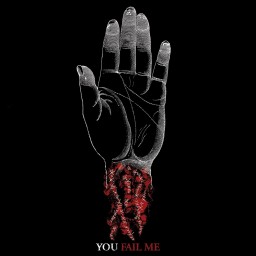
Massachusetts’ finest mathcore exponents Converge & I have had a fairly fruitful relationship over the last decade or so. I first encountered them through their 1996 sophomore album “Petitioning The Empty Sky” shortly after release & whilst I had a bit of time for it, there would be a gap of more than a decade before our paths would cross again following my extended hiatus from the metal scene. Upon returning to the passion of my youth in 2009, I quickly caught on to the buzz surrounding the band’s “Jane Doe” LP which inevitably led to me immersing myself in the rest of Converge’s back catalogue. This included the follow-up to “Jane Doe” in 2004’s “You Fail Me” which saw the band initiating a new business relationship with punk rock label Epitaph Record. Epitaph was owned & run by Bad Religion guitarist Brett Gurewitz & had built a strong reputation as a breeding ground for commercially successful punk bands like NOFX, Pennywise, The Offspring, Rancid & Bad Religion for over two decades by this stage so it was a move that opened up opportunities for a hardcore-based band like Converge. “You Fail Me” would also be the band’s first album as a four-piece following the departure of guitarist Aaron Dalbec who was asked to leave after the band & their management became concerned with Aaron’s increasing focus on his hardcore punk side project Bane.
Epitaph would recruit experienced producer Alan Douches to produce “You Fail Me” in partnership with Converge guitarist Kurt Ballou & the result seems to have received mixed responses from what I’ve read online over the years. In fact, Ballou has openly stated that he felt the original mix was lacking something & put that down to engineer Matt Ellard’s lack of comfort & familiarity with the mixing desk he was asked to use & also having to battle through consistent power failures throughout the process. I’m not sure if the Spotify version I’ve been listening to this week is the one that was later remixed by Ballou & remastered by Douches for the 2016 “redux” edition or not but I certainly don’t have any problems with how it sounds. On the contrary, it’s a perfect representation of where Converge were at at this particular moment in time. The separation between the instruments is spot on & each band member receives a clarity & brightness that hasn’t always been afforded to metalcore bands over the years. There’s enough crunch to crush the listener under the weight of the heavier moments but enough subtlety to ensure that the nuances of Converge’s newly stripped back sound are also highlighted. The rhythm section sound particularly impressive in my opinion so there’s very little to complain about in this regard.
It’s interesting to see how Converge have developed their sound in the three years since Jane Doe & I’d be keen to hear how much the band members feel the new label & line-up have contributed to that. This is an extremely professionally put together package & it shows a newly found maturity in the band’s song-writing skills with a number of fresh ideas being presented with universally successful results. The four-piece lineup seems to have had some sort of impact on the direction of this material as it’s noticeably less dense & more stripped back than its gargantuan older brother “Jane Doe” & there’s also a fair bit more melody on display. Short opener “First Light” is a prime example of Converge’s exciting new approach with its atmospheric unaccompanied guitar work openly paying homage to Neil Young’s “Dead Man” soundtrack; a beautifully atmospheric record whose wonders I’ve basked in repeatedly for more than two decades now. The next track “Last Light” would also hint at the themes presented in the opener to great effect. Then we also get lengthy acoustic track “In Her Shadow” in the middle of the album; an experiment that has inevitably caused great divide amongst long-time fans. Personally, I think it works to break the record up nicely with its post-rock feel even hinting at psychedelia at times. But never fear all you metalcore fans, there’s more than enough heavy stuff included to satisfy your crazed thirst for rabid mosh-pits. My personal favourite is the gigantic title track which sees the band going for a sludgier approach driven by Nate Newton’s huge bass sound. Its use of repetition to build tension works brilliantly & I think it’s one of the best moments in Converge’s career overall. But “You Fail Me” also sees Converge returning to their hardcore punk roots more regularly than they did on “Jane Doe” & unsurprisingly those moments are the ones that appeal to me the least on the album (see “Eagles Become Vultures” for example). But, impressively, there are no genuinely weak tracks included here & it’s hard to argue with the band’s status at the top of the mathcore/metalcore tree.
Converge were a class act at this stage in their careers & everything is presented with purpose & precision & (even though metalcore isn’t my subgenre of choice) I find it hard not to really dig everything this band touches. The consistency in this material is almost intimidating to be honest. A lot of these tracks blur the lines between mathcore & traditional metalcore with the technicality that was so obvious on “Jane Doe” being more subtly utilized but no less impactful here; another a sign of the band’s new-found maturity. It sounds like Converge are more focused on song-writing & artistic expression rather than simply pulverizing the listener into submission or amazing their audience with their undoubted techniques. There’s an increased level of precision about everything they do & it makes the techier arrangements sound so fluent that it would probably be pretty easy for the more complex arrangements to fly straight over the untrained listener’s heads. This band is so talented & virtuosic by this stage that it’s almost embarrassing. Drummer Ben Koller is the clear highlight for me personally though & I regularly find myself having to pick my jaw up off the ground after those high-speed snare rolls he specializes in. What a band!
Front man Jacob Bannon’s vocal performance is a little different to what it was previously. The lyrical content is all about human failure & he uses a variety of techniques to get his point across. Personally, I’ve always found him to be the least appealing aspect of the band & that doesn’t change here. It’s mainly his more aggressive moments that I struggle with. His trademark shrieks of raw vitriol often sound like he’s spitting his lyrics out through a mouth-full of phlegm & he doesn’t possess the strength & power of many of his contemporaries. In fact, I often wonder if it’s Bannon’s contributions that leave me seeing my scoring of Converge albums being limited to the three & a half’s & four’s but I usually end up deciding that it’s more of an overall stylistic thing as no matter how good Converge are at their chosen craft, I’m not too sure they’ll ever manage to get me reaching for the higher scores.
Overall, “You Fail Me” showcases an extremely talented group of musicians flexing their creative muscles & continually pushing themselves artistically, musically & technically. It’s a more accessible record than “Jane Doe” was but its impact is felt in different & more subtle ways. I admire this album as a musician & a lover of music & it may just have been Converge’s best release to the time in my opinion.
For fans of: Botch, Drowningman, The Dillinger Escape Plan.
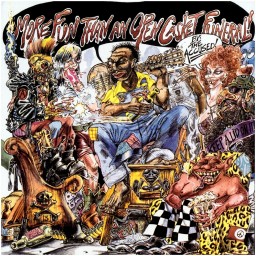
My awareness of Washington-born (& later Seattle-based) crossover thrash outfit The Accused began when I was still enduring the early years of high school back in the late 1980’s. I was a cocky young long-haired metalhead attending a school that wasn’t particularly conducive to extreme forms of music so I was forced to actively seek out alternative avenues for identifying new bands & that often meant finding ways to infiltrate social networks within older age brackets than my own. There was a group of skateboarders that were into thrash in the year above me & looking back now I find it pretty amazing just how many of the great metal bands of the day I was introduced to through them (either directly or indirectly). Given their past-time of choice, it probably won’t surprise many of you to hear that these skaters were just as passionate about crossover thrash bands like Suicidal Tendencies & DRI as they were for your more traditional thrash sound. And needless to say, The Accused would be one of the many bands that I would first experience through cheap dubbed cassettes that were sourced for me through friends of these particular skaters. From memory, I think I lost my Accused virginity through the band’s 1986 debut album “The Return of... Martha Splatterhead” which I’ve only recently revisited & found that I still have a lot of time for however 1987’s “More Fun Than An Open-Casket Funeral” album had less of an impact on me back in the day so let’s see if age & maturity has seen my appreciation of it grow over the last three decades.
First impressions show the production job to be a noticeably improved on the extremely dirty way the band was presented on “The Return of... Martha Splatterhead”. There’s still an obvious rawness here but it’s nicely balanced as far as clarity & overall brightness goes. It’s hard not to notice that the drum kit is a little unbalanced though. Not to mention the fact that the toms & kick drum sound a bit loose & flabby. Initially I found this to be a little annoying but repeat listens saw me becoming acclimatized pretty quickly so it’s not a major concern. The rhythm guitar sound definitely has a foot in both camps as far as metal & punk go & I think it suits The Accused’s sound nicely while the solos could do with a bit more definition to them (perhaps this was intentional?).
I would imagine that front man Blain’s over-the-top vocal delivery is probably an obstacle for some would-be fans but I find him to be reasonably tolerable most of the time. He certainly can’t be faulted for lack of effort, that’s for sure. In fact, I think he suits The Accused’s more frantic thrash & crossover songs very nicely to be honest... even if he does sound like he’s trying to swallow his own head lot of the time. On the instrumental side of things though, “More Fun Than An Open-Casket Funeral” is a bit of a mixed bag. I remember “The Return of... Martha Splatterhead” being a little more consistently focused on a high-velocity crossover sound which was heavy on the hardcore side of the equation while here The Accused seem to be going for an each way bet with a fair chunk of this material sounding more like traditional thrash metal than it does crossover (see “Halo Of Flies”, “Lifeless Zone”, “Scotty”, “Bethany Home” & “Mechanized Death” for examples). The opening track "Halo Of Flies" even starts off with two riffs that are blatantly ripped off from Slayer's "The Final Command" & Kreator's "Command Of The Blade" respectively. During those thrashier moments it’s only the crazed, punk-driven vocal stylings of Blaine that remind you of The Accused’s hardcore pedigree. Then, on the other side of the coin we have four straight-up hardcore punk tunes in “Judgement Day”, “Splatter Rock”, “Septi-Child” & the God-awful cover version of Cliff Richard’s “Devil Woman”. Unfortunately The Accused have also elected to throw in a few additional curve balls like short bass solo “S.H.C.” & closing banjo ditty “I’ll Be Glad When You’re Dead” to keep the listeners on their toes. I’m very much against novelty tracks & the few we get here are all pretty much disposable which inevitably tarnishes my impressions of the overall album.
The most frustrating thing about “More Fun Than An Open-Casket Funeral” is that it starts out so strongly but fades so badly in the back end. The first five tracks are arguably the best of the fourteen included with the first two being the clear album highlights (particularly spectacular crossover thrash tune “W.C.A.L.T.”) so you’ll rarely find a better example of a top-heavy album. It’s probably not a big surprise that the earlier tracks tend to focus entirely on thrash & crossover. As I’ve mentioned in countless reviews in the past, I’m not the biggest fan of hardcore so it’s no surprise that I only find one of those punkier tunes to be very interesting. There’s a lethargic feel to a couple of them that’s in direct contrast to the urgency & electricity of The Accused’s crossover material which is where I think they’re at their best. So overall I find this to be a disappointing release that was a clear step down from the more consistently raw & youthful energy of the debut.
For fans of: DRI, The Exploited (1990's), "Animosity"-era Corrosion of Conformity.
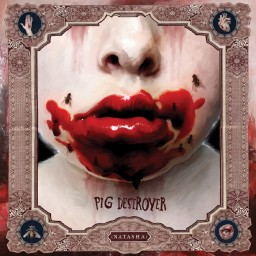
You may have noticed that I recently revisited 2004’s “Terrifyer” album from Washington-based grindcore trio Pig Destroyer; a record that I’d missed at the time of release but cottoned on to five years later & have thoroughly enjoyed ever since. I had originally secured “Terrifyer” in a digital format which included an immensely epic 32 minute bonus track known as “Natasha” in accompaniment; a piece that I regarded as not only an essential part of the release but also the clear highlight. In fact, it was actually that track that elevated my opinion of “Terrifyer” from a very solid & enjoyable grindcore record to a true classic of extreme metal so I’ve always regarded it as a part of the full album experience. But when I returned to “Terrifyer” through Spotify last week, it became immediately obvious that it was missing a key component. That’s right ladies & gentlemen! “Natasha” was nowhere to be found. Apparently the bonus track had been cut for subsequent reissues & I soon discovered that it had been awarded its own release as a single-track E.P. in a slightly extend 37 minute format in 2008. This left me pondering for some time over whether to include it under my “Terrifyer” review or not. I mean I hadn’t known the album without it & it had made such a major impact on me at the time. But I eventually decided to omit it & conduct this separate review of the “Natasha” E.P. as I feel that it’s definitely a very different beast to the proper album. Of course, this led to my scoring being slightly lower for “Terrifyer” but it just seems more appropriate.
For those that are familiar with Pig Destroyer’s grindcore pedigree but haven’t had the pleasure of experiencing “Natasha” as yet, please erase all preconceived notions of what you’re potentially in store for because this particular track sounds absolutely nothing like any of their albums. In fact, it’s very clear as to why the band felt the need to separate it from their proper albums as it was always destined to alienate some fans. “Natasha” sits in direct contract to the band’s short one minute blasts of energy & aggression & prefers a beautifully drawn out & slowly enveloping ambient approach that I find to be considerably more appealing. And when I say ambient, I MEAN ambient because a good portion of this release can be described as legitimate ambient music & some very high quality ambient music at that. As a long-time fan of that particular genre, I can tell you that Pig Destroyer have absolutely nailed the art of creating an atmosphere through the use of sounds, synths & samples & right from the very start I feel myself being swept off to a dark & eerie place where I’m enveloped in a shroud of menace. Despite the lengthy & drawn-out arrangement, there is never a hint at boredom & the composition has been perfectly tailored to accentuate the highlights & leave me feeling that this is the fullest realization of the concept the band took into the studio. When the guitars & drums finally chime in, I experience an all-encompassing feeling of power & realise that I’m amongst kindred spirits.
The production job on “Natasha” is nothing short of phenomenal & is spot on for this style of music. When you really break it down, this track is a series of different ideas that have been joined together to create a whole that’s clearly greater than the individual parts. Many of the segways between these parts really shouldn’t work either. Sometimes you’ll get a heavy riff section simply being faded out & a more ambient section faded in but the timing is absolutely spot on & it’s done with such professionalism that it seems entirely appropriate. The guitars & drums couldn’t be more crushing & if there’s not a bass player here then the producer has done a stellar job at beefing out those guitars. The stereo spectrum has been fully utilized which shouldn’t be a surprise as the track was always intended for a 5.1 surround sound DVD release (which is the format it originally came in when included with “Terrifyer”).
“Natasha” has nothing whatsoever to do with grindcore. It utilizes a number of different subgenres across its lengthy duration but its basis is in doomy sludge metal & a number of slow dirging riffs can be heard scattered evenly across the tracklisting. The earlier parts have a definite Godflesh feel to them (minus the industrial element of course) while the unaccompanied riff towards the middle of the track is a lot dronier & wouldn’t be out of place on an early Earth record. There’s a definite post-metal sensibility about how the whole thing is constructed that brings to mind the likes of Neurosis though with the ambience out-weighing the metal for the most part. I feel that Swans have been a definite influence on Pig Destroyer in this regard (particularly during the gorgeous female vocal section) & that synth-driven period two-thirds of the way into the piece is simply breath-taking in its ethereal splendor. But never fear all you extreme metal fans! The doomier sections are absolutely soul-crushing with drummer Brian Harvey contributing the perfect accompaniment to fully accentuate the overall heaviness of Scott Hull’s guargantuan riffs.
Interestingly, those of you that have already read my review of "Terrifyer" would be aware that J.R. Hayes' vocal delivery wasn't exactly my cup of tea but here it's a completely different story. Hayes offers much more variety with a number of different approaches being employed from whispered spoken word to a tortured & mournful style that reminds my of early 90's Anathema to a more aggressive & vicious delivery that sits somewhere between Ministry's Al Jourgensen & hardcore punk. So essentially we've seen J.R. expanding on Pig Destroyer's overall appeal levels for me & in the process becoming a tool to further enhance the atmosphere the band are trying to create. His vocals are by no meaning over-used though as they're used fairly sparingly compared to your average 1-2 minute blast-fest.
I can’t express how effective this all is. In fact, not only does “Natasha” hold its own against the elite releases from the sludge/doom metal subgenres, it actually surpasses the vast majority of them. And listening to it as an isolated release in its own right (i.e. without the blasting 32 minutes of grindcore in front of it) has only further enhanced its artistic grandeur. To say that “Natasha” couldn’t possibly be more suited to my tastes & interests is an under-statement. It’s pretty much the sum of all of the things that I love about organically created music & I regard it as one of very few metal records that are truly perfect. Make no mistake, “Natasha” is one of the most underrated records I’ve ever come across. It’s a genuine classic & should by all rights be place on a pedestal as the highlight of Pig Destroyer’s career to date.
For fans of: Thou, Grief, Harvey Milk
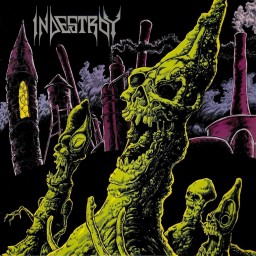
Maryland four-piece thrashers Indestroy first formed under the moniker of Fatal Sin in 1983 before renaming themselves three years later. Their musical career would be a relatively short one with just 1987’s self-titled full-length & 1989’s “Senseless Theories” E.P. seeing the light of day before they’d call it quits in 1990, just in the nick of time with the grunge movement about to throw a big cat amongst the thrash metal pigeons. My only personal exposure to Indestroy came through the self-titled album several decades ago now but it clearly didn’t make a huge impression on me as I don’t believe I ever entertained the idea of tracking down the E.P. afterwards.
Indestroy’s debut was released through New Renaissance Records in 1987; a very busy extreme metal label that would also release records from bands like At War, Wehrmacht, Dream Death, Necrophagia & Blood Feast within just a two year period. New Renaissance was a fairly low budget venture though & inferior production jobs were par for the course so you shouldn’t go into “Indestroy” expecting a bright & vibrant sounding album. On the contrary, the sound production would be the most disappointing element of the record with the rhythm guitars being too low in the mix & a noticeable lack of high end throughout. Jeff Parsons’ bass guitar sounds nice & full but the riffs aren’t given the chance to fully showcase their wares which limits the appeal of an album that’s really been built around them. I guess we shouldn’t be surprised though given New Renaissance’s track record & the fairly minimal level of experience of producer Chris Kozlowski who hadn’t produced a metal release of any note at that stage as far as I’m aware. It’s actually pretty hard not to let this element of the album dictate the scope of its scoring potential to be honest & I think that there’s a definite possibility that I might have reached for a more favourable rating had the sound quality been decent.
From a technical point of view, Indestroy were more than capable musicians & composers. In fact, the riffs possess a level of sophistication & complexity that wasn’t often seen in extreme metal at the time & it was clear that the band knew what they were doing. There’s certainly a looseness to the performances but it’s nothing that wouldn’t have been ironed out by a decent producer & production budget. Surprisingly for a low-profile debut like this, the guitar solos of Drew “Blood” Adrian are actually really shredding & show him to be a more than capable guitar hero. I actually find the lead work to be the highlight of the album as it adds some excitement to a set of songs that had great potential but are held back by the sluggish production. Rhythm guitarist Mark Strassburg’s vocals are the other career limiter though. His delivery is inconsistent & he doesn’t sit well in the mix on some tracks. During his better moments he sounds quite similar to Megadeth’s Dave Mustaine but at other times he sounds a little immature to my ears & I think Indestroy may have been better served by a dedicated front man.
Musically, Indestroy cover several subgenres across the tracklisting. The basis for their sound is built on US thrash metal with Nuclear Assault, early Exodus & particularly “Killing Is My Business… & Business Is Good!”-era Megadeth seeming to be the primary sources of inspiration behind tracks like “The Gate”, “Fatal Sin”, “Brain Damaged” & “Shadowlord”. During their shorter & more aggressive numbers like “U.S.S.A.”, “Dead Girls (Don’t Say No)” & “Dismembered” however, the band sounds a little closer to speed metal with a bit less complexity to the riffage. Then there are slower & less intense tracks like “Ground Zero”, “Justice Sucks” & “A.I.M.L.E.S.S.” which take a more measured & traditional heavy metal approach so the album certainly isn’t lacking in the variety department. I find that the bassy production & general ambition in some of the song-writing often reminds me of Danish heavy metal masters Mercyful Fate which is quite a compliment but the most obvious influence is clearly early Megadeth who also sported an impressive level of complexity for the time. Album highlight “Fatal Sin” is a obvious example of this as it’s clearly trying to emulate the class & prowess of Mr. Mustaine & his cronies.
Overall, I find Indestroy’s debut to be a frustrating experience. I mean there’s enough evidence presented here to suggest that there’s a more than decent album hiding in there somewhere. All that was needed was an experienced metal producer to draw it out. As it stands though, I don’t think I’ll be returning to “Indestroy” any time soon as (despite the best efforts of the instrumentalists) the product just sounds inferior. The B side also sees the quality of the song-writing fading noticeably which leaves me feeling a bit flat afterwards. It’s hard to overcome that feeling by remembering the stronger first half after sitting through the last four tracks which are all pretty lackluster. You get the feeling that the next release from the band could have been really good though as the groundwork had been completed here & all that’s required are a few tweaks so perhaps it might be worth checking out the subsequent E.P. to see if that ended up being the case.
For fans of: Nuclear Assault, Exodus, early Megadeth
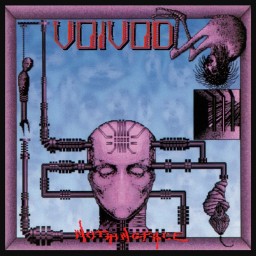
It’s quite alarming to think that my relationship with the unusual Canadian metal institution known as Voivod is now pushing out past the three decade mark but their 1989 album “Nothingface” was where it all stems from. I can vividly still recall my first encounter with the band. It was through a late-night radio program around that 1989/90 period & the song in particular was the opening track “The Unknown Knows”. I’d read a little bit about Voivod through articles in metal magazines but this particular track didn’t sound like any metal I’d heard before & I wasn't entirely sure what to make of it at first. But I used to tape all of these underground radio programs as they were only on once a week & I’d give them repeat listens for the next seven days. I’d even keep the best songs on mix tapes that I’d make up. Needless to say that there was something about that song that kept me coming back even though it took me well outside of my comfort zone & I think that sums up the “Nothingface” album in a way too.
Voivod had begun life as a rough & ready speed metal outfit in the early 80’s with their influences ranging from Motorhead & Venom to hardcore punk with a little progressive rock thrown in for good measure. I didn’t mind their first two albums but things really started to take off when they began expanding on their prog rock influences & in doing so they created the critically acclaimed & seminal “Dimension Hatross” album in 1988; a record that had a particularly large impact on me personally. But 1989’s “Nothingface saw Voivod’s transition being completed with the band finally having reached a sound that was completely on the other side of the musical spectrum from where they first began.
The production job on “Nothingface” is exceptional. Music this complex & dissonant requires a level of audio quality to be fully appreciated & producer Glen Robinson has done an excellent job at representing the nuances of what Voivod were trying to achieve here. Piggy’s dissonant guitar riffs are always beautifully defined while bassist Blacky offers just the right balance of grit & clarity whilst filling out the bottom end & front man Snake sits in a nice little niche all of his own. The overall balance & separation is excellent throughout & it’s hard not to compare it to the noisy mess that made up Voivod’s 1986 sophomore effort “Rrröööaaarrr”.
Voivod have always been affiliated with the thrash metal movement but I have to admit that I’ve never been comfortable with that association to be honest. Their first two records hardly contained a single thrash riff & I’m much happier to describe them as dirty speed metal from a theoretical point of view. Those speed metal roots would become progressively more diluted with each effort though & “Nothingface” represents somewhat of a climax in the band’s musical & artistic development. Snake’s vocals take a cleaner & slightly quirky direction as he’s now completely dropped the abrasive edge of his early days. He still sounds a little bit wacky though. Kinda like he could be a combination of Faith No More’s Chuck Mosley & Mike Patton. His delivery won’t be for everyone but I think he suits the unusual sound that Voivod were pushing at this stage in their career. Guitarist Piggy has always had a unique & noticeably dissonant sound built on Motorhead & punk rock but his ability to take that into new & progressive territory without ever sounding like he’s losing control is a real highlight. His guitar solos are perhaps more sporadic than in the past but when they have their time in the sun they generally offer something fresh & interesting from a melodic point of view. I could argue that Piggy’s ALWAYS been the highlight of Voivod’s sound but that would be down-playing his band-mates a little more than I’m comfortable with. And besides, the performance of bassist Blacky is nothing short of phenomenal here as he’s stepped out into waters that are generally reserved for the elite musicians of the prog rock spectrum. Particularly Chris Squire of Yes. In fact, I’d go so far as to say that it’s Blacky’s contribution that leaves the most lasting impression on me here.
Most fans would readily admit that “Nothingface” was the least metal & most light-weight album that Voivod had released to the time but I’m gonna go one step further & suggest that what we have here is no longer a metal release at all. It fits much more comfortably alongside the great works of King Crimson, Rush & Yes than it does the elite progressive metal releases. For starters, the guitar sound & style is completely devoid of palm-muting & the tone is much more akin to that of punk rock. The tempos are substantially more laid back than the band’s more ferocious earlier works & there’s nothing too intimidating about the overall atmosphere. There’s also a weird & adventurous feel to the music that I relate to bands like Mr Bungle (who were more than likely influenced by this record) & a less obvious but still apparent alternative element that makes me think of a band like Jane’s Addiction. It’s exhilarating stuff really & even though I don’t find any of this material to be genuinely classic, even the weaker tracks keep you on the edge of your seat in anticipation of what strange direction Voivod will take off to next. There’s a lot of talk on the internet about how ridiculously complex & technical “Nothingface” is too but that’s not exactly true when you put it into a prog rock context. The changes don’t sound forced & I never feel that the band are simply throwing out technicality for the sake of impressing despite the clear abundance of skill on offer. But what this added complexity does when combined with the quirky vocal approach is make Voivod's product less accessible & despite being a noticeably lighter Voivod record, there’s no suggestion that “Nothingface” is a sell-out. It’s still an extremely challenging record as you won’t find any hit singles amongst this lot.
A lot of the album’s marketing has been focused around the cover version of Pink Floyd but people need to remember that “Astronomy Domine” was taken from Floyd’s more psychedelic debut album rather than their radio-friendly mid-70’s to mid-80’s heyday & it’s a very good example of the cover version too. Some people seem to think that it interrupts the flow of the album but I disagree. If you forget that it’s a cover & simply listen to the music then I find that it works in the overall context of the tracklisting & is in fact one of the highlights of what is a very consistent album. There isn’t a weak track included although I have to admit that I don’t see a genuine classic here either & the high quality fades a little over the last three tracks which are still quite interesting but lack the hooks of the earlier material.
Overall, “Nothingface” is more of an intriguing record than a classic one in my opinion. It may not be a match for Voivod’s genuinely amazing “Dimension Hatross” album from the previous year but it’s certainly a worthy addition to any collection & I rate it comfortably more highly than the band’s early speed metal works.
For fans of: Rush, Yes, Mr. Bungle
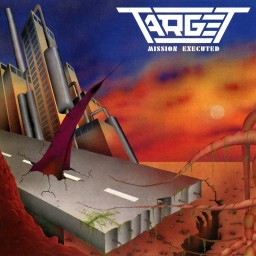
The tale of Belgian thrash metallers Target is only very short but it’s one that deserves to be heard amidst the wealth of unheralded underground thrash stories that have been lost in the annals of time since the genre’s heyday in the mid-to-late 1980’s. I first became aware of Target through tape trading in the early 90’s & remember being quite a fan of both of their late 80’s albums. Sadly, the band wasn’t destined for a long career though & would disintegrate by the time the 90’s rolled around. This is perhaps not such a bad thing for a thrash band given what most of their peers would go through during the grunge years it has to be said. But let’s start with Target’s debut album “Mission Executed” which drifted past most extreme metal fans radars without much fanfare amidst the peak of the thrash metal movement in 1987.
The album cover for “Mission Executed” is a typically low budget affair that wasn’t exactly going to instill faith in the casual consumer. It looks a lot like some of those ironically put together retro synth wave covers that are floating around these days & you wouldn’t know that what you were in for was a thrash metal record from the look of the sleeve. Given the climate at the time where most record-buying consumers had to take a punt on releases based on word of mouth or the attractiveness of the album cover, it’s not surprising that Target struggled to gain traction. It would have been interesting to see whether they would have been more successful had they had access to the sort of cover art that bands like Kreator were thriving on at the time but I guess we’ll never know.
The production job on “Mission Executed” seems to have copped a little bit of flack from online reviewers over the years but I have to say that I can’t see where those comments are coming from. Perhaps I’m listening to the remastered version which is apparently much better? I’m not sure but the guitars are rip-roaring & the drums pounding in all the right areas with front man Guy Degrave given lots of room to move so there are no complaints from me in this department. I particularly love the rhythm guitar sound which is nice & raw with a metal as fuck attitude running straight through its core. It certainly adds to the intensity of the band’s sound.
The delivery of vocalist Guy Degrave sits somewhere in the realm of your classic American thrash front men like Metal Church's David Wayne or Overkill’s Bobby Blitz rather than the more raspy European model. He possesses more than enough balls to make sure that Target’s heavier moments sport a suitably violent accompaniment but can also tackle some more melodic & traditional heavy metal moments without causing a detrimental effect. I really like him although there are a few examples of him overstepping his mark in the theatrics here & there. The twin guitar attack produces an absolute riff-fest though & any thrash fan should find more than enough to bang their head to here. The barrage of riffs are superbly accentuated by drummer Christ Braems who is the highlight of the album in my opinion. He was clearly very well versed in the finer points of thrash drumming because he makes every post a winner here in ensuring that Target receive every last drop of value out of some already high quality riffs. The guitar solos of Lex Vogelaar & Franky Van Aerde seem to get a lot of praise in other reviews but while they’re certainly serviceable I wouldn’t go so far as to say that they add a lot to Target’s music. They just seem to be an excuse to chuck a bunch of notes together without much thought of constructing any sort of sub-plot to the main storyline.
Target generally seem to be lumped in with the small group of bands that make up the technical thrash metal subgenre but their debut doesn’t really ever produce the sort of complexity required to fit the mould to tell you the truth. It’s much more aligned with the traditional thrash metal model that their American counterparts had cut their teeth on & you can easily hear the influence of bands like Slayer & Exodus. But as the album progresses you’ll likely also pick up on elements of your classic heavy metal sound being borrowed. I’d suggest that these influences are generally coming from the US power metal scene though as there’s still a noticeable crunch to the riffs that was more in line with the bands that fell somewhere in between heavy metal & thrash metal like Metal Church or early Laaz Rockit. You’ll also get a little speed metal thrown in here & there with some simpler & more melodic up-tempo material included on occasion but overall you’ll be left with little doubt that Target were a bunch of passionate thrashers & they were at their best when they were at their most unrestrained & aggressive.
“Mission Executed” gets off to an absolutely stonking start with the opening two tunes “Mission To The Andes” & “Hordes of Insanity” being genuinely classic European thrash metal anthems that fit right smack bang in the middle of my comfort zone. In fact, upon my first revisit last week I got quite excited, thinking that perhaps I’d uncovered an unheralded underground classic that I’d been forgetting about for all these years. But the quality certainly drops off after that initial onslaught & the music gets a touch less trashy for a couple of tracks. These are still very enjoyable mind you. Just not at the same quality as the earlier numbers. It’s interesting that Target’s less impressive output tends to match up with the songs where they haven’t quite nailed the song structures. They’ll sometimes extend the segways further than they needed to or try to include too many riffs in a song for the sake of it. But there are no real failures here because Target are a class act & the quality & professionalism of their music is able to get them by even during these less impressive periods. Closing track “Death Blow” is a great way to end proceedings & you’ll rarely hear a better instrumental track on a thrash record.
I have to say that I’ve been pleasantly surprised by “Mission Executed”. This is one high quality thrash record that’s been criminally overlooked in favour of a significant amount of inferior product, especially in the European market. I highly recommend you give it a few spins if you’re serious about your thrash.
For fans of: Deathrow, Metal Church, Flotsam & Jetsam
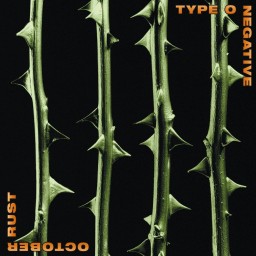
By the time 1996 rolled around I’d been aware of Brooklyn-based gothic doom merchants Type O Negative for several years already. My de-facto partner had been a huge fan of the band so their albums (particularly 1993’s “Bloody Kisses”) had gotten regular spins around the home we shared together. However that relationship came to an abrupt end under the worst possible circumstances just before the release of their fourth studio album “October Rust” & it sent me spiraling into the most difficult time of my life thus far as I tried to recover emotionally. So you can imagine that listening to a new Type O Negative album wasn’t exactly something that was high on my priorities list at the time. Particularly given the early reports that it was the band’s most commercially accessible outing yet & the evidence of the poppy single “My Girlfriend’s Girlfriend”. But when a good mate at work (who wasn’t a metalhead by any stretch of the imagination) pushed me to give it few spins after becoming somewhat obsessive about it I was left with no choice but to do so, if only to appease his continuous hounding. And boy was I glad I did because not only did I find “October Rust” to be a stunningly addictive record but it somehow managed to significantly assist me through the emotional turmoil I was going through.
Type O Negative have always had a very strange sense of humour & the start of “October Rust” is a prime example of this. The first 38 seconds of the album is made up of the sort of amplifier hum that’s produced when you pull the cable out of your electric guitar with your amplifier left on. It’s meant as a joke but it’s a long way from funny. It’s just a waste of time & space really. Then an even worse artistic decision follows with the band members expending one of the most pointless 21 second periods of my life in verbally thanking me for buying the record. No worries guys but can we get on with some fucking music now please?? If we skip right to the end of the album, the final untitled 9 second track is also a spoken-word thank you from Peter Steele & these musical missteps almost lead me to believe that Type O Negative have intentionally tried to self-sabotage their appeal. I mean what other conceivable reason can there be for this sort of misguided self-indulgence?? Thankfully though, the rest of this lengthy album (it totals a duration of 73 minutes) is made up of legitimate songs & some extremely high quality ones at that.
In a word, the production on “October Rust” could best be described as glistening. The band have incorporated a number of new elements to create a more expansive & ultimately more attractive & marketable product with Josh Silver’s use of synthesizers filling out, complimenting & enhancing Type O Negative's dark metal sound throughout. Kenny Hickey’s guitar sound is particularly fuzzy & distorted with a noticeable reliance on chorus FX & it works to become a huge unified beast when combined with Peter Steele’s impressively thick & heavy bass sound. The use of melodic vocal harmonies has the potential to isolate those of us that are averse to a bit of cheese but it’s done in such a tasteful & professional manner & the hooks are of such a high quality that it’s very hard not to be drawn in for the long haul.
Steele’s performance on the album is pretty phenomenal to be honest. His vocals are as deep & powerful as any he delivered in his career & they really suit the newly developed Type O Negative sound. It’s not hard to recognise the influence of gothic rock bands like Sisters Of Mercy on his style here & that’s a theme that runs through other elements of the album too. In fact, many of the melodic instrumental bridges scattered across the tracklisting appear to have an obvious connection to The Cure & it works beautifully. Peter’s bass playing is also a highlight with a post-punk influence being consistently visible in many of his bass lines. Again, this is perfectly amalgamated with the doomier sound that Type O Negative were previously known for & this diverse range of influences is one of the real strengths of “October Rust”.
Sadly, there are a couple of weaker songs included. The popular single “My Girlfriend’s Girlfriend” is much too quirky & commercially focused for my liking while the cover version of Neil Young’s “Cinnamon Girl” was a strange choice indeed. But thankfully these two blemishes are amongst the shorter tracks included with most of the other tracks exceeding the five minute mark. There are still a multitude of highlights to choose from with a good two thirds of the tracklisting falling into the classic category. Most of the material lies firmly within the realm of gothic metal but, as with many bands associated with the subgenre, the band’s doom metal roots are never too far off with tracks like “Red Water (Christmas Mourning)” & “Haunted” presenting some of the most depressively dreary & majestically heavy riffs we’d heard from Type O Negative to the time. It’s really interesting though that I often find myself thinking of early 80’s new-wave & pop bands like Duran Duran, Simple Minds & Tears For Fears when I hear the lush synth-driven melodic content & vocal harmonies that have been integrated into many of these songs. That might sound horrible to most metalheads but trust me when I say that it’s a big positive & one of the key elements that makes this release so unique.
Strangely, “October Rust” not only left me enamored with its hooks for weeks (if not months) on end but it also managed to help me recover from some extreme emotional trauma even though it should by all rights have been some sort of reminder of the root cause. In truth, I don’t think that would have been possible if Type O Negative hadn’t taken a fresh approach as it would have been too easy to link the album with my past experiences with the band. But even if I put my past aside & listen to “October Rust” with fresh ears in the modern day, I find that I’m often left in awe of its ability to balance sheer depressive heaviness with insanely beautiful melody. Sure there are a few misfires on offer but that’s Type O Negative for ya & the peaks here are astronomical. This is essential listening for fans of gothic metal.
For fans of: Moonspell, Paradise Lost, Tiamat.
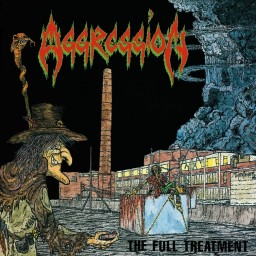
Canadian crossover thrashers Aggression are a four-piece outfit who formed in Montreal in 1984 & are still around today as far as I’m aware. They’ve released a number of albums over the years but the only one that I’ve ever come into contact with is their 1987 debut full-length “The Full Treatment” which is the subject of today’s review. It seems to be their most well-known release but they’re hardly a household name within the underground thrash community.
There’s one major flaw with “The Full Treatment” & it hits you immediately upon pressing play so we might as well get it out of the way early. The cavernous & murky production job on this record leaves a lot to be desired with the rhythm section dominating the mix & leaving the rhythm guitars struggling to be heard a lot of the time. It reminds me of NME’s “Unholy Death” or Voivod’s “Rrroooaaarrr” in its inaccessibility actually. Both are records that have their appeal limited not by the music being produced but by the packaging they’re presented in. Perhaps “The Full Treatment” doesn’t suffer quite as much as “Rrroooaaarrr” does in this regard but it takes some getting used to. Especially if you put this record on immediately after listening to Queensryche like I’ve done on this particular revisit.
From a musical point of view Aggression is generally regarded as a thrash metal band with crossover tendencies however I’d argue that there’s easily enough crossover here for the term to be employed in a full-time capacity. In fact, Aggression try their hand at a variety of different approaches on “The Full Treatment”. On the one hand you’ll hear ultra-aggressive straight-down-the-line thrash metal tunes in the vein of classic Dark Angel (“Frozen Aggressor”, “Dripping Flesh”, “Rotten By Torture”, “The Final Massacre”) but then other tracks like “One For The Woods” & “Demolition Of Your Face” feel a lot closer to a pure hardcore punk sound than a metal one. Brilliant opener “Forsaken Survival” reaches a clear compromise that sits comfortably under the crossover thrash tag while “Green Goblin” & “The Reaping Hook” actually take things a lot further in the intensity stakes with a total thrashcore approach being employed complete with impressive blastbeats. Early UK grindcore exponents Unseen Terror come to mind on these occasions.
As is commonly the case with me, I find the straight-up hardcore tracks to be tough going. I’ve never been much of a punk fan & these tunes aren’t gonna change that however the more brutal thrash material is often exhilarating & it’s a shame that a few of these tracks seem destined for greatness early on only to run out of steam as the tracks progress (see “The Reaping Hook” or “Dripping Flesh” for example). Vocalist Pierre "Cactus Pete" Fleurant is the ace up Aggression’s sleeve though & it’s his hate-fueled yet charismatic delivery that represents the band’s strength. Just listen to the pure anger he displays on opening track “Forsaken Survival” which takes your expectations & firmly stuffs them back down your neck. I fucking love that tune! It’s by far the album highlight & is up there with the greatest achievements for Canadian thrash overall in my opinion. It’s just a shame that it sets a standard that the rest of “The Full Treatment” fails to live up to. That’s not to say that the remainder of the album is full of failures though. The two tracks that follow it are also pretty enjoyable but things descend rapidly from there with a noticeable mid-album lull only being recovered by the high quality thrashfest that is “Rotten By Torture” towards the end of the album. Ambitious eight minute closer “The Final Massacre” takes a slower direction but it doesn’t quite work in my opinion with its riffs sounding a little generic & flat.
So “The Full Treatment” is a bit of a mixed bag to be honest. I only really find myself enjoying half of this material however there’s enough quality there to carry the weaker tracks & make the album worth exploring. The passion & authenticity in Aggression’s music is undeniable & I think those elements might be the primary reason for me having scored the album so favourably despite all of its failings. I mean even the tracks that I don’t like have parts that kick my ass in some capacity so you can rest assured that relief is never too far away.
For fans of: early Slaughter, “Darkness Descends”-era Dark Angel, Cryptic Slaughter
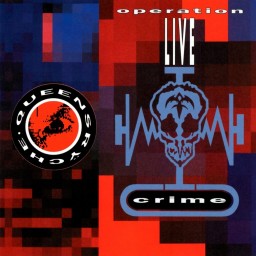
Aaaaahhhhhh… the old album-performed-in-its-entirety live album debate, eh? Some people love ‘em… some people think they’re purely a marketing cash-grab. I fall into the former category & I think that a part of that comes from my years as a performing musician. I love to hear the electricity & uncertainty of a live performance. Ben, on the other hand, has predominantly always found live releases to be a waste of time & money & has been of the opinion that if you already have all of the tracks in their generally superior studio format then why would you have a need to revisit live versions. Well I regularly find that the additional nuances that become evident in a live performance can add or take away from the overall product & it often makes for a much more unique experience than Ben gives it credit for. But in saying that, I rarely come away with a completely different score for a live-in-its-entirety style album & (while I hate to say it more than anything in the world) perhaps this proves Ben’s point to an extent. I mean there’s generally some tracks that are better & worse than their studio counterparts but I have to admit that it’s very rare that anything other than the production can cause these releases to rate in anything but a very similar way to their original versions. But anyway… back to the topic at hand.
I’ve always been a big fan of Queensryche’s “Operation: Mindcrime” album. I wouldn’t say that I’ve ever regarded it as a genuine classic of the progressive metal subgenre but it’s my favourite work from a band that I generally always liked (at least I did until the mid-90’s). The thing with concept albums though, is that they’re often filled out with tracks that contribute more to the storyline than they do from an artistic point of view & it’s rare to hear a release that manages to completely nail the format. “Operation: Mindcrime” wasn’t too far off the mark but it was a fair way from being perfect. It was undoubtedly a strong piece of progressive heavy metal though & the prospect of a full live album rendition was enticing as it had been a fair while since I’d taken the studio version for a drive.
From a production point of view this album had a lot to live up to. The progressive rock & metal subgenres are crammed full of spectacular sounding live records that are performed with a precision that only microsurgeons can relate to & a performance of one of the great classics of the progressive metal movement would come with an expectation of even greater heights. So does it deliver from a purely sonic point of view? Weeeelllll…. I’m not sure it does actually. It certainly sounds more than passable & the synths fill out the sound nicely whenever they’re implemented however I’ve heard plenty of live releases that sound better over the years. It just sounds…. well… suitable without ever really excelling I guess. A decent sounding prog metal live album. Nothing more, nothing less. The performances on the other hand, are spot on but I don’t imagine that this was ever in question from such a class act. Even operatic front man Geoff Tate nails pretty much every task he’s asked to undertake & shows just what an amazing performer he is but I don’t think that was ever really in doubt, was it?
But it’s the subtle differences that make the live album a valued piece of artistic expression & here we get a few; some positive & others not so positive. It’s amazing how often these pluses & minuses tend to balance each other out over the course of a full-album live release though & that’s very much the case here. The intro track “I Remember Now” simply isn’t loud enough to have the impact it had on the studio album, the lack of studio gloss leaves “Revolution Calling” more open to the fact that the song-writing is a little bit subpar & classics like “Breaking The Silence”, “I Don’t Believe In Love” & “Eyes Of A Stranger” all fall just short of the euphoric peaks of their glory days. However, “Anarchy-X” has never sounded so exciting, studio album low-point “Spreading The Disease” has picked up some added energy that sees it moving up into my graces for the first time & the one-two punch of highlight tracks “The Mission” & “Suite Sister Mary” is more crushing in both its execution & its amazing scope & grandeur than ever before.
Given how similar the overall result was likely to be, the inclusion of two additional songs on top of the album tracklisting was always going to make or break “Operation: LIVEcrime” as an essential release & I have to say that the track selection could have been better. I don’t mind either “The Lady Wore Black” or “Roads To Madness” but neither were particular favourites of mine from their respective releases. The low-key “Roads To Madness” was also a strange way to close out the record. It’s not a bad track but in this context it’s hard not to see it as an anticlimax when they could have ended the record with a more epic track like “Queen Of The Reich”, “Take Hold Of The Flame” or “Empire”. It seems like a missed opportunity to me.
But it’s hard to criticize an album that possesses the undeniable class & quality of “Operation: LIVEcrime”. It will disappoint approximately none of Queensryche’s loyal fanbase or fans of quality progressive music in general for that matter & you can mark it down as another essential release for the band. Perhaps the last one for Queensryche actually.
For fans of: Crimson Glory, Fates Warning, Dream Theater
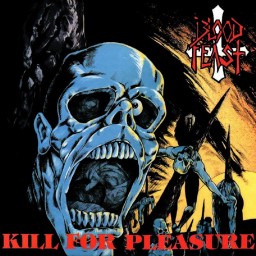
The debut studio album from New Jersey based thrashers Blood Feast is a raw & aggressive affair that sports a take-no-prisoners approach. The noisy production has the sort of authentically raw 80's underground atmosphere that old tape traders like myself would be comfortable with & it works pretty well for this material with the out-of-control guitar solos having a fair bit of Slayer's Jeff Hanneman & Kerry King about them even if they're not on par from a technical point of view. It's also worth noting that there's a fair whack of hardcore punk about Blood Feast's style which adds a little more violence & intensity to some of this material in a similar way to early Sodom. The obligatory loose execution that was so common in extreme metal at this point in time is well represented but its not anything too extreme.
Vocalist Gary Markovitch's delivery sits somewhere between the gravel-throated style of Exodus front man Steve Souza & the growly death metal grunting of Possessed's Jeff Becerra & Death's Chuck Schuldiner but there's a bit of variety in his approach between the individual tracks. Actually Blood Feast are often mentioned as a prominent influence on the young US death metal scene & are regularly referred to in the same terms as the more brutal thrash bands like Demolition Hammer, Kreator & Morbid Saint. I'd suggest that there are definitely a couple of tracks that border on death metal amongst this lot (mostly because Markovitch starts to head further in that direction) but I wouldn't say that "Kill For Pleasure" is as consistently intense or brutal as the bands I mentioned & the instrumentation doesn't veer too far off the path of aggressive US thrash metal. There are a couple of really great mosh-pit worthy numbers here though (see "Venomous Death" & "The Evil") & thankfully the highlights are strong enough to compensate for an inconsistent tracklisting sporting as many failures as there are successes.
Overall, "Kill For Pleasure" is a flawed but enthusiastic effort that has enough quality thrash metal on offer to keep me bobbing my head. I actually prefer it to Blood Feast's more highly regarded "Face Fate" E.P. from later the same year. But what's with the album title?? Surely Blood Feast had heard of Kreator's hugely influential "Pleasure To Kill" album at this point, hadn't they?
For fans of: early Exodus, "Show No Mercy"-era Slayer, Possessed.
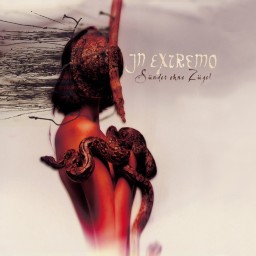
2001's "Sünder ohne Zügel" represents the fifth & most celebrated album from German folk metallers In Extremo who are supposedly one of the senior players in a subgenre known as "Medieval Folk Metal". I only recently heard about this particular subgenre & immediately found myself feeling curious to see what it sounded like. And it was this curiosity that drew me into giving "Sünder ohne Zügel" a few spins.
Surprisingly, there's very little of anything "medieval" about this record. In fact, it sounds very clean & modern compared to most folk metal I've heard which left me pondering over whether it even qualified for the genre at all. But after several listens I came to the realization that there was just enough folk instrumentation to warrant the Folk Metal tag (particularly the regular bagpipe contributions) with the rest of In Extremo's sound being comprised mainly of Nu Metal & Alternative Metal with little bits of Progressive, Industrial & Traditional Heavy Metal tossed into mix on occasion too. The vocals of front man Das letzte Einhorn are delivered in the deep, croaky, monotonous & heavily German style of Rammstein's Till Lindemann & are written in the band's native tongue as far as I can tell.
There are 4 or 5 very good songs scattered across the tracklisting & the band was obviously quite experienced in the studio because everything sounds very clear, tight & generally pretty heavy. But sadly there are too many tracks where I find myself put off by parts that sound more like Limp Bizkit or the more generic Korn efforts than they do the better works of the largely black metal driven folk metal genre. And then we get those cheesy folk melodies. Certainly not as many as you'll find in most folk metal outings but they're there nonetheless. So overall this amounts to a record that (whilst generally well composed & executed) ultimately fits comfortably within the confines of my "none of my business" file.
For fans of: Subway To Sally, Saltatio Mortis, Ignis Fatuu
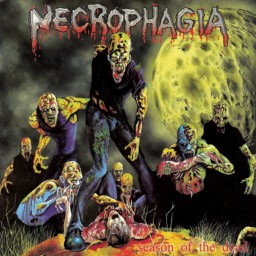
For those that think Death's "Scream Bloody Gore" album was the first true death metal album (for the record, it was Possessed's "Seven Churches" from 1985), think again because the debut full-length from Ohio's Necrophagia entitled "Season Of The Dead" beat them to the punch by a good three months & came armed with the gory horror movie themes & palm-muted tremolo-picked riffage that would go on to become a trademark of the genre.
Killjoy's vocals might not be as deep & monster-like as modern death grunters go for but they certainly sit within death metal guidelines in my opinion & are similar to those of Mike Browning (Morbid Angel/Nocturnus) & Henry Veggian (Revenant). Unfortunately they do represent the most annoying part of the album though as some of the good work that's done by the instrumentalists is undone by some unusually random phrasing that seems almost improvised at times. In fact, it often sounds like he's growling away over a completely different song but the moments when he's on the money are some of the album's highlights (see "Ancient Slumber).
As with most early death metal, we still get our fair share of thrashy Slayer worship here at times but this is generally offset by a grisly death metal atmosphere which is occasionally enhanced by the use of horror movie cinematics. It's interesting that Necrophagia aren't averse to slowing things down a bit for the odd doomy passage with the darkness turned up to ten & it's easy to see where a band like Autopsy might have picked up on that concept. I can't say that I'm a fan of the bizarre experimental sections that pop up on a couple of tracks such as the twisted circus-style parts of opening track "Forbidden Pleasure" which is presumably supposed to tie in with the zombie flick themes. It sounds particularly random to me.
The production doesn't do the album any favours & it would have been good to hear how this would have sounded with a little more emphasis being placed on the rhythm guitars. There's a lot of bass in the mix & it highlights a pretty decent performance from Bill James. Larry Madison's guitar solos have a serious similarity to the style that Morbid Angel's Trey Azagthoth was pushing at the time & it's an interesting question as to who influenced who here given that Necrophagia had been around for a good four years by this stage. I've never heard Necrophagia's demo tapes so I can't say for sure but I suspect that Trey is safe in this respect.
There are some strange cut-&-paste style drop-ins scattered across the tracklisting where it's very clear that two disparate recordings have been pasted together in a haphazard manner & it can sound a little jarring at times but overall I still find "Season Of The Dead" to be an enjoyable listen all these years later. It's an important (if inessential) part of the death metal story.
For fans of: Revenant, early Morbid Angel/Autopsy.
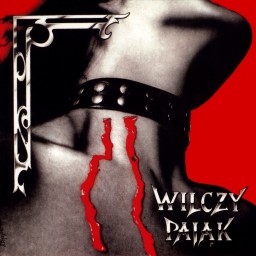
1987’s “Wilczy Pająk” album represents the self-titled debut from five-piece Polish thrash metallers Wolf Spider; a band who would wisely change their moniker to the translated English version shortly after the release of this record with all future releases utilizing English song titles & lyrics. It showcases the crude beginnings of a band that would become a lot thrashier & more technical over the next couple of records but here still seem to be in the process of defining their sound.
Despite commonly being labelled as a thrash metal release, “Wilczy Pająk” sees Wolf Spider testing the waters in a few different subgenres with speed metal being the dominant one in my opinion. Sure there are a few thrashers included here but most tracks rely on simpler yet no less rapid riffs with a few toes still hanging on to the NWOBHM for dear life. “Zemsta mściciela” is probably the only track that sees the band slowing things down enough to qualify for the traditional heavy metal camp but many of the songs include sections or riffs that sound more traditional so I feel that the speed metal label is a more accurate description of what to expect than the thrash one is.
Upon first listen I was caught a little off guard by the low quality production because “Wilczy Pająk” sounds very much like a cheap demo tape. It’s got a very noisy & tinny sound with the crashing of the cymbals dominating the mix & I can’t help but think that I might have rated the album a touch higher if it was afforded a more appropriate production job. Upon investigation I found that some online versions sounded a bit better than others so it would be worth your while to hunt around but it won’t result in a totally acceptable outcome.
The musicianship on display is actually pretty good. Particularly the shredding guitar solos which highlight some excellent chops despite receiving far too much high end in the mix. I think the solos might be the best parts of the record actually. Vocalist Leszek Szpigiel is a pretty decent front man too although he’s possibly not quite as aggressive as many European thrash fans might be used to. His delivery reminds me more of bands like Loudness, Scorpions & several mid-80’s French heavy metal acts. In fact, there are some similarities between the overall sound of the NWOBHM-influenced mid-80’s French scene & the sound that Wolf Spider are pushing here (minus the additional thrash component of course).
From a song-writing point of view, “Wilczy Pająk” starts off really strong with the first couple of tracks leaving me feeling very positive about what lay ahead; particularly the sub-two minute opener “Żądna ofiary twarz” which is the most aggressive song on the tracklisting. But sadly the quality drops off noticeably from there & only manages to recover for closing track “M.C.”. Wolf Spider’s weaker moments usually match up with the less successful attempts at vocal phrasing with several verses sounding like Leszek is trying to stuff too many words into a bar purely for the sake of lyrical continuity. It leaves me thinking that perhaps some of this material was a bit underdone & that a little more time & experience might have been required to see the songs realize their optimum level of appeal. So overall I find “Wilczy Pająk” to be a little flat. It's certainly not bad but you won’t find that hidden underground gem you’re hunting for here I’m afraid.
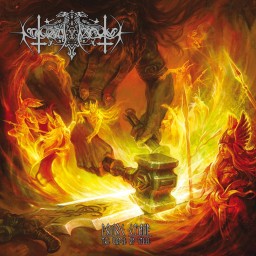
Look…. Let’s be honest here. I was never going to like this album & I never really expected to either. This was my first revisit after having given “Голос сталі” a run back at the time of release & finding it to be quite repulsive. But there’s something you need to know about me. I suffer from OCD (i.e. obsessive completism disorder) & this means that I find it very hard to accept that I don’t at least have an informed opinion on every important metal release there is. And unfortunately for me, that includes the folk metal subgenre which (with the exception of a couple of bands) I find to be directly opposed to my personal tastes most of the time. To be more specific, it’s a genre that I’ve have had a running battle with for decades now. BUT…. thankfully the metal Gods have had some sort of mercy on me because “Голос сталі” (or “The Voice Of Steel” if you prefer the translated version) isn’t half as bad as I remember (although admittedly a fair way from something that I’d legitimately enjoy).
“Голос сталі” certainly requires a fair commitment from the listener as it’s a lengthy album coming in at just under 70 minutes in duration with most of the tracks approaching or exceeding the ten minute mark. But to their credit, Nokturnal Mortum don’t every stand still for too long & I don’t think I ever become bored as such. There’s a lot in this material to be honest & the creative juices were clearly flowing at this point in time. An expansive production job certainly helps & we see a number of folk instruments employed to good effect along with the regular use of synthesizers. I think the synths work really well as (unlike many of their peers) the band don’t overdo them. They’re always noticeable but play more of a supporting role most of the time which helps to beef up Nokturnal Mortum’s sound. They also give “Голос сталі” a bit of a progressive feel & I’d guess that Pink Floyd & 70’s progressive electronic music might have been an influence on the band. In fact, there’s still a definite symphonic aspect to the Nokturnal Mortum’s sound which is not surprising as they originally started as a symphonic black metal outfit in the mid 90’s. The black metal vocals are still here in full capacity too but I have to admit that they don’t add much to the music. They’re serviceable enough but lack a bit of character. It would have added something to album if they’d varied the vocal delivery a bit more like they did on a track like “Небо сумних ночей”. Don’t get me wrong, it’s a horrible track & the low point of the album but Varggoth (if it’s him) sounds more like Johan Edlund from Tiamat & I would have liked to see other variations in vocal delivery across the album.
Although “Голос сталі” is generally regarded as a folk metal release (& I’m not denying that it is), there’s a little bit more to it than that. Predictably I find the genuine folk metal material to be a real struggle but there’s also some really interesting & ambitious ideas being explored at times too. For example, the lead guitar work more often than not sounds more like Mark Knopfler from Dire Straits than anything else & the accompanying instrumentalists have worked with that concept to create some genuinely original sections within the longer pieces. It was quite ingenious really & I find those sections to be quite intriguing. The other parts that interest me tend to be the less cheesy black metal & Viking metal parts with Emperor & “Twilight Of The Gods”-era Bathory being the main influences there. But don’t fret all of you hardcore folk metal fans out there, when Nokturnal Mortum get their gallantry on they still folk it up with the best of ‘em & it’s here that I find myself failing to withhold a cringe or ten. Interestingly I really like the intro piece “Інтро” which is pure folk music (i.e. sans metal) & it reminds me that I actually don’t mind folk music. I just really struggle with folk melodies being incorporated within a metal context as I feel that the two genres tend to fight opposing battles & a track like “Шляхом сонця” showcases that in no uncertain terms.
Overall, it was inevitable that I’d find “Голос сталі” to be hard work & fans of the folk metal subgenre should probably take my opinion with a grain of salt. But I do think that Nokturnal Mortum have managed to put together a reasonably creative piece of art here. If not one that would appeal to my personal tastes much.
For fans of: Moonsorrow, Kroda, Temnozor
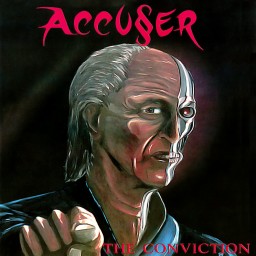
I was first introduced to German thrash metallers Accuser through the underground tape trading scene back in the early 1990’s. They weren’t terribly well known at the time however I came into contact with their first two albums through a dubbed cassette I received from a European trader. The A side included the topic of this review in 1987’s “The Conviction”; a record that included just seven tracks with a few of them being quite lengthy for a thrash metal release. I don’t recall listening to “The Conviction” more than a few times but I do remember thinking that they were more than decent so I was interested to see how they’d fair a good three decades later.
Those of you who follow my listening habits would likely be aware that I’ve been revisiting a lot of very raw Teutonic & South American thrash metal in recent times so it was a pleasant change to find that “The Conviction” actually features a pretty clear production by mid-80’s German thrash standards. The rhythm section is very clear with the bass guitar in particular receiving enough grunt to be able to drive the material through with a consistent energy level. The rhythm guitar sound does vary a little between tracks which isn’t unusual for the time but it’s not a major concern & the record sounds pretty professional overall. But the production isn’t the only area with a little more polish than you’re likely used to. The musicianship is also very good & is world’s away from the early Kreator, Sodom or Destruction releases. The riffs are very tightly performed which gives “The Conviction” more of an American edge to its sound. If I’m overly critical I’d suggest that the guitar solos aren’t all that engaging but they’re not exactly inadequate either.
I’m not entirely certain as to whether Accuser have just the one vocalist as the style of delivery changes from track to track; at some points sounding very much like Accept’s Udo Dirkschneider while at others coming closer to the trademark raspy Teutonic thrash growl. I probably prefer the Accept style to be honest as I can’t say that the other styles are terribly engaging even though they’re more than tolerable. Thankfully though, it’s the instrumentalists that carry the band.
Stylistically “The Conviction” is very much a tale of two sides. The A side sees Accuser taking a predominantly speed metal approach with the pedal planted firmly to the metal & the riffs & guitar melodies taking a more traditional direction. The signature German speed metal sound is definitely in effect with early Iron Angel, Living Death, Holy Moses & the faster Accept material being good points of reference. You’ll also find several examples of melodic guitar harmonies that you wouldn’t normally find in a genuine thrash metal environment but are much more frequently seen on speed metal records like the first couple of Helloween releases. The B side however sees Accuser launching off into a more complex, modern & particularly US sounding thrash metal sound with Exodus being the obvious influence. Both styles are pretty well done & I have to wonder whether the A side was comprised of Accuser’s older material with the B side showcasing their newer thrash metal direction. If pushed I’d suggest that I slightly prefer the thrashier material (album highlight “Sadistic Terror” in particular) but that’s hardly a surprise now given my musical pedigree.
Overall I find “The Conviction” to be a reasonably enjoyable experience. The tight execution & the urgency of the riffs are definite drawcards for the band but it’s a shame that they couldn’t nail the song-writing to an extent that saw a few more highlight tracks. There’s a level of consistency about the tracklisting though with just the one blemish in the speed metal number “Screaming For Guilt”. Despite releasing a couple of reasonably successful first up albums, Accuser apparently drifted from my memory pretty quickly back in the early 90’s as I don’t recall checking out any of their post-80’s releases but perhaps I should rectify that now as there’s some definite promise here.
For fans of: Exodus, Living Death & the more aggressive Accept material.
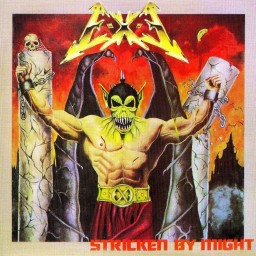
New York thrash metal outfit E-X-E first came to my attention in the early 90’s, once again though the tape trading scene that shaped such a large portion of my musical tastes & opinions for the coming decades. The band’s 1987 debut album “Stricken By Might” had appeared on one side of a badly recorded 90 minute cassette I received in my mail box from some foreign location of which I no longer remember but I do recall getting quite a bit of enjoyment out of it without it ever threatening to command regular revisits. I don’t believe I ever checked out E-X-E’s 1990 sophomore album “Sicker Than I Thought!” but from what I can tell it was somewhat of a let-down in comparison so that may not be such a bad thing.
“Stricken By Might” is a long way from a well-polished, high-budget & over-produced affair. On the contrary, it’s fuelled purely on metal-as-fuck attitude & the sort of old-school mentality that made the mid-to-late 80’s such a special time to be discovering extreme metal. This is real music made by real people & in many ways it epitomizes what metal initially aspired to be. E-X-E sadly weren’t quite skilled enough to pull off the full package as yet but even if they had been they may not have wanted to anyway as the raw & dirty production & naïve yet energetic performances really help to create an attractive old-school atmosphere of the type that many bands are still trying to replicate today. Stylistically, E-X-E have most of the 80’s covered too by delivering an each way bet into everything that was great about the decade in metal. Thrash metal , speed metal & heavy metal all receive the treatment & there’s even a bit of crossover thrash on opening number “Slaughter Disorder”. In fact, some of the tracks see the band switching genres regularly between the various parts of the song & it wasn’t all that easy to whack a genre tag on the band.
Front man Joseph Palma isn’t the most talented vocalist you’ll ever encounter. He can actually be quite pitchy at times but there’s an attractive authenticity in his mid & higher register delivery that makes details like that seem fairly inconsequential. Drummer Charles Lopez opts for a very simple approach that at times sees him sounding a bit repetitive. There’s definitely a Teutonic edge to his style but unfortunately his kit isn’t terribly well balanced in the mix with his snare drum being noticeably louder than the rest of his kit. It’s interesting that many of E-X-E’s riffs don’t employ the trademark thrash metal palm-muting whilst still being thrashy in nature & this characteristic very much brings to mind Canadian speed metal originators Exciter who are actually a pretty good reference point for E-X-E’s dirty & energetic sound. But it’s the hyperactive guitar solos of Adam “Muammar” Marigliano & Rui “Evil” Tavora that highlight the savage electricity of E-X-E best with Slayer’s Jeff Hanneman & Kerry King being obvious influences. These two may not be half as talented from a technical point of view but they certainly know how to thrash out & their performances are one of the highlights of the album in my opinion.
Overall, “Stricken By Might” is a very consistent record with just the one failure in the uneventful “Warchild”. In saying that though, it’s a little unusual that the two clear highlight tracks are left so late in the game. Anthrax-influenced thrasher “Fatally Wounded” is my pick of the bunch & you’ll rarely find a better example of raw 80’s thrash than that. Closing number “Crib Death” is also outstanding & sees E-X-E muscling up substantially with a sound that verges pretty closely to death metal & sees the band finishing on a real high. “Stricken By Might” would have been a truly mind-blowing album if it had of contained a full tracklisting at the quality of those two tracks. As it is though there’s still a fair bit to keep me entertained & I’d suggest that “Stricken By might” is yet another example of how the underground thrash scene was coming of age in the wake of 1986’s string of career highlights from the bigger name acts. It’s definitely worth a few spins.
For fans of: Exciter, Hallows Eve, early Slayer.
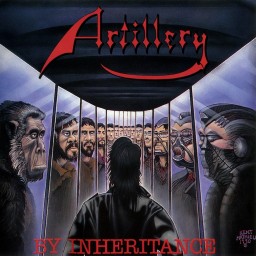
1990’s “By Inheritance” album was my entry point with Artillery which isn't a bad place to start as its gone on to become the Danish thrash institution's most celebrated release. I picked it up through the tape trading scene shortly after release but if I’m honest I probably didn’t give it as big a thrashing as most of my peers did as I struggled to see what all the fuss was about at the time. It wasn’t really until I did some research into the band’s earlier releases that I saw what an musical departure it was for Artillery in a number of areas but that still didn’t lead to me holding “By Inheritance” up on any sort of pedestal.
Artillery’s first two albums (1985’s “Fear Of Tomorrow” & 1987’s “Terror Squad”) were both solid releases in their own right & I enjoy both of them to varying degrees, particularly "Terror Squad" which is still my Artillery record of choice to this day. Comparatively, “By Inheritance” almost sounds like it comes from an entirely different band. The professionalism of the production & performances are exceptional with the instrumentalists taking a lot more risks & showing off a whole new level of ambition that would see the album succeed in a time when the popularity of thrash metal was definitely on the decline in the wake of the death metal onslaught. The Metallica worship of Artillery’s formative years was now long gone although they’d definitely learnt some invaluable lessons from their idols regarding song structure & the incorporation of outside influences.
What we have here is a highly melodic & noticeably technical release that still resides comfortably within the confines of the thrash metal genre. The song structures are often quite progressive with plenty of changes & you can easily pick up on the influence of mid-to-late 80’s progressive metal here. The riffs themselves contain impressive complexity as well as immaculate execution & the regular incorporation of exotic Middle Eastern melodies into the framework of a thrash record was very ambitious if not always totally successful. These additions all make for an interesting & challenging result & I can’t help but feel that Artillery have pulled a lot of influence from classic Iron Maiden in relation to their melodic & thematic experimentation. That’s almost certainly the case with the huge increase in melodic & harmonic content at the very least. In fact, “By Inheritance” often strikes me as thrash metal’s answer to melodic death metal in this regard. There’s always some sort of melodic idea being expressed & you could very easily label this as melodic thrash metal.
“By Inheritance” showcases a band that was well on top of their game. And why shouldn’t they be when they’ve had a good three years to improve since their last album. The rhythm guitar performances in particular are quite outstanding & I’m often left drawing comparisons with the likes of Coroner which should give you a hint at the level of proficiency on display. The vocals of Flemming Rønsdorf certainly fit into the higher register of thrash front men but they have genuine character & suit the music very well despite giving me the distinct impression that they would have fit even more comfortably over a US power metal band like Savatage. Flemming often sounds a little bit like Overkill’s Bobby Blitz at times too & I’ve always enjoyed Blitz.
The thing that turns off most detractors of this record however is the fact that it’s a little less intense than Artillery’s previous work & I’d be lying if I didn’t admit that this prevents me from reaching for the higher scores. The drumming in particular sounds pretty light-weight & bouncy at times & leaves me craving a bit more Dave Lombardo in the approach. It certainly gives the complex riffs plenty of room to breath but it’s unlikely to get my head banging or my body thrashing. Another issue for me is the quality hole that resides right in the middle of the tracklisting. I’ve never found “Bombfood”, “Don’t Believe” or “Life In Bondage” to be terribly appealing songs & they do take the tarnish off what was a relatively strong start (with the exception of the God-awful Middle Eastern intro track “7:00 From Tashkent”). The Nazareth cover version “Razamanaz” has been a big topic for discussion over the years but I have to admit that it’s grown on me. It certainly stands out like a sore thumb in the tracklisting & there’s very little doubt that the record would have flowed better without it but it definitely has its charm despite being a simpler & more traditional heavy metal number.
Overall, I find “By Inheritance” to be an interesting & enjoyable listen, if not one that I feel like returning to all that regularly. I think it serves as somewhat of a gateway into the thrash scene for fans of genres like progressive metal & melodic death metal as it possesses many of the attributes that fans of those subgenres look for in their metal. Unfortunately it’s unlikely that I’ll ever get to the point of holding the album up as a beacon for European thrash but I prefer it over an album like “Fear of Tomorrow” these days.
For fans of: Overkill, Megadeth, Heathen
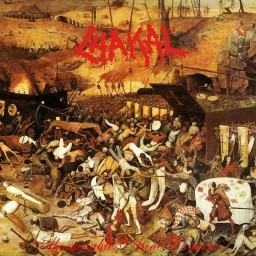
Brazilian thrashers Chakal hail from a region with a reasonably strong pedigree in raw, underground thrash metal with Belo Horizonte being the home of bands like Sepultura, Overdose, Sarcofago, Mutilator, Holocausto & Exterminator in the mid 80's. The band first formed in 1985 with their earliest recordings of any note appearing on the "Warfare Noise" compilation in 1986 alongside Mutilator, Holocausto & Sarcofago. Another year would pass before Chakal's debut album "Abominable anno domini" would be recorded & released; a record that I picked up on through one of my two South American tape trading colleagues based in Chile & Peru in the early 90's. The album didn't do a lot for me at the time from memory & I had very little recollection of what to expect when going into my first revisit in close to thirty years.
The formula that Chakal are pushing here will be a familiar one if you have any sort of experience with some of the other Brazilian bands I've mentioned above. The production is suitably raw with the mix changing noticeably between tracks. In fact, i found myself adjusting the volume knob a bit between tracks too which indicates that the album wasn't well mastered (if it was mastered at all). Unfortunately the rhythm guitars are situated a long way back in the mix which seems to be a very common thing with low budget mid-80's metal releases for some reason but the vocals & solos compensate by being much too loud & subsequently not really allowing the overall sound to gel all that well. The bass guitar is also much louder than the guitars on some tracks which isn't ideal.
The musicianship on display here is sub-standard at best with the drummer Wiz often struggling to stay in time. He's clearly been influenced by Kreator's Ventor on the evidence here as he goes for some very similar beats. There are times when the riffs the rhythm guitarists are playing don't really seem to fit with the beats either & they seem to be trying very hard to make something to work that's just never going to. There's a good amount of intensity & aggression about this riffage though without ever challenging the likes of Sarcofago in the extremity stakes & it goes at least part of the way to overcoming some fairly generic thrash riffs at times with Possessed, early Sepultura & particularly early Kreator being the most obvious points of reference. The best parts of "Abominable anno domini" though are when Chakal push out further into legitimate death metal territory with "Warriors Of Disgrace" & "The Dead Walk" being not only the clear highlights of the album but also some of the best extreme metal to come out of South America to the time. I absolutely love the way that the vocals are used to accentuate the changes in riff & rhythm. Unfortunately the guitar solos are absolutely appalling with Mark & Pepeu having no understanding of keys or any other sort of musical theory for that matter. It's a real shame when some of the better material here is tainted by such inept attempts at leadwork & Chakal would have been better off leaving the solos to better qualified bands.
But the real talking point here is front man Vladimir Korg whose vocals are particularly aggressive for a mainly thrash focused band. In fact I'd suggest that his delivery has a lot more in common with genuine death metal than it does with thrash. He kinda combines a raspy Coroner/Sadus approach with a more evil one that's very much in line with the material that Possessed & Death were putting out at the time. I actually really enjoy Vladimir's delivery & I think he's clearly the best thing about the album. He sounds even more effective on those death metal-driven highlight tracks too.
Unfortunately though, it's the inconsistent song-writing & inept instrumental performances that let Chakal down here despite a lot of enthusiasm. The highlight tracks may well be right up my alley but they're still marginally tainted by some horrible attempts at guitar solos in the middle of each song & the weaker tracks (see "Children Sacrifice") are really pretty terrible. There's simply not enough quality tracks to balance out the rubbish so despite Chakal not being the worst South American thrash band going round they don't manage to achieve an album that commands long-term appeal.
For fans of: Possessed & early Kreator/Sepultura.
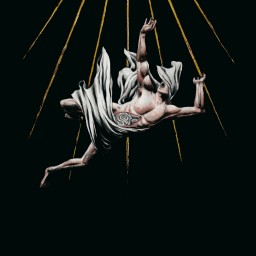
The French black metal masters return after 2005's monumental "Kenose" E.P. (one of my top three metal records ever) with another high quality release & the sheer scope of this album is pretty mind-blowing to be honest. In fact, it's this sort of record that makes Deathspell Omega the most intriguing band on the planet in my opinion. The intensity of the blasting drums is a real drawcard for me but this time I do find that the production job sees them sounding a little less precise & the dissonant riffs at times find it a struggle to overcome the sheer chaos going on around them. I absolutely love the growly vocals of Mikko Aspa though. They sit amongst the most grim & evil in the entire black metal game & are perfectly suited to the instrumentation around them.
This is definitely a more avant-garde release than "Kenose" was & Deathspell Omega would take that style to additional levels in the future. Here I think it works well but in hindsight I don't think it was as fully realized as we'd see on a record like 2010's "Paracletus". There are a few sections that descend into complete chaos where I struggle to make sense of it all whilst some of the tempo changes can be quite sudden & jarring. I think these elements were intentional though & feel they're intended to frighten the listener out of any sort of comfort zone they may have found for themselves amidst the impenetrable darkness of Deathspell Omega's musical onslaught. I can't think of a band that compares on a number of levels & I'm particularly attracted to the intellectual aspect to their lyrics & image. I also love that they take some serious technical chops & use them in the most bizarre, unusual & frightening way rather than simply trying to show off.
Deathspell Omega possess the mind-bending dissonance of Gorguts, the dark menace of Mayhem & the avant-garde experimentation of Ved Buens Ende. It's really great that there are bands like this out there to keep me exploring modern underground metal. Particularly one that traverses the darkness so comprehensively when a lot of modern black metal is noticeably less intimidating than the classics of the 80's & 90's. Whilst the undeniable class of Deathspell Omega is beyond question, unfortunately I don't find myself placing "Fas – Ite, maledicti, in ignem aeternum" on the same sort of pedestal as its predecessor. There's little doubt that it's a consistently entertaining listen that keeps me on the edge of my seat for the entire runtime though & it won't disappoint fans of serious extreme metal.
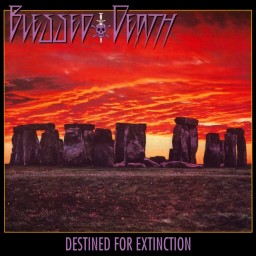
I didn't have much time for 1985's "Kill Or Be Killed" debut from New Jersey outfit Blessed Death which is often linked to thrash but was actually more of a speed metal record. However their 1987 follow-up record "Destined For Extinction" is another kettle of fish altogether with the band having fully transitioned into an aggressive thrash outfit in line with the model that some of America's more brutal thrash exponents were pushing at the time. The production isn't wonderful but the dirty sound seems to suit the band's nastier approach & you can always make out what's going on so it's not an issue at all. Vocalist Larry Portelli may be a sticking point for some with his seemingly random use of high-pitched screams but (with the exception of the very ordinary "Pray For Death") I can comfortably deal with him most of the time.
At the end of the day this album takes me back to my roots. It's nothing you haven't heard before & I don't think they ever quite nail the song-writing quality to compete with the top tier bands but all fans of 83-86 period Slayer & "Darkness Descends"-era Dark Angel should find a lot to enjoy here. Blessed Death tip toe around the Slayer plagiarism line pretty closely at times with the solo sections in particular being a carbon copy of Slayer's most frantic & extreme works but (as I said with my recent Exumer review) that can't be a bad thing as classic Slayer is simply the best music ever recorded in my opinion.
It was hard to know what to expect when I revisited 1999’s third studio album from Birmingham funeral doom metal stalwarts Esoteric recently. I’ve had a wide array of experiences with this album in the past with my enjoyment levels varying greatly depending on my mood, my fatigue levels & the strengths & weaknesses of my listening device of choice. In fact, it’s not uncommon for me to find my first listen to be a hard slog as “Metamorphogenesis” can be particularly inaccessible at times & I usually find that it doesn’t open up until the second listen. It’s therefore very important to give it a few spins before making any sort of judgement & (despite my having checked the album out a few times before) my first run though on this particular revisit was still pretty tough going. This is largely contributed to by the incredibly dense production with the extensive layering of different elements seemingly melding into an impenetrable & relentless wall of nonsensical noise that requires you to have all of your faculties available to you in order to make sense of what’s going on. It certainly didn’t help that I was quite fatigued after work either as my brain simply wasn’t up to it but everything made a lot more sense on repeat listens. The use of headphones is also highly recommended as it seems to draw all of the disparate elements & layers closer together from my experience & once everything clicks you’ll see the record in a completely different light moving forwards.
“Metamorphogenesis” takes the form of three lengthy pieces ranging from 11 to 17 minutes in duration & adding up to a total of 44 minutes. This makes it a relatively short release for Esoteric when compared with their previous two records which were both double albums. But never fear! You won’t find any 3 minute pop songs amongst this lot with the tracks ranging from twelve to seventeen minutes in length & you shouldn’t expect to be humming along to many melodic hooks afterwards either. Interestingly, two of the three tracks begin with all guns blazing instead of employing the gradual slow build-up model that seems to be a standard with this sort of music. It can actually be pretty jarring if you’re not ready for it. Particularly with the first track as I always forget to prepare myself to experience a sudden barrage that includes multiple vocal & lead guitar tracks going right from the word go. But I guess you could say that Esoteric’s whole approach to music is confronting. Their unique style of funeral doom metal can be overwhelming & suffocating in its density with separation between the instruments having been sacrificed in favour of sheer weight & volume. The bass that forces its way out of your speakers is somewhat akin to that of drone metal in a way as Esoteric seem to employ the use of noise & speaker reverberation in a similar (but less obvious) fashion & the use of repetition is also used for a similar purpose. Despite the huge amount of different parts that are layered into each piece, these tracks are drawn out for days & I wonder about the influence of post rock on the band as there’s a definite similarity to the way they build towards a crescendo over a long period & with the listener not really noticing.
Unlike most purveyors of funeral doom, each of the three tracks included has its own unique personality but shares similar characteristics. The space & cosmic themes the band employs suit the instrumentation to a tee with loads of effects being utilized to take the listener out of their comfort zone. In fact, some sections seem to have been intentionally composed of completely disparate parts that make no real sense but ultimately contribute by putting you into a defined head space before the next section comes in to crush you with ridiculously heavy but equally beautiful instrumentation. The experience is noticeably psychedelic & the idea of a bad acid trip comes to mind on more than the odd occasion. But I don’t say that in a negative fashion. It’s simply that Esoteric sound like no one else on Earth on this album. Their use of dual vocals is both relentless & unintelligible but it’s used as more of an accompaniment to the overall soundscape than as a musical protagonist. The lead guitar work is also a constant with the melodies of bands like Katatonia & Anathema being the obvious reference only never in as twisted a fashion as you’ll be submitted to here with the various licks being drawn back into the wall of noise rather than sitting out front on their own.
Once it clicked with me, I found “Metamorphosis” to be an astounding album. It took me to realise that some of the things that initially caught me off guard were intentionally employed & that Esoteric wouldn’t have achieved such an otherworldly result without them for me to see the true genius in this music. It shares a lot in common with Australian doom/death legends diSEMBOWELMENT in its psychedelic qualities & thick & unique atmosphere &, while we’re on the topic of Aussie music, I also hear a lot of “Paradox”-era Cruciform in the riffs & structures with the band not being afraid of lifting the tempo on occasion too. Most doom metal is all about those riffs & Esoteric possess those in spades but they don’t feel the need to thrust them down your throat when there’s so much more to be said. Funeral doom metal can often be one-dimensional but “Metamorphogenesis” almost has too many dimensions for its own good at times. Esoteric can take you to uncharted parts of the universe with this music & I can’t recommend “Metamorphogenesis” enough.
For fans of: diSEMBOWELMENT, Mournful Congregation, Ahab